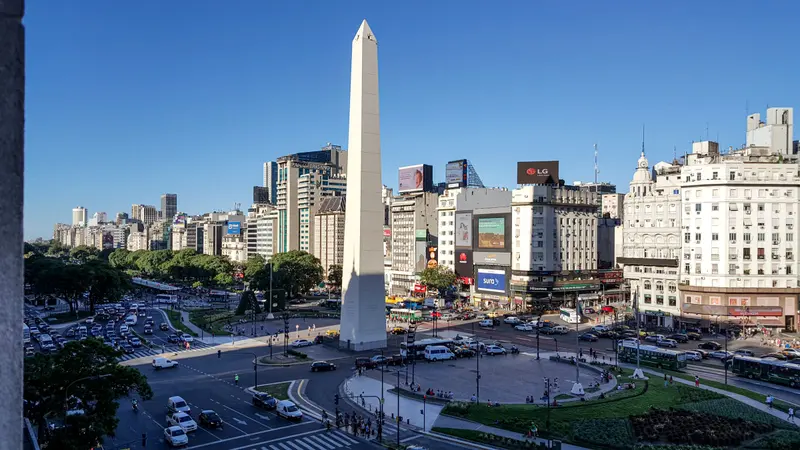
Cafés in Argentina Buenos Aires
Buenos Aires bares notables and Palermo roasters, El Cairo in Rosario, Córdoba's old cafés, plus torrado, mate and café con leche.
Photo: Jose Luis Vanasco, Pexels License
Argentina grows no coffee and buys all of it abroad, about US$200 million worth a year by a 2024 estimate.2 Brazil is the main supplier. Argentina took more than 370,000 60-kg bags of Brazilian coffee in 2024, enough to rank among the 20 largest buyers of Brazilian beans, and in the first half of 2025 it was the second-largest buyer of Brazilian soluble coffee, with 193,000 bags.21
The national drink is mate, an infusion of yerba mate leaves. Yerba is in more than 90% of Argentine homes, mate was declared the infusión nacional (national infusion) in 2013, and 30 November is the Día Nacional del Mate.4 Argentines got through 258,814 t of yerba in 2024, 9.3% less than in 2023.4 Coffee is the smaller habit: Nestlé puts it at about 1 kg per person a year, or roughly 208 cups.3
Argentina's café cities
What Argentines brew at home
Coffee is part of the routine in 86.5% of Argentine households, by Nestlé's count, and breakfast accounts for 42% of the cups, against 12% after dinner.3 Roasted and ground coffee leads the market with 39%, just ahead of instant at 37%; capsules and whole beans have 8% each.3 The home cup is usually milky. In a study by the chain Café Martínez, more than 70% of drinkers chose café con leche at home.3
Delivery has become another way in. The app PedidosYa said in October 2025 that coffee orders had grown 42% in a year, with latte, black coffee, café con leche and cappuccino the favorites and 09:00 on Fridays the busiest hour.3
Tostado and torrado: two legal kinds of coffee
Argentine food law separates two products. Tostado is coffee roasted plain; torrado is roasted in the presence of sugars that caramelize onto the beans, a product the legal site Derecho en Zapatillas calls typical of markets such as Argentina's.5 Article 1166 of the Código Alimentario Argentino, the national food code, caps those added sugars at 10.0% and allows 8.0% moisture, against 5.0% for plain roasted coffee.5
Spain sells a similar product as café torrefacto, and Germany and Austria as glazed coffee.6 Little sweetness survives the roaster: a brewed cup of torrado holds less than 0.1 g of sugar, against 6.25 g in a standard sachet.6
Bares notables beyond Buenos Aires
Other cities now catalog their old cafés too. Córdoba held its first Semana de los Bares y Cafés Notables in June 2022 and recognized 13 places, among them Sorocabana, El Quijote and La Tasca del Paseo; the oldest, Café de la Plaza in Barrio Alta Córdoba, received the first plaque.8
In April 2024 Rosario's city council created a Catálogo de Bares y Bodegones Notables. A place qualifies after at least 30 years in business, as a neighborhood landmark, or through ties to the city's history and culture.7 The first list of 28 runs from Wembley, on Avenida Belgrano since 1903, to El Cairo, opened in 1943 at Santa Fe and Sarmiento, and includes Confitería Augustus, on Corrientes at the pedestrian Córdoba street, from 1964.7
Roasters, chains and the specialty wave
Café Martínez grew out of a roastery. The chain traces back to Atiliano Martínez, a Spanish immigrant who imported and roasted coffee; its flagship on Calle Talcahuano began selling coffee by the cup only in 1994. By 2023 it had more than 200 branches in Argentina, Uruguay, Paraguay and Bolivia, 14 of them company-owned.9
Specialty roasters in Argentina, Chile and Uruguay buy mostly from Colombia, Peru, Guatemala and Brazil, and about 80% of their customers order milk drinks such as cappuccinos, lattes and flat whites.10 Training has spread with them: one barista school, the Academia MUMAC, had taught more than 2,000 baristas by October 2025.3
Buenos Aires
The capital's own catalog is the longest of the three, with 90 bares notables on the list the city validated in March 2026.11 For specialty coffee, Sprudge's 2025 guide names Cuervo, founded by the musicians Pablo Tokatlian and Agustín Caro, among the pioneers, and credits The Shelter Coffee, opened in 2015, with raising standards; its best-known bar is on Uriburu, in Balvanera.12 Prices run high here: a coffee averaged AR$3,800 in the city in July 2026, against AR$3,200 nationally and AR$2,500 in Santiago del Estero.13
Sources
- Café brasileiro: sensorial além fronteiras, Diário do Comércio, Café sem Filtro column (September 13, 2025, citing Cecafé), accessed October 2026
- Se encarece uno de los grandes placeres de los argentinos: el precio mundial del café alcanzó su valor más alto en 30 años, Bichos de Campo (April 12, 2024), accessed October 2026
- Día del café: cuánto se consume en Argentina y qué variedades conquistan al mercado, Forbes Argentina (October 1, 2025), accessed October 2026
- La yerba mate en cifras: consumo, producción y comercio exterior en 2024-2025, Bolsa de Comercio de Rosario (March 28, 2025), accessed October 2026
- El café a través de la ley y la historia, Derecho en Zapatillas (October 1, 2025), accessed October 2026
- Cuál es la verdad científica detrás del café torrado y sus mitos, Revista Noticias, Perfil (September 27, 2024), accessed October 2026
- Cuáles son los bares y bodegones notables de Rosario: un nuevo circuito que no te lo podés perder, InfoGastronómica (April 21, 2024), accessed October 2026
- La ciudad tendrá una semana para disfrutar de sus bares y cafés notables, InfoNegocios Córdoba (June 9, 2022), accessed October 2026
- De importar, tostar y vender café a tener más de 200 sucursales en la Argentina y la región: Café Martínez, Forbes Argentina (March 12, 2023), accessed October 2026
- El rol de los microtostadores en los países no productores de América latina, Perfect Daily Grind Español (August 31, 2022), accessed October 2026
- Bares Notables de la Ciudad de Buenos Aires, consolidado 2025 (annex to Resolución 1225/MCGC/26, validated March 2026), Ministerio de Cultura, Ciudad de Buenos Aires / Boletín Oficial, accessed October 2026
- The Sprudge Guide To Coffee In Buenos Aires, Sprudge (November 17, 2025), accessed October 2026
- El café más barato del país está en el norte argentino: cuesta menos de 2.600 pesos en estas tres provincias, Canal 26 (July 24, 2026, citing Fudo), accessed October 2026
Cafés in Argentina: questions
Is coffee grown in Argentina?
No. Argentina imports all its coffee, worth about US$200 million a year by a 2024 estimate. Brazil is the main supplier: Argentina bought more than 370,000 60-kg bags of Brazilian coffee in 2024. Specialty roasters in Argentina buy mostly from Colombia, Peru, Guatemala and Brazil.
What is café torrado in Argentina?
Torrado is coffee roasted together with sugar that caramelizes onto the beans. Argentina's food code treats it separately from tostado, plain roasted coffee: article 1166 caps the added sugars at 10.0%. Spain sells a similar product as torrefacto. A brewed cup of torrado holds less than 0.1 g of sugar.
Which is more popular in Argentina, mate or coffee?
Mate. Yerba mate is in more than 90% of Argentine homes, mate was declared the national infusion in 2013, and Argentines consumed 258,814 t of yerba in 2024. Coffee consumption is about 1 kg per person a year by Nestlé's estimate, around 208 cups, and it is part of the routine in 86.5% of households.
Your café deserves better than a pin someone else dropped
Free listings are free for good. A featured page gives you photos, a menu and your own URL, in your café's own design, for less than a coffee a day.