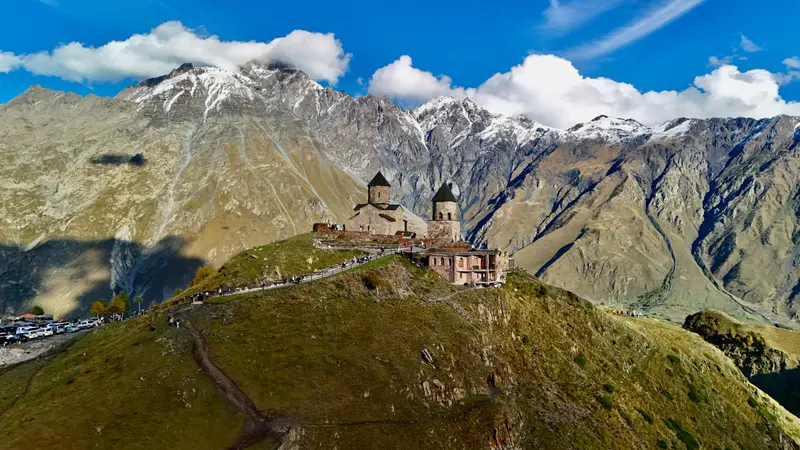
Cafés in Georgia Tbilisi
In the Caucasus: turkuli brewed at home, a tea country turned to coffee, and Tbilisi's roasters in Vera, Saburtalo and the old town.
Photo: Lekko Ponad, Pexels License
Georgia was long a nation of tea drinkers, with black tea from Guria and Samegrelo, and coffee has gained the upper hand since the 1990s.3 The coffee is imported. By Geostat's figures, Georgia brought in 7,050 tonnes worth $51.1 million between January and November 2025, against $39.3 million for a similar volume a year earlier, and against $14.4 million a decade before.1
Much of it arrives cheap or instant. In January to July 2021, Indonesia supplied about 1,700 of the 3,400 tonnes of green and roasted coffee Georgia imported, and the country bought another 1,400 tonnes of instant coffee, about 1,100 tonnes of it from Russia.2 For drinking at home, instant still led the market in 2021.7
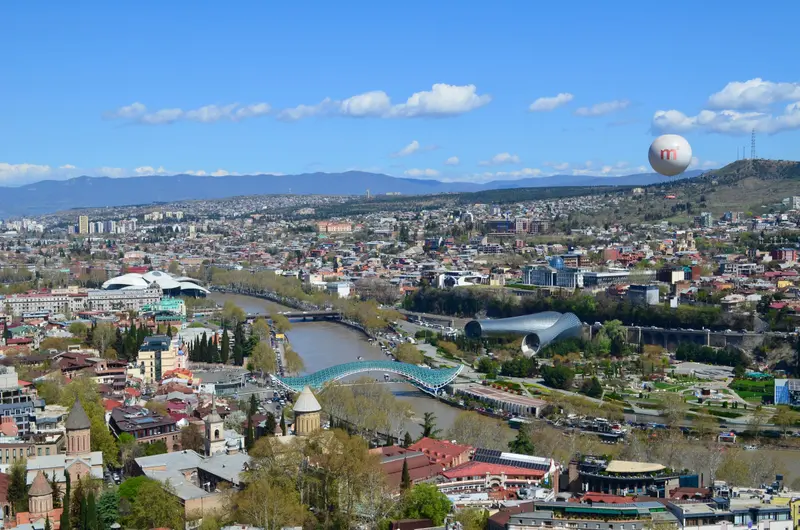
Georgia's café cities
Turkuli: coffee in Georgian homes
Before espresso machines spread, coffee in Georgia meant turkuli, Turkish coffee (თურქული ყავა, turkuli qava), served in a small porcelain cup.45 A heaped spoon of ground coffee, often with several spoons of sugar, goes into cold water and is heated in a small copper pot or an electric kettle. In Georgian homes this is still the usual way to make coffee.4
Beans came from market dealers, who sold them by the scoop from plastic buckets. At the main bazaar next to Tbilisi's central railway station, one dealer mixed house blends from more than a dozen kinds of beans.4 Instant was the other everyday choice: in 2001, the best a neighborhood market might offer was a can of Pele instant powder.6
Espresso and the first roasters
In 2001, espresso was hard to find in Tbilisi; one writer could name only the Marriott and Prospero's, an English-language bookshop.6 Café Gabriadze, in the old town, is older: it opened in 1996 beside the Gabriadze Theater at 13 Ioane Shavteli Street, with an interior by the artist and director Rezo Gabriadze, and its terrace faces his clock tower.9
Roasting came next. In October 2010 Ruben Avetisian, from Yerevan, put a roaster into a storefront on Perovskaya (Akhvlediani) Street for Le Café du Monde, since closed, and named his blends after the painter Pirosmani and the director Parajanov. In 2015, most local restaurants and cafés still bought mass-produced Lavazza.4 Coffee Lab opened on Alexander Kazbegi Avenue in Saburtalo in 2016, roasts on a Giesen and represents more than twenty equipment brands.8 By 2021 its wholesale arm supplied more than 150 hotels, restaurants, cafés and offices.7
Meama and the industrial roasters
Meama, a Georgian coffee company, imported beans from 18 countries by 2021 and roasted them in Tbilisi.7 Its owners have invested more than ₾100 million in it. A July 2025 FinSpot analysis found Meama and the roaster Cherie running at a loss, while Mondo, which also sells imported coffee and equipment, was consistently profitable.1
Tbilisi neighborhoods and prices
Vera has two of the city's best-known roasters. Café Stamba, in the Stamba Hotel at 14 Merab Kostava Street, roasts on a Probat, and Shavi Coffee Roasters, founded in late 2021 on Mikheil Zandukeli Street, roasts light and medium.8 In Marjanishvili, Satatsuri sits just outside Fabrika and has become a landmark café.10 Minimalist, on Zakaria Paliashvili Street, serves only manual brews.6
Near Rustaveli Avenue, Yuri Kasradze opened Santino at 15 Atoneli Street in 2021, with a Modbar system and a long international drinks menu. Puri Guliani, a bakery-café near Saarbrücken Square, has an express branch in Vake.8
Chains grew alongside. Erti Kava, founded in Mestia in 2017, opened branches in Mestia, Tbilisi and Batumi.11 Costa Coffee had three Tbilisi cafés by early 2026, and Starbucks planned its first, in Vake, for March 2026. The Tbilisi Coffee Festival began in 2023, and its 2025 edition drew about 50 companies and 5,000 visitors.1
Prices have climbed with the beans. A coffee cost ₾5–8 on average in 2021.7 By 2025, a cappuccino in Tbilisi cost around ₾10.3
Sources
- Brewing beyond the cup: how Georgia's coffee market is evolving (Lana Kokaia, 1 March 2026), Investor.ge, AmCham Georgia, accessed October 2026
- Georgia buys coffee worth $16 million in January–July (2021), Caucasus Business Week, accessed October 2026
- The Price of a Cup: Why Georgia Spent $40 Million on Coffee in 2024 (Ivan Nechaev, 11 March 2025), Georgia Today, accessed October 2026
- Le Café du Monde (Paul Rimple, 12 June 2015), Culinary Backstreets, accessed October 2026
- ყავა, Wikipedia (Georgian), accessed October 2026
- Minimalist (Paul Rimple, 21 June 2018), Culinary Backstreets, accessed October 2026
- Georgia's coffee market: small beans, big innovations (Mackenzie Baldinger, 12 December 2021), Investor.ge, AmCham Georgia, accessed October 2026
- The Sprudge Guide To Coffee In Tbilisi, Georgia (Nikita Solberg, 16 August 2022), Sprudge, accessed October 2026
- Café Gabriadze, Gault&Millau Georgia, accessed October 2026
- Satatsuri: Café Culture, Georgian Style (Pearly Jacob, 24 November 2022), Culinary Backstreets, accessed October 2026
- Georgian coffee house brand Erti Kava plans $1m coffee factory and training center in Tbilisi, Caucasus Business Week, accessed October 2026
Cafés in Georgia: questions
What is turkuli coffee in Georgia?
Turkuli is Georgian for Turkish coffee, the usual way coffee is made in Georgian homes. A heaped spoon of ground coffee, often with several spoons of sugar, is added to cold water and heated in a small copper pot or electric kettle, then served in a small porcelain cup. Before espresso machines spread, it was what coffee meant in Georgia.
Where did specialty coffee start in Tbilisi, Georgia?
In Tbilisi, Ruben Avetisian roasted beans at Le Café du Monde on Perovskaya Street from October 2010, and Coffee Lab opened in Saburtalo in 2016, roasting on a Giesen and supplying more than 150 businesses by 2021. Shavi Coffee Roasters and Café Stamba, both in Vera, followed, Shavi in late 2021.
How much does a cappuccino cost in Tbilisi, Georgia?
As of 2025, a cappuccino in Tbilisi cost around ₾10, up from an average of ₾5–8 for a coffee in 2021. The rise followed record bean prices: Georgia paid $51.1 million for 7,050 tonnes of coffee imports between January and November 2025, against $39.3 million for a similar volume a year earlier.
Your café deserves better than a pin someone else dropped
Free listings are free for good. A featured page gives you photos, a menu and your own URL, in your café's own design, for less than a coffee a day.