Cafés in Türkiye Istanbul
Turkish coffee from the cezve, Rize tea in tulip glasses, mırra in the southeast, Ottoman coffeehouses and the roasters of Istanbul.
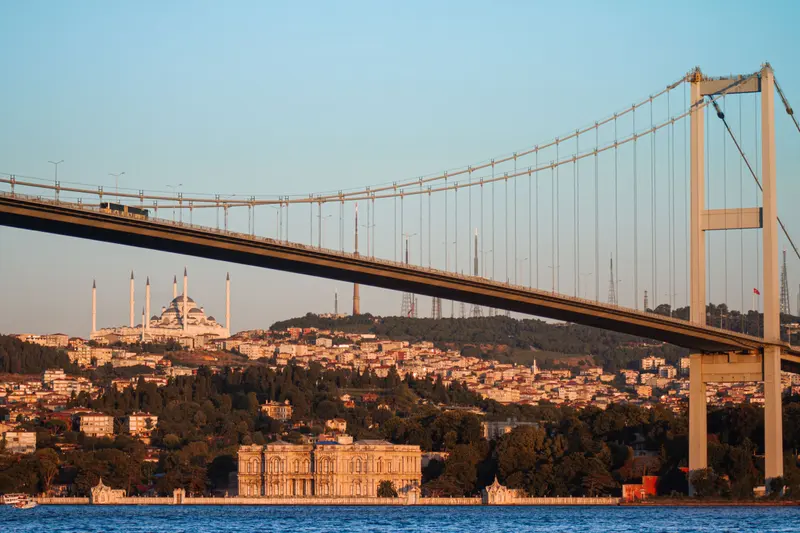
Photo: Fatih Ekmen, Pexels License
UNESCO put Turkish coffee culture and tradition on its Representative List of the Intangible Cultural Heritage of Humanity in 2013.1 Its description starts with freshly roasted beans ground fine and brewed slowly on a stove, and calls the drink a symbol of hospitality, friendship, refinement and entertainment, with a place at engagement ceremonies and holidays.1
Türkiye grows none of it. Imports under customs heading 0901 rose 83% in value in 2025, from $497 million to $909.2 million, and Brazil supplied $568.5 million of that, far ahead of the Netherlands, Colombia, Germany and Ethiopia.2 Industry figures reported by Cumhuriyet in July 2025 put consumption at 1.5 kg per person a year, three times the 450 g of eleven years earlier; a medium americano at the big chains then cost ₺130 and a latte ₺165.3
Tea is still what people drink all day. An International Tea Committee report cited in December 2021 put consumption at 4 kg per person a year, up from 3.5 kg, and the head of Rize's commodity exchange reckoned on three to five glasses a day.4 In 2022 UNESCO inscribed the culture of çay, shared with Azerbaijan, on the same list: mostly black tea, served hot in pear-shaped cups with sugar, lemon slices or sweets.5
Türkiye's café cities
How coffee reached the Ottoman capital
Turkish sources tell two arrival stories. In one, Özdemir Paşa, the Ottoman governor of Yemen, took a liking to coffee there and brought it to Istanbul.6 In the other, the chronicler Peçevi dates its arrival to the Hijri year 962, or 1554–55, and writes that until then there was neither coffee nor a coffeehouse in Istanbul or anywhere in the realm.7 Then Hakem of Aleppo and Şems of Damascus opened large shops in Tahtakale and started selling it.7
The palace took to it early. Suleiman the Magnificent kept a kahvecibaşı, a chief coffee-maker, and later sultans kept the post.8 Others tried to stamp it out. Murad IV abolished coffeehouses in 1633 and had keepers cudgelled for a first offence, but the bans came and went, were often ignored and left no lasting mark on how much coffee people drank.89
The kahvehane: news, spies and a salted cup
The kahvehane (coffeehouse) was where news traveled, which made rulers nervous. Muslims owned 95% of the coffeehouses and Janissaries 42% of those, and between 1840 and 1845 spies filed weekly reports to the police on the opinions they overheard.9 Ottoman miniatures show a meddah, a storyteller, performing to the room.9
UNESCO still names the coffeehouse as the main place Turkish coffee is drunk, for conversation, news and reading, while the know-how of making it passes informally within families.1 One family custom belongs to engagements: the bride-to-be sometimes puts salt instead of sugar in the groom's coffee, to gauge his character.8
Dibek, mırra and menengiç
The cezve (coffee pot) is only one way to make it. Dibek coffee is named after the stone mortar in which roasted beans are crushed to a coarser grind.8 In the south and along the Syrian border, in Adana, Gaziantep, Mardin, Mersin and Şanlıurfa, people drink mırra, from the Arabic for bitter: beans boiled again and again, strained in stages, sometimes spiced with cardamom and never sweetened.10
Mırra comes in a handleless cup, about half full, served from the oldest guest to the youngest.10 Folk tales say a guest who sets the empty cup down instead of handing it back must fill it with gold, marry the server, arrange the server's marriage or furnish the trousseau.10 Menengiç kahvesi is brewed not from coffee beans but from the dried, roasted fruit of the terebinth tree, Pistacia terebinthus; Gaziantep counts as its home, and milk can replace the water.11
Rize and the state tea company
Tea is a 20th-century crop here. Law No. 407 of 1924 gave tea growing legal footing in Rize and Borçka, with the agricultural inspector Zihni Derin in charge; the first fresh leaves were harvested in 1938, and a 1940 tea law put new plantations under state license.12 Rize's first tea factory opened in 1947.4
In 2024 Türkiye produced 1.4 million tonnes of fresh leaf, 67.7% of it in Rize province, and ÇAYKUR, the state tea company, bought 54% of the harvest.13 FAO data for 2023 rank the country sixth in the world for dry tea, after China, India, Kenya, Vietnam and Sri Lanka.13 ÇAYKUR runs 49 leaf-processing factories along the eastern Black Sea coast.12
Istanbul, from the cezve to the roaster
Istanbul holds every stage of this story within a ferry ride: coffee merchants around Eminönü, tea gardens in Sultanahmet and Moda, and specialty roasters in Karaköy and in Kadıköy on the Asian shore. In October 2013 the city hosted the fifth World Cezve/Ibrik Championship, for coffee brewed the Turkish way, and Turgay Yildizli of Türkiye won it with 468 points.14
Sources
- Turkish coffee culture and tradition, UNESCO Intangible Cultural Heritage (inscribed 2013), accessed October 2026
- Kahvenin faturası milyar doları aştı, Ekonomi Gazetesi (Merve Yiğitcan, February 26, 2026), accessed October 2026
- Küresel fiyat dalgası Türkiye'ye de ulaştı, yurttaş için lüks oldu: Kahvenin keyfi kaçtı, Cumhuriyet (Sude Şahan Kadife, July 22, 2025), accessed October 2026
- Turkey breaks own record in tea consumption amid pandemic, Hürriyet Daily News (December 1, 2021), accessed October 2026
- Culture of Çay (tea), a symbol of identity, hospitality and social interaction, UNESCO Intangible Cultural Heritage (Azerbaijan and Türkiye, inscribed 2022), accessed October 2026
- Türk kahvesi, Vikipedi (Turkish Wikipedia), accessed October 2026
- Hakem (Halebli), İstanbul Ansiklopedisi, accessed October 2026
- Turkish coffee, Wikipedia, accessed October 2026
- Ottoman coffeehouse, Wikipedia, accessed October 2026
- Mırra, Vikipedi (Turkish Wikipedia), accessed October 2026
- Menengiç kahvesi, Vikipedi (Turkish Wikipedia), accessed October 2026
- Çay İşletmeleri Genel Müdürlüğü (ÇAYKUR), Küre Ansiklopedisi, accessed October 2026
- Tarım Ürünleri Piyasaları: Çay (Temmuz 2025), TEPGE, Ministry of Agriculture and Forestry, accessed October 2026
- A Look Back at the WCE's Cezve/Ibrik Championship in Istanbul, Daily Coffee News (November 5, 2013), accessed October 2026
Cafés in Türkiye: questions
When did coffee first arrive in Türkiye?
Coffee reached Istanbul in the 16th century. The chronicler Peçevi dates it to 1554–55, when Hakem of Aleppo and Şems of Damascus opened large coffee shops in Tahtakale; another account credits Özdemir Paşa, the Ottoman governor of Yemen. Suleiman the Magnificent kept a kahvecibaşı, a chief coffee-maker, at the palace.
How much tea do people drink in Türkiye?
An International Tea Committee report cited in 2021 put tea consumption in Türkiye at 4 kg per person a year, up from 3.5 kg, or three to five glasses a day for the average person. Rize province grew 67.7% of the country's fresh tea leaf in 2024. UNESCO added the culture of çay to its heritage list in 2022.
What is mırra coffee in Türkiye?
Mırra is a bitter, unsweetened coffee drunk in southern Türkiye, in Adana, Gaziantep, Mardin, Mersin and Şanlıurfa. The beans are boiled repeatedly and strained in stages, sometimes with cardamom. It is served about half full in a small cup without a handle, from the oldest guest to the youngest, and the cup goes back to the server.
Your café deserves better than a pin someone else dropped
Free listings are free for good. A featured page gives you photos, a menu and your own URL, in your café's own design, for less than a coffee a day.