Cafés in Spain Barcelona, Madrid and Valencia
Café solo, cortado and torrefacto, Málaga's sombra, Valencia's cremaet, Agaete coffee, and the cafés of Barcelona, Madrid and Valencia.
Photo: Enrico Perini, Pexels License
Spain drinks about 67 million cups of coffee a day, or 1.5 per person, according to sector figures reported by the news agency EFE in 2025. Consumption per head rose 3.7% in 2024 even though the price of coffee climbed 7.2% that year.1
Almost all of it is imported. Spain bought 345,274 tonnes of coffee in 2024, 12.96% more than in 2023; Vietnam (110,735 tonnes) and Brazil (98,125 tonnes) supplied more than 60% of the green coffee, and robusta made up 49.6% of the beans.1 Spanish roasters and instant-coffee makers produced 218,507 tonnes in 2023.1
Much of the drinking happens outside the home. In 2024 Spaniards had 1,118.4 million coffees away from home, 51 per person, and spent €1,317.1 million on them; 61.8% of people aged 15 to 75 had at least one in the year.2
Spain's café cities
Barcelona
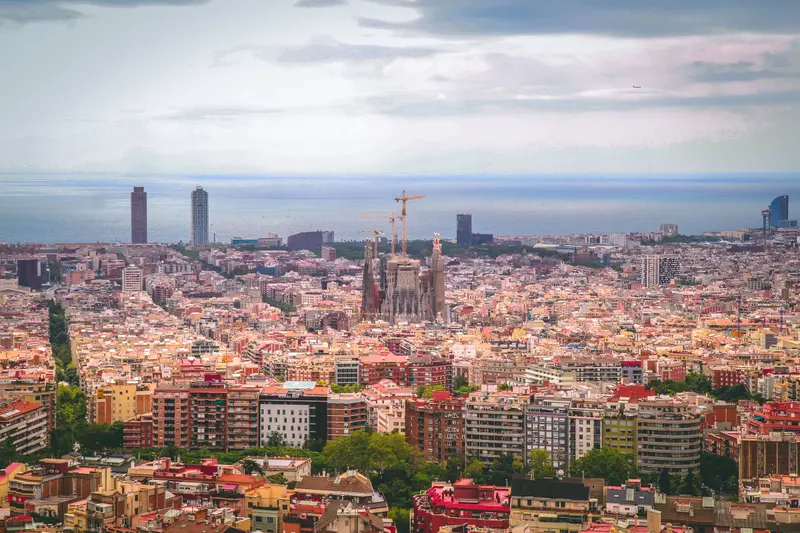
A tallat at an Eixample bar, a suís on Carrer de Petritxol and roasters in El Born and Poblenou. 1215 cafés.
Madrid
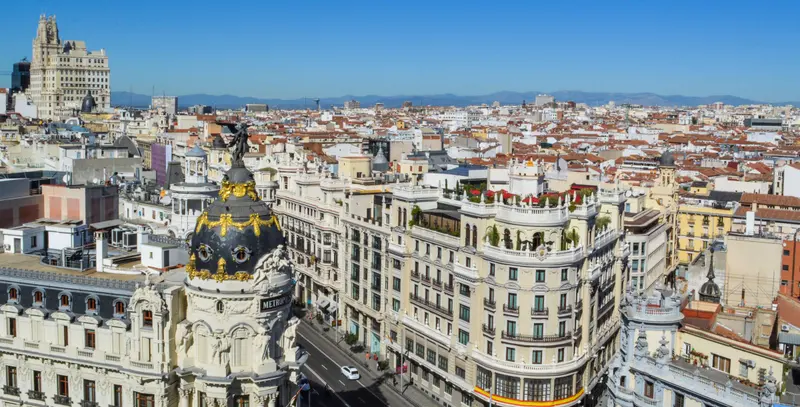
Café con leche and churros in Sol, specialty bars in Malasaña and terraces in La Latina. 1137 cafés.
Valencia
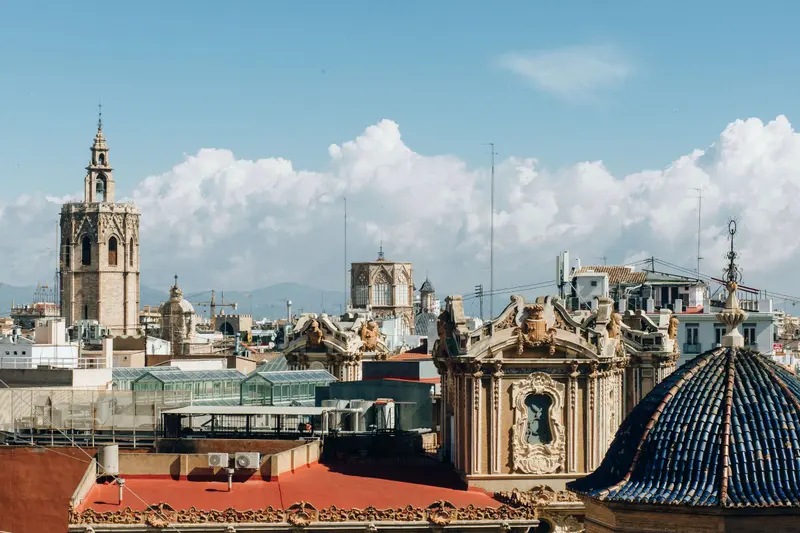
Horchata and café del temps, specialty bars in Ruzafa and cafés near the Mercado Central. 526 cafés.
Solo, cortado, con leche
Spanish coffee is built on espresso. A café solo is a small black espresso, a cortado adds a dash of milk, a café con leche is equal measures of coffee and milk, and a carajillo adds a shot of alcohol.3 The milky one is the morning coffee and a stronger one follows lunch, served in a small glass or cup rather than a mug.3
Málaga has its own scale. After the Civil War the founder of the city's Café Central drew up a chart of coffees by their share of milk, and the names spread across the province: a largo is 90% coffee, a mitad half and half, a sombra (shadow) 20% coffee and a nube (cloud) 10%.7 The chart ends with the no me lo pongas, 'don't serve me one', which contains nothing at all.7
Tenerife builds its coffee in layers. A barraquito stacks condensed milk, Licor 43, espresso, milk and foam, and is finished with a slice of lemon and cinnamon; without the liqueur, the capital's version is the leche y leche, coffee with both milk and condensed milk.8
Torrefacto: coffee roasted with sugar
Many bars still brew torrefacto, beans roasted with sucrose or glucose syrup added before the roast ends. Spain's coffee quality standard caps the sugar at 15 kg per 100 kg of green coffee, and a bag labeled mezcla blends natural-roast and torrefacto beans.4 Typical mezclas run 50/50, 70/30 or 80/20.5
The method is traced to Cuba. José Gómez Tejedor, founder of Cafés La Estrella, learned it in the Caribbean, patented it in 1901 and had it to himself until 1921; scarcity during the Civil War then made sugar-roasting the default, since the coating kept beans fresh for longer.5 It is fading: in 2026 Sergio Robles of Cafés My Way put torrefacto at about 12.5% of consumption.6
Bars, chains and a late specialty wave
Coffee is a daily habit for most Spaniards. In the Project Café España 2025 survey, 80% of Spanish consumers drank hot coffee every day and 83% had ordered coffee at an independent café in the past year.6 Chains are growing too: branded coffee shops reached 2,215 in the year to April 2025, 3% more than a year earlier, which made Spain Europe's seventh-largest branded market, ahead of Poland.6
Specialty coffee came later than in much of Europe. It took hold around 2014, when the number of specialty cafés doubled, with Madrid and Barcelona in the lead; Valencia, Andalusia and Galicia have gained ground since.6
Agaete: coffee grown in Gran Canaria
Spain's only coffee grows in the Agaete valley in the northwest of Gran Canaria.10 Growers there plant Arabica Typica between 150 and 550 m above sea level, a tradition traced to the 19th century.9 At Finca La Laja, whose owner says his family is in its fifth generation of coffee growers, cherries are picked by hand from spring into July.10 In 2026 the Canary Islands government sent the application for a Café de Agaete Protected Geographical Indication to the European Commission, with approval not expected before mid-2027.9
Barcelona, Madrid and Valencia
Barcelona and Madrid each have a café where painters and writers gathered. Els Quatre Gats opened in Barcelona on 12 June 1897 in Casa Martí, a building by Josep Puig i Cadafalch; Pere Romeu ran it with backing from the painters Ramon Casas and Santiago Rusiñol and from Miquel Utrillo, and Picasso held his first solo exhibition in its main room. The original business closed in June 1903.12
Madrid's counterpart is the Café Gijón on Paseo de Recoletos, founded by Gumersindo Gómez, a native of Gijón in Asturias. In the 1940s the poet Gerardo Diego presided over an early-afternoon tertulia (regular gathering) there, and Camilo José Cela was a regular. In 1949 the actor Fernando Fernán Gómez created the Café Gijón prize for short novels and paid for its first edition himself.11
Specialty coffee started small in Barcelona and Madrid. Francisco González of Nomad, a Barcelona roaster, says it sold about seven or eight coffees a day when it opened.6 Their habits still differ: in 2024 out-of-home coffee consumption in the Barcelona metropolitan area ran 21.7% above the national average of 1.89 liters per person, while the Madrid metropolitan area came in 55.2% below it.2
Valencia sits in the Levante region, where out-of-home consumption ran 29.7% above the national average in 2024.2 There the esmorzaret, the Valencian almuerzo (mid-morning meal), ends with a cremaet, a flamed rum coffee: rum heated with sugar, cinnamon, lemon or orange peel and a few coffee beans, set alight, then topped with espresso so the glass shows three layers.13 Its origin is disputed; one theory credits Spanish soldiers in Cuba's war of 1895–1898 with pairing coffee and rum.13
A café del tiempo in Valencia is coffee with ice, and in 2024 one bar there charged a customer 15 cents for the ice alone.14
Sources
- Sube el precio, pero no baja el consumo: España bebe 67 millones de tazas de café diarias aunque sea un 7,2% más caro (1 October 2025), Infobae (citing EFE, INE and the Asociación Española del Café), accessed October 2026
- Consumo y gasto en café (Alimentación en España), Mercasa, accessed October 2026
- How to order and drink coffee like a Spaniard (updated 1 April 2024), The Local Spain, accessed October 2026
- Real Decreto 1676/2012, por el que se aprueba la norma de calidad para el café, Boletín Oficial del Estado, accessed October 2026
- España está enamorada de un tipo de café que Europa tiene vetado (16 August 2025), Xataka, accessed October 2026
- El mercado español del café de especialidad ha florecido tardíamente (14 February 2026), Perfect Daily Grind Español, accessed October 2026
- El arte de saber llamar a las cosas por su nombre (5 June 2019), Merca2, accessed October 2026
- How to prepare a Barraquito coffee, Tenerife's star drink (14 December 2019), Turismo de Tenerife, accessed October 2026
- El único café de Europa se cultiva en Canarias y busca hacer historia: ya tramita su sello de Indicación Geográfica Protegida (6 August 2026), Infobae, accessed October 2026
- Agaete, el valle de Gran Canaria donde crece el único y cotizado café de España (23 May 2026), Directo al Paladar, accessed October 2026
- Café Gijón, Wikipedia (Spanish), accessed October 2026
- Els Quatre Gats, Wikipedia, accessed October 2026
- Cremaet, el carajillo “con guarnición” con el que los valencianos coronan su esmorzaret (Marta Moreira, 25 October 2022), Directo al Paladar, accessed October 2026
- La divertida confusión que dejó indignado a un cliente al pedir la cuenta en un bar de Valencia (Liliana Fuchs, 28 August 2024), Directo al Paladar, accessed October 2026
Guides
Café opening hours around the world
When cafés open and close: 06:00 coffee in Vietnam, Italian bars shut by 20:00, Melbourne cafés done by 15:00, Sundays in Berlin, Ramadan in Dubai.
How to orderEspresso drinks from ristretto to café bombón
What each espresso drink really is: ristretto and lungo, americano vs long black, three macchiatos, cortado, gibraltar, piccolo, flat white and bombón.
Cafés in Spain: questions
What is torrefacto coffee in Spain?
Torrefacto is coffee roasted with sucrose or glucose syrup added before the roast ends. Spain's quality standard caps it at 15 kg of sugar per 100 kg of green coffee, and a mezcla blends natural-roast and torrefacto beans. José Gómez Tejedor of Cafés La Estrella patented the method in 1901, and Civil War scarcity made it the default.
How much coffee do people drink in Spain?
Spain drinks about 67 million cups of coffee a day, or 1.5 per person, according to sector figures reported in 2025, and consumption per head rose 3.7% in 2024. Away from home, Spaniards had 1,118.4 million coffees in 2024, or 51 per person, and 61.8% of people aged 15 to 75 had at least one.
Where is coffee grown in Spain?
Spain's only coffee grows in the Agaete valley in northwest Gran Canaria, in the Canary Islands. Growers plant Arabica Typica between 150 and 550 m above sea level and pick by hand from spring into July. In 2026 the Canary Islands government sent an application for a Café de Agaete Protected Geographical Indication to the European Commission.
Your café deserves better than a pin someone else dropped
Free listings are free for good. A featured page gives you photos, a menu and your own URL, in your café's own design, for less than a coffee a day.