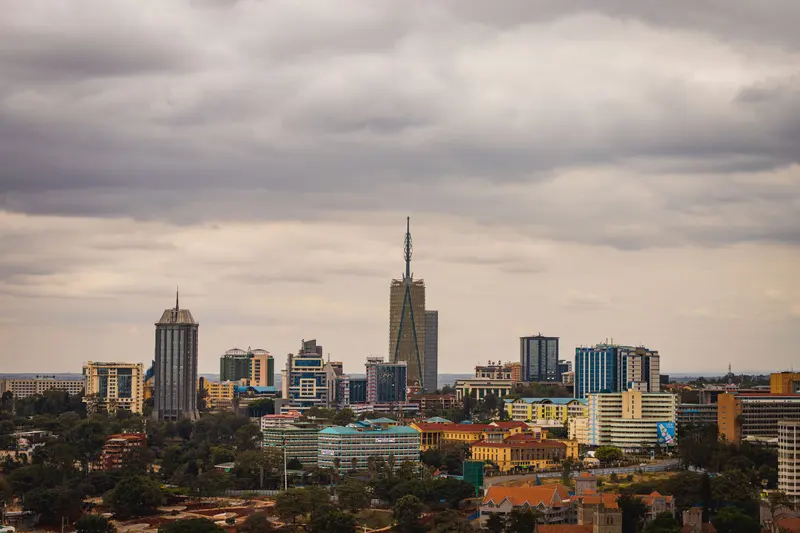
Cafés in Kenya Nairobi
Nairobi's coffee shops and the country behind them, from Nyeri and Kericho farms to the coffee exchange, AA and peaberry grades and tea.
Photo: Vince Pictures, Pexels License
Kenya grows arabica almost exclusively, at roughly 1,400 to 2,100 m on volcanic soils in the central highlands and the Rift Valley; SL-28, SL-34, Ruiru 11 and Batian are the best-known varieties.3 About 70% of the crop comes from small farms, which hold about 75% of the land under coffee.1 Output fell from about 130,000 tonnes in 1987/88 to 40,000 tonnes in 2011/12, as a property boom took coffee land and prices swung.1
Prices have since done more for the trade than volume. In the nine months to September 2025 Kenya exported 45,249 tonnes of unroasted coffee worth KSh 43.4 billion, up 4.4% by weight and 38.6% by value, and the average auction price rose to US$6.99 a kilogram from US$4.58 in 2024.5 Europe takes more than half of all shipments, with the United States second.5
Kenya's café cities
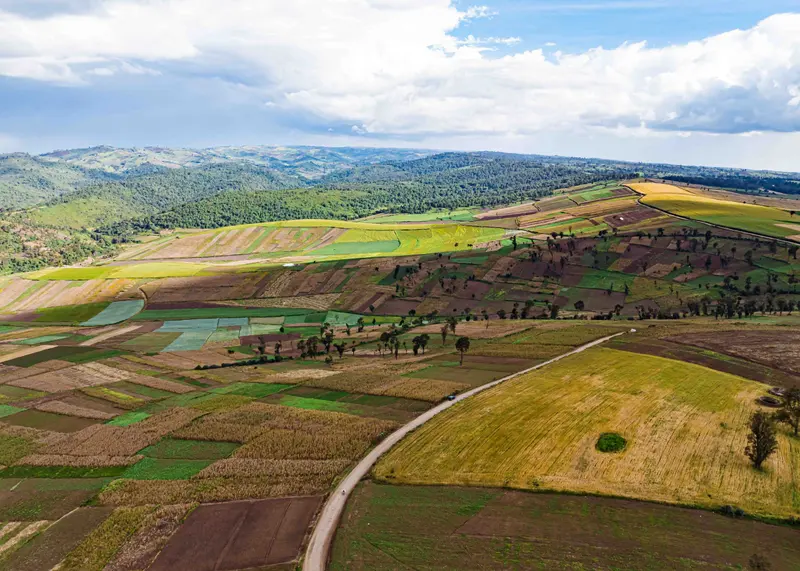
Where Kenyan coffee grows: Mount Kenya, the Aberdares and the west
The classic coffee counties sit around Mount Kenya and the Aberdare Range: Nyeri, Kirinyaga, Murang'a, Kiambu, Embu and Meru.3 Coffee also grows in Kisii, Bungoma, Nakuru, Kericho, Nandi and on Mount Elgon, and on a smaller scale in Machakos and the Taita Hills.1
The map is moving west. Up to the 29th auction of the 2025/26 season, Kericho sold more coffee at the exchange than any other county, 6.00 million kg against 3.03 million kg the season before, ahead of Murang'a, Nyeri and Kirinyaga.6 Central Kenya's share of auction volume fell from 62% to 51%, while Kisii's earnings rose more than fourfold and Nyamira's nearly sixfold.6
From cherry to auction at the Nairobi Coffee Exchange
Smallholders deliver cherry or parchment to cooperatives, which pass it to licensed mills to be hulled and cleaned into green coffee.3 The first auction was held in September 1935, and after independence in 1963 Kenya organized the trade around a weekly, government-run open auction.2 The exchange now sells lots by competitive bidding on quality, settles payments through its Direct Settlement System and answers to the Capital Markets Authority.2
Not every bag goes under the hammer: direct sales channels serve buyers in Europe, North America and parts of Asia.5 In the 2024/25 season farmers sold 31.33 million kg of clean coffee at the exchange for US$216.44 million; by 8 July 2026 the 2025/26 season had already passed 36.36 million kg.6
AA, AB, PB: how Kenyan grades work
Grades sort washed beans by size and density, not taste. AA is the largest bean and the one most sought after for specialty export; AB is a size down and widely used in blends; PB, peaberry, is the small round bean that forms when only one seed develops in the cherry.4 C marks smaller beans, E (elephant) very large ones, and TT and T light beans that float or fall through the screens.4
MH and ML, known as mbuni, are dry-processed, unwashed coffee.4 Cup quality, the taste and aroma, is judged separately and can raise a lot's price beyond what its size grade suggests.4
Tea, the bigger crop
Tea arrived in 1903, when settlers planted seedlings experimentally at Limuru in Kiambu County; some of those bushes have grown into trees on what is now the Mabroukie estate.7 Commercial growing began in 1924 and stayed in colonial hands until 1956, when African farmers were allowed to plant it.7 The Kenya Tea Development Authority was set up on 20 January 1964 to serve small growers; its successor, the Kenya Tea Development Agency, provides services to more than 600,000 of them.10
Kenya produces over 450 million kg of tea a year in 19 counties, at 1,500 to 2,700 m, and the crop earns about 23% of the country's foreign exchange.7 The main growing areas are the slopes of Mount Kenya, the Aberdares and the Nyambene Hills and the plains of Kericho and Kisii.8 Most leaf is made by the crush, tear, curl (CTC) method for blending and sold at the public auction in Mombasa; in 2018 Kenya was the world's largest exporter of black tea.9
Nairobi: where the crop is priced
Coffee growing in Kenya started on mission farms near Nairobi, which became the nucleus of the industry.1 The city still sets the price, through the weekly auctions of the exchange that carries its name, and Nairobi County is a coffee county in its own right, though its auction sales fell in 2025/26.26 The coffee shops are in Westlands, Kilimani and Lavington, and in the CBD.
Sources
- Coffee production in Kenya, Wikipedia, accessed October 2026
- About NCE: history and role, Nairobi Coffee Exchange, accessed October 2026
- Kenya coffee origin, Nairobi Coffee Exchange, accessed October 2026
- Coffee grades, Nairobi Coffee Exchange, accessed October 2026
- Coffee exports up to Sh43bn in nine months on higher prices, Business Daily (Kabui Mwangi, November 25, 2025), accessed October 2026
- Kericho tops Kenya coffee sales as earnings hit Sh31.9bn, The Star (July 8, 2026), accessed October 2026
- History of Kenyan tea, Tea Board of Kenya, accessed October 2026
- Tea growing, Tea Board of Kenya, accessed October 2026
- Tea production in Kenya, Wikipedia, accessed October 2026
- Kenya Tea Development Agency, Wikipedia, accessed October 2026
Cafés in Kenya: questions
Where is coffee grown in Kenya?
Mostly around Mount Kenya and the Aberdare Range, in Nyeri, Kirinyaga, Murang'a, Kiambu, Embu and Meru, at roughly 1,400 to 2,100 m. Western counties are rising: up to the 29th auction of 2025/26, Kericho sold more coffee at the Nairobi Coffee Exchange than any other county, and central Kenya's share of auction volume fell from 62% to 51%.
How is Kenyan coffee sold at the Nairobi Coffee Exchange?
Smallholders deliver cherry to cooperatives, mills hull it, and the exchange sells the lots by competitive bidding on quality, settling payments through its Direct Settlement System. Kenya has run a weekly open auction since independence; the first auction was held in 1935. Some coffee bypasses the auction through direct sales to buyers in Europe, North America and Asia.
Does Kenya produce more tea or coffee?
Far more tea. Kenya produces over 450 million kg of tea a year, which earns about 23% of its foreign exchange, and in 2018 it was the world's largest black tea exporter. Coffee exports were 45,249 tonnes in the nine months to September 2025, after output fell from about 130,000 tonnes in 1987/88.
Your café deserves better than a pin someone else dropped
Free listings are free for good. A featured page gives you photos, a menu and your own URL, in your café's own design, for less than a coffee a day.