Cafés in the Philippines Manila
Kapeng barako from Batangas, Benguet arabica, the 3-in-1 sachet and Manila's cafés from the Escolta to Poblacion.
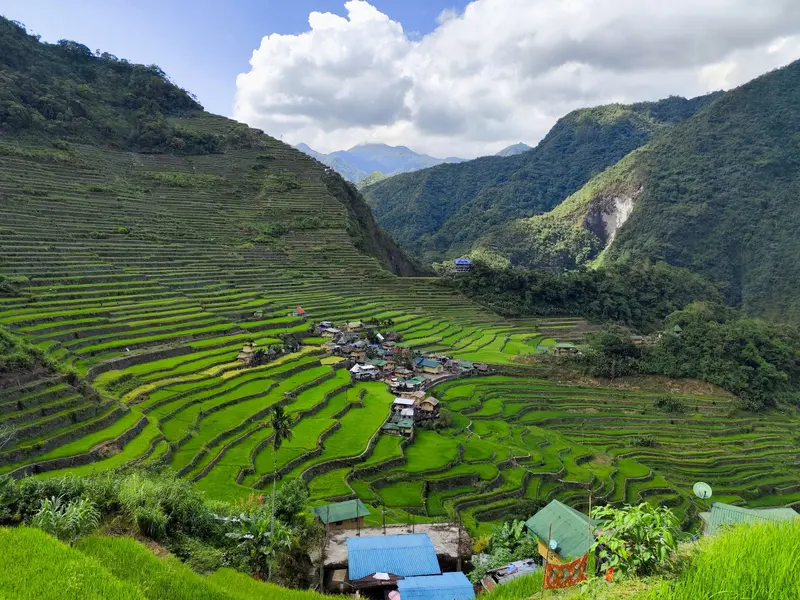
Photo: Elgene Buhong, Pexels License
The Philippines drinks far more coffee than it grows. The USDA's July 2026 forecast for 2026/27 puts the harvest at 475,000 60-kg bags, about 28,500 tonnes, against domestic consumption of 6.73 million bags, the sixth-largest figure in its tables after the EU, the US, Brazil, Japan and China.1 Imports of 6.25 million bags make the country the fourth-largest coffee importer, behind the EU, the US and Japan.1
Most of that coffee is instant. The Philippines is forecast to import 5.5 million bags of soluble coffee in 2026/27, more than any other country and about 28% of world soluble imports.1 A Department of Trade and Industry policy brief puts instant coffee's share of Philippine consumption at 90%.4
Philippines's café cities
Lipa, the friar story and the 1880s boom
The usual story has a Spanish Franciscan plant the first coffee tree in Lipa, Batangas, in 1740. The Philippine Coffee Board repeats it, while noting that no records confirm when coffee arrived.2 The food historian Felice Prudente Sta. Maria told a Board webinar in 2022 that researchers have found no written evidence for the friar, and that Spain's colonies only began getting coffee in 1796.3 Even in José Rizal's 19th century, chocolate was still the main drink in Spain and the Philippines.4
The boom is better documented. Batangas shipped coffee to America and Australia from the mid-1850s, and to Spain, France and Britain once the Suez Canal opened; by the Board's account the Philippines was the world's fourth-largest exporter of coffee beans in 1886.2 Lipa's boom crop was arabica, according to the historian Ceferino Capuchino and a 1928 article in the Philippine Agriculture Review.5 VERA Files notes that 19th-century export statistics contradict the boldest claims, such as Lipa once being the world's only supplier.4
Then the trees died. Coffee rust struck in 1891, the Board says, and within two years national output had fallen to a sixth of its former level.2 In the 1950s the government brought in a more resistant variety with American help, and instant coffee production began; the Philippines joined the International Coffee Organization in 1980.2
Four coffees, from Benguet to Mindanao
The Philippines is one of the few countries growing all four commercial coffees: arabica, robusta, liberica and excelsa.2 Robusta dominates, at about 76.5% of output in the industry's 2021–2025 roadmap, and grows in the lowlands of Mindanao and southern Luzon.6 Sultan Kudarat, in Mindanao, was the top coffee-producing province in 2024, according to the Philippine Statistics Authority, and is working to be recognized as the country's "Robusta Capital".7
Arabica comes from the Cordillera: Benguet, Kalinga and Sagada in Mountain Province, above 1,000 m.6 Excelsa grows in Batangas, Quezon, Sorsogon and parts of Mindanao, and liberica mainly in Batangas and Cavite.6 The harvest runs from October to March.2 Local arabica costs more than imports: in October 2026 The Manila Times reported Benguet arabica at ₱750–900 a kilo, against about ₱650 for imported Brazilian beans.10
Kapeng barako and the 3-in-1 sachet
Kapeng barako is coffee from Batangas and Cavite, mostly Coffea liberica. Barako means "stud" and comes from the Spanish verraco, wild boar.8 The trees reach 20 m and are picked from ladders, and the cup is strong, with an aroma likened to aniseed; it is traditionally drunk black or sweetened with muscovado.8 At home it is often brewed by pouring hot water over grounds wrapped in cloth and sweetened with pulot (honey) or kayumangging asukal (brown sugar).9
Barako is now a small crop: liberica accounts for about 1% of Philippine production, according to the Department of Agriculture's 2017–2022 coffee roadmap.5 The everyday cup is more often a sachet. Sta. Maria's account of Philippine coffee history ends with how Filipinos discovered instant coffee and the great popularity of the 3-in-1, the single-serve packet of instant coffee, creamer and sugar.3
Manila: from the Escolta to Poblacion
By 1881 Manila had three cafés: Café de la Campana on the Escolta, El Suizo in Santa Cruz and La Esperanza in Intramuros.4 The chain era began a century later in Makati. The first Starbucks in the Philippines opened on December 4, 1997, in the 6750 building on Ayala Avenue, the brand's third Asian market after Japan and Singapore; by 2022 there were 424 branches.11
Specialty cafés have since made Philippine beans the selling point. In Poblacion ("town proper"), Makati's old center, Commune has spent more than a decade serving 100% Philippine coffee bought directly from farmers, and Solid Ground pulls espresso from local roasters such as Cappo, Type A and Candid.12 The trade meets in Makati too: at the 2nd Philippine Coffee Sustainability Congress in October 2026, the Coffee Board's Ceasario Rex Kapunan said cafés might raise prices from December.10
Sources
- Coffee: World Markets and Trade (July 2026), USDA Foreign Agricultural Service, accessed October 2026
- Philippine Coffee: Our Coffee Heritage, Philippine Coffee Board, accessed October 2026
- Who really brought coffee first to the Philippines? A food historian offers some answers, ABS-CBN ANCX (October 14, 2022), accessed October 2026
- Kape: Myths, tall tales and history, VERA Files (R.C. Ladrido, October 15, 2022), accessed October 2026
- The beginnings of kapeng barako's association with Batangas, Batangas History, Culture and Folklore (May 2020), accessed October 2026
- Brewing Strong: The Competitive Edge of the Philippine Coffee Archipelago in Global Sourcing, IFEX Philippines, CITEM/DTI (May 19, 2026), accessed October 2026
- Brewing partnership, grounded in sustainability, Peace and Equity Foundation (August 5, 2025), accessed October 2026
- Kapeng barako, Wikipedia, accessed October 2026
- Kapeng barako, Wikipedia (Tagalog), accessed October 2026
- Low supply, rising costs to drive coffee prices up, The Manila Times via Newswav (Chynna Grace Ong, October 19, 2026), accessed October 2026
- As Starbucks turns 25 in the PH, CEO Noey Lopez looks back on how it all began, ABS-CBN ANCX (December 4, 2022), accessed October 2026
- These are the best cafés in Poblacion 2026, Tatler Asia (Isabel Martel Francisco, July 28, 2026), accessed October 2026
Cafés in the Philippines: questions
What is kapeng barako in the Philippines?
Kapeng barako is coffee from Batangas and Cavite, mostly Coffea liberica. Barako means "stud", from the Spanish verraco, wild boar. The trees grow up to 20 m and the cup is strong, with an aroma likened to aniseed. It is drunk black or sweetened with muscovado, honey or brown sugar, and liberica makes up only about 1% of Philippine production.
How much coffee does the Philippines grow and drink?
The USDA forecasts a Philippine harvest of 475,000 60-kg bags in 2026/27 against consumption of 6.73 million bags, so most coffee is imported: 6.25 million bags, the fourth-largest import volume in the world. The Philippines is also the biggest buyer of soluble coffee, at 5.5 million bags, and a government policy brief puts instant coffee at 90% of what Filipinos drink.
Where is coffee grown in the Philippines?
The Philippines grows arabica, robusta, liberica and excelsa. Robusta, about 76.5% of output, grows in the lowlands of Mindanao and southern Luzon, and Sultan Kudarat was the top province in 2024. Arabica comes from Benguet, Kalinga and Sagada above 1,000 m, liberica from Batangas and Cavite, and excelsa from Batangas, Quezon and Sorsogon. The harvest runs from October to March.
Your café deserves better than a pin someone else dropped
Free listings are free for good. A featured page gives you photos, a menu and your own URL, in your café's own design, for less than a coffee a day.