 By Yannick Schroth
Coffee cultures · 6 min read · October 2026
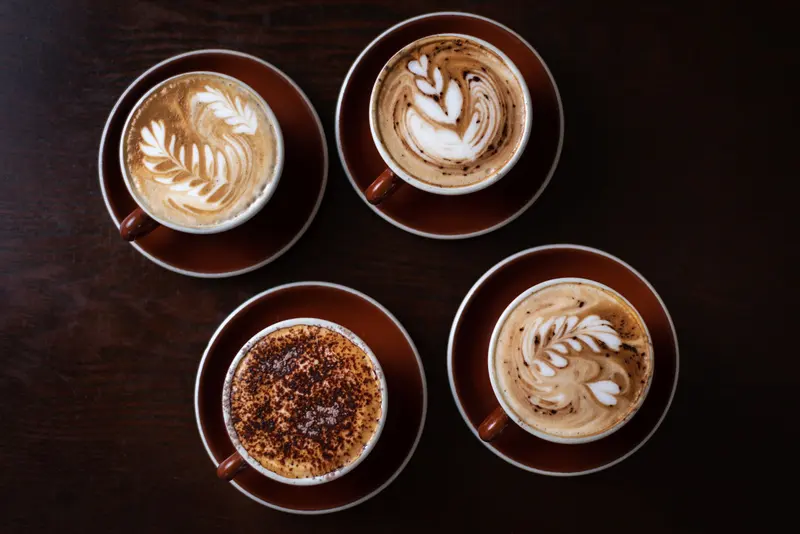
In a Melbourne specialty bar, a flat white means a six-ounce ceramic cup holding one part espresso and five parts milk, steamed to a creamy texture close to a latte's.4 The top is a thin layer of microfoam rather than the stiff cap of a cappuccino.1 Australia and New Zealand both say they invented it, and neither has closed the case.1
The drink reached Britain by 2005, and Starbucks added it to its American menu on 6 January 2015.1 Around it sits an Australian vocabulary: the long black, the piccolo, Melbourne's magic and the babyccino for children, all built on an espresso culture that took off with post-war migration from Greece and Italy.78
Who invented the flat white: Sydney or Wellington
The oldest printed traces are Australian. A Sydney Morning Herald review of the Sydney café Miller's Treat mentioned a "flat white coffee" in May 1983, and in January 1985 the cafeteria at Parliament House in Canberra posted a "flat white only" sign during a milk shortage, because the milk on hand would not froth.1
Alan Preston, who grew up in Far North Queensland, put the drink on the permanent menu of Moors Espresso Bar in Sydney's Chinatown in 1985 and says photographs show it there.2 He traces it to sugar-town cafés with imported Italian machines, where growers ordered a "flat"; he added "white" to make the menu line clearer, then opened five more cafés serving it.2 Italians had come to those cane fields since 1891, when the agent Chiaffredo Venerano Fraire recruited cutters for the Queensland government.2
New Zealand's best-known claim is from Wellington. The former barista Fraser McInnes says he made the first flat white there in 1989 when a cappuccino refused to foam, and that his business partner's menu note read "a Wellington flat white is a failed cappuccino."3 The Dominion Post placed that failed cappuccino at Bar Bodega on Willis Street.1 In Auckland, Derek Townsend and Darrell Ahlers of Cafe DKD say they created it as an alternative to the latte, having taken the name from a friend who had worked in Sydney cafés.1
McInnes concedes that earlier flat whites may have been poured in Auckland.3 The Sydney coffee historian Ian Bersten said in 2015 he was "100 percent certain" the drink existed in 1984, and he has also suggested it began in 1950s England, where the term turns up in a 1963 film.13
Long black, piccolo, magic and babyccino
A short black is simply an espresso.4 In Melbourne an americano is a double shot over a cup about three-quarters full of hot water, while a long black uses only one to two ounces of water under the same double shot, so it comes out far more concentrated.4 A short macchiato is an espresso with a dollop of foam; a long macchiato adds the foam to a long black, though baristas trained in Sydney tend to leave out the water.4
The piccolo is a single shot filled to the brim with steamed milk, in an espresso cup or a miniature latte glass of 90 to 120 ml, which makes it about twice as strong as a latte.4 Melbourne lattes themselves come in a 220 ml glass rather than a cup.4
The magic is Melbourne's off-menu order: a double ristretto, a shot pulled early, under steamed milk, in a cup about three-quarters the size of a flat white.5 The Age dates it to the 2000s, and the credit is split between St Ali in South Melbourne, Cafe Ray's in Brunswick and Newtown S.C. on Brunswick Street, Fitzroy, where the lawyer Zenon Misko says he asked the owner to rework his usual order.5 From 2023 it was sold in 330 Marks & Spencer stores in Britain.5
The babyccino is frothed milk in a small cup for children, its name a blend of baby and cappuccino.6 Its earliest known appearance in print is in Melbourne's Sunday Age on 14 May 1995, which called it "the no-coffee coffee for the junior set" and gave the usual price as 50 cents.6 In 1996 the same paper credited the coffee shops of Hastings Street in Noosa Heads with probably inventing it.6
Greek milk bars and Italian espresso bars
Before espresso, Melbourne's coffee was often a chicory brew, and American troops stationed in the city during the Second World War pushed quality up.8 The machines came after the war. J. Goldstein & Co., an Australian maker and distributor of café equipment, had held an import licence for espresso machines before the war but let it lapse; the Greek milk bar owner Sam Akon took it up and had machines in his Patricia's milk bars in 1948 and 1949.7
Leonard Janiszewski, the Macquarie University historian who traced this with the photographer Effy Alexakis, reads Akon's move as a bet on the 1947 immigration policy: more Southern Europeans would mean a market for espresso.7 Pellegrini's on Bourke Street, which has always claimed Melbourne's first commercial machine, is dated to 1954 by the pair's records.7 Through the 1950s espresso bars spread across Melbourne and its suburbs, giving migrants somewhere to meet.8
Not everyone approved. Conservatives called the bars magnets for unsavory characters, and on 14 January 1961 the newspaper The Truth ran an exposé on "espresso bar vultures" linking them to prostitution rackets.8 A broadcast interview with an "espresso bar girl" was later shown to have been fabricated at the request of police and the press, and the State Library of Victoria judges that the harm to the reputation of Italian migrants was serious but not permanent.8
Why Starbucks struggled in Australia
In July 2008 Starbucks closed 61 of its 85 Australian stores and cut almost 700 jobs.9 Inside Retail later put the reported loss at A$143 million.10 Australian Food News blamed a model that could not compete with independent coffee shops or with McDonald's McCafé and Gloria Jean's, run by an operator that understood local shopping habits less well than those rivals.9
Inside Retail added rapid expansion into costly locations such as Darwin and Tasmania, and wrote that independent coffee shops held almost 84% of the market.10 "Australians don't necessarily love global American brands," Paul Patterson, a marketing professor at UNSW, told the magazine.10
In May 2014 the Withers family group, which runs 7-Eleven in Australia, took over the licence and the 24 remaining stores, saying it would adapt the brand to the local market.9 By mid-2017 it had 29 stores and was aiming at tourists and international students in prime city-center sites, with winning over local coffee drinkers a lower priority.10
Smashed avo and the café brunch
The Australian café is a breakfast room as much as a coffee bar. Bill Granger, a self-taught cook born in Melbourne, opened bills in Darlinghurst in 1993, and with his wife grew it into 19 restaurants in cities including Sydney, London, Tokyo and Seoul.11 The Washington Post has suggested he may have been the first to put avocado toast on a modern café menu, in Sydney that same year.12
The dish became a national argument on 16 October 2016, when the columnist Bernard Salt wrote in The Australian about young people paying A$22 for smashed avocado with crumbled feta on five-grain toast instead of saving for a house.12 Five days later he said the piece satirized baby boomers.12 The Sydney Morning Herald calculated that skipping A$66 of brunch a week would buy only a 10% deposit, and only in Hobart.12
What a coffee costs in 2026, and the end of card surcharges
The Daily Brew Report 2026 from Hey You and Westpac DataX found the smallest annual rise in coffee prices in six years, 60% slower than general inflation, with the national average at A$4.69 in June 2026.13 Tasmania was the most expensive state at A$5.44, and Queensland rose fastest, up 7.81% to A$5.17, so a coffee a day there now costs more than A$36 a week.13
Paying by card got simpler on 1 October 2026. Under the Reserve Bank of Australia's final decision, merchants may no longer add a surcharge to debit, credit or prepaid card payments on eftpos, Mastercard or Visa, and the cap on interchange fees for consumer credit cards fell from 0.8% to 0.3%.14 American Express and buy-now-pay-later services are outside the ban.14
Cafés pushed back. The Australian Restaurant and Cafe Association expected menu prices to rise on the start date, gave the example of a coffee going from A$5.08 to A$5.10, and said cash payers would lose most; the RBA expects any increases to be negligible.14