 By Yannick Schroth
Coffee travel · 5 min read · October 2026
The Eje Cafetero (coffee axis) covers the Andean slopes of Caldas, Risaralda and Quindío, where coffee grows between 1,000 and 2,000 m, at an average of 1,540 m.3 UNESCO added the Coffee Cultural Landscape of Colombia to its World Heritage List at its 35th session in 2011, with a core zone of 141,120 ha and a buffer zone of 207,000 ha.1
It is a landscape of smallholdings. ICOMOS, UNESCO's advisory body on cultural sites, counted about 24,000 coffee farms and some 80,000 residents inside the listed zones; the average farm covers 4.6 ha, of which 2.6 ha are planted with coffee.2 Three places make practical bases. Salento and Filandia are Quindío towns at around 1,900 m,1112 while Manizales, the capital of Caldas, sits higher, at 2,160 m.13
What UNESCO listed in the Eje Cafetero
The listing protects working land rather than a park. Coffee here is planted on slopes that average close to 50 percent, which rules out most machinery and keeps the work manual, picking above all.3 Towns sit mostly on the ridges above the farms, and the six rural zones range from 826 ha to 47,406 ha.2
Building is part of the heritage too. The older towns went up in tapia, rammed earth, and bahareque, walls of plaited cane and mud, under clay-tile roofs, and about 57 percent of the walls in the listed area are still built of those traditional materials.23 ICOMOS also noted houses with sliding roofs over coffee-drying areas, a detail the nomination itself left out.2
What a coffee farm tour covers
Most tours follow the bean from plant to cup. Traditionally, ripe cherries were depulped, fermented to loosen the sticky mucilage, washed, and dried on patios or in guardiolas, big rotating drums fed with hot air.2 Farms in the listed area now mostly use a machine that strips the cherry with almost no water, then dry the beans on concrete patios or with warm air.2
Finca El Ocaso, about 4.5 km from Salento's plaza, runs its traditional tour through gardens and coffee plots, past a compost station and into the beneficio (wet mill) for depulping, drying, storage and hulling.56 It ends with coffee made the farmhouse way, in a pot and through a cloth filter. The tour takes 1 hour 30 minutes, needs no booking, and children under 6 go free.6
Longer formats add a lab. On El Ocaso's roasting tour, groups of up to six visitors aged 15 and over roast and bag a batch of their own.7 Near Manizales, Hacienda Venecia opens its tour with a cup of coffee and a talk on the origin, history and varieties of coffee before the walk through the plantation.14
| Tour | Where | Length | Price (COP, 2026) |
|---|---|---|---|
| Coffee tour tradicional, Finca El Ocaso | Salento | 1 h 30 min | 60,0006 |
| Roasting tour, Finca El Ocaso | Salento | 2 h 45 min | 150,0007 |
| Shared coffee tour, Hacienda Venecia | Near Manizales | About 2 h 30 min | 110,000 adults, 70,000 under 129 |
Prices as published by each farm in October 2026. Hacienda Venecia's rate excludes the 19 percent VAT charged to Colombian residents.9
Salento and the road to Cocora
Salento was founded on 5 January 1842 and stands at about 1,895 m, 24 km northeast of Armenia.11 Much of its original bahareque survives, especially on Carrera 6, the Calle Real, which leads to the Alto de la Cruz lookout up 250 steps marked with the Stations of the Cross.11 Weekends and public holidays bring the crowds.11
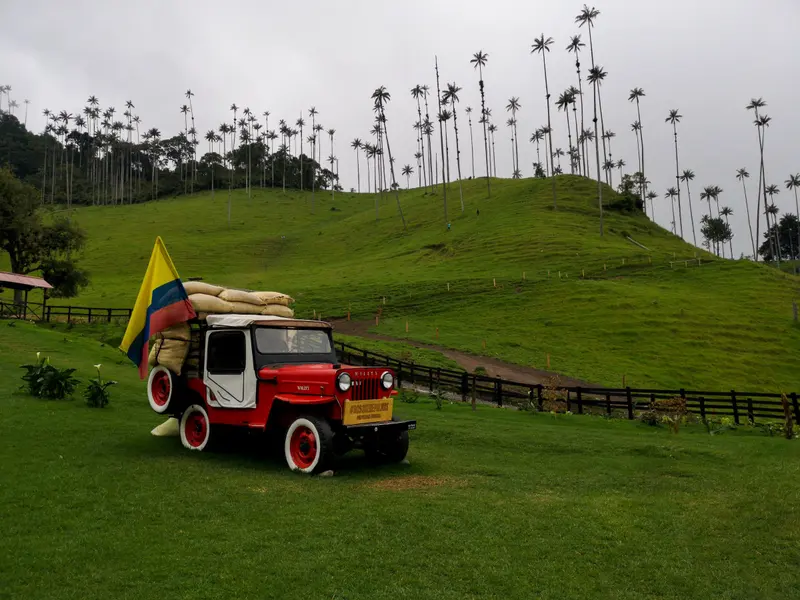
Jeep taxis leave the town square for the Cocora settlement, about 11 km up the valley, where visitors carry on on foot or on horseback.11 El Ocaso lies 3.8 km past the town cemetery. Walking from the plaza takes about an hour, downhill all the way, and private Willys jeeps from the plaza carry groups of up to 10.5
Filandia, the basket town
Filandia, in the north of Quindío, was founded on 20 August 1878 by settlers from Antioquia and became a municipality in 1892.12 Its main square stands at roughly 1,910 m, with an average temperature of 18°C and 2,829 mm of rain a year.12
Its craft is basketry. The UNESCO nomination file names baskets from Filandia among the best-known coffee handicrafts of the region, and the town holds a Fiesta del Canasto, a basket festival.3 The same document describes Filandia's setting as flatter than its neighbors', with streets of two-story houses.3
Manizales and Hacienda Venecia
Manizales was founded on 12 October 1849 by twenty settlers from Antioquia and sits at about 2,160 m, near the Nevado del Ruiz volcano.13 Coffee bodies based in and around the city include the Caldas growers' committee, the warehousing company Almacafé and Cenicafé, the national coffee research center.13
Hacienda Venecia's entrance is at the San Peregrino bridge on the Autopista del Café. Buses from the Manizales terminal run every 20 minutes, take about 25 minutes and cost an estimated COP 5,000 (2026); ask to be dropped at the bridge, since the bus continues to another city.10 With notice by phone or WhatsApp, the farm sends a free shuttle to Las Palmas restaurant, across the bridge. The shared tour starts at 09:45.109
Getting there from Medellín and Bogotá
By road, Hacienda Venecia gives about 6 hours from Medellín to the San Peregrino bridge, at an estimated COP 65,000, and 7 to 9 hours from Bogotá, at about COP 90,000 (2026).10 From Pereira the bridge is about 45 minutes away by bus.10
For Salento, change in Armenia or Pereira. Buses from Armenia ran every 20 minutes between 05:30 and 20:00 in late 2023, taking about 45 minutes for COP 5,900; from Pereira's main terminal the ride took an hour and cost COP 11,500 in March 2024.8 The last bus back to either city leaves Salento's main square at 18:00.8
Flying into Manizales is less predictable. La Nubia airport has a runway of about 1,400 m, operates from 06:00 to 18:00 and often closes when fog cuts visibility.13
Harvest seasons, altitude and weather
Colombia brings in two crops a year. The main harvest runs from October to December, and the secondary crop, the mitaca, from April to June.4 Over the coffee axis the intertropical confluence zone passes twice a year, producing two rainy and two dry seasons, so a single branch can carry flowers, green cherries and ripe ones at the same time.3
That is why picking is selective and done by hand, and why ripe cherries come in for about 50 weeks of the year, with pronounced peaks at the end of each half of the year.3 The peaks are the months to see pickers working the rows at full pace.
The coffee belt averages about 22°C, with 1,200 to 3,000 mm of rain spread through the year.3 Higher up it is cooler: Manizales averages 17.0°C, with daytime highs near 21°C and lows near 12°C, about 1,580 mm of rain, and October as its wettest month.13 Pack a rain layer for any season.
Tip. Book a weekday if you want to see the mill running. At Hacienda Venecia the processing machines stand idle on Saturdays, Sundays and holidays, when no coffee comes in, though guides still take visitors through the mill.14