 By Yannick Schroth
Coffee cultures · 5 min read · October 2026
A tinto is Colombia's everyday black coffee: brewed by infusion or filtered as café colado, served without milk and often sweetened with panela, unrefined cane sugar, or with plain sugar.2 The word comes from the Latin tinctus, "dyed", long used for dark liquids and above all for wine; when coffee spread through Colombia in the late 19th and early 20th centuries, the drink took a name the language already had.2 Colombians average two to three cups a day.2
For decades, the beans in that cup were not the ones the country was famous for. In 2020 BBC Mundo reported that about 93% of Colombia's roughly 14 million bags a year were exported, and that the country imported about 800,000 bags of low-grade pasilla from Ecuador and Peru to meet domestic demand of about 1.8 million bags.1
Tinto on the street and at the counter
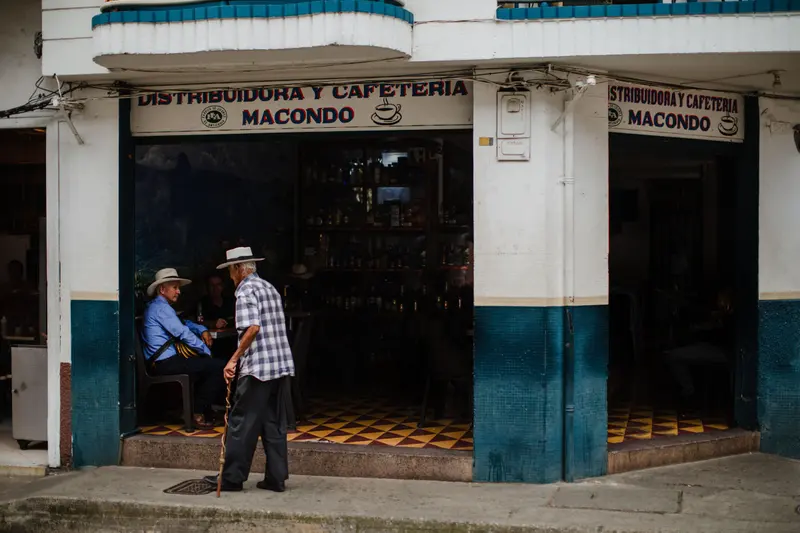
Tinto is sold from thermoses by street vendors, at bakery counters and in chain cafés.411 In Medellín's La Minorista market in March 2025, one vendor charged COP 1,000 for a tinto and COP 2,000 for a perico; in Barrio Colombia a tinto cost COP 1,200–1,300, and elsewhere vendors had moved to COP 1,400.12
Price follows the neighborhood more than the coffee. In October 2026, El Colombiano found tintos at COP 1,000–8,000 in Medellín's Centro and COP 2,600 at a cafetería in San Javier, while a 310 ml tinto made with Juan Valdez coffee at Terpel's Al Toque stations cost about COP 6,500.11 The paper noted that these are not the same product sold at different prices: origin, traceability and brewing method all go into the cup.11
Some of what is sold as tinto is not brewed at all. In 2007, half of the tintos drunk in Colombia were made with instant coffee, according to the polling firm Centro Nacional de Consultoría.1 The barista Juan Manuel Ortiz told BBC Mundo that a typical tinto tastes "of metal" to him.1
| Where in Medellín | Tinto, October 2026 |
|---|---|
| Bakeries around Parque de Guadalupe, Manrique | COP 1,000–1,500 |
| Cafetería in San Javier | COP 2,600 |
| Centro (range) | COP 1,000–8,000 |
| Pergamino (manual brew, serves two cups) | from COP 4,700 |
| Juan Valdez, in store | about COP 5,300 |
| Juan Valdez, delivery apps | about COP 7,900 |
| Café Torbellino | from COP 6,000 |
| Al Toque at Terpel stations (310 ml) | about COP 6,500 |
| Starbucks | COP 9,500 |
Prices reported by El Colombiano on 1 October 2026.11
Perico, pintado, chaqueta and carajillo
Milk changes the order. In Bogotá and the highlands around it, ask for a perico, a small coffee with milk that usually comes with something from the bakery counter; in Antioquia and the Eje Cafetero, a pintadito is coffee with only a little milk.4 At La Minorista in 2025, a perico cost twice as much as a tinto.12
Aguapanela is panela dissolved in boiling water, sometimes with lemon.3 Mixed with black coffee it becomes a chaqueta, part of the morning routine on farms and in rural areas of Antioquia and the Eje Cafetero.4
The carajillo is Spanish in origin and popular in Colombia: hot dark-roast coffee with sugar and a shot of rum or brandy.5 It is a drink for the end of a meal rather than the start of the day.5
Why Colombia drank its lower grades
The 1962 International Coffee Agreement formalized export quotas. The Federación Nacional de Cafeteros (FNC), the growers' federation, decided with growers and exporters to send the best coffee abroad and keep the lower grades at home, supported by a purchase subsidy.1 Ana María Sierra, coordinator of the federation's Toma Café program, told BBC Mundo that the quota pact created a surplus in the local market.1 Luis Fernando Samper, who worked on the Juan Valdez brand, judged that the policy encouraged drinking but discouraged any distinction by quality.1
Roasting at home was held back too. Rules known as the "ley de pasilla y ripio" discouraged local roasting and kept the country exporting green coffee, until a regulatory change the FNC promoted in 2003 opened room for companies like Bogotá's Amor Perfecto.7
When the quota agreement ended in 1989, the state stopped subsidizing coffee and local consumption fell below the Latin American average.1 The export rule outlived it: in 2015, a government-commissioned study seen by Reuters still recommended scrapping the minimum quality standard for exportable beans, so growers could sell into the low-end segment abroad.6
Juan Valdez and the Café de Colombia brand
Abroad, the federation sold the opposite image. The agency Doyle Dane Bernbach created the Juan Valdez logo for it in March 1959, and "Café de Colombia" became a certification mark in the United States on 7 July 1981.8 Colombia recognized Café de Colombia as a denominación de origen (protected designation of origin) in 2005, and the European Union granted it protected geographical indication status on 27 September 2007.8
Samper told BBC Mundo that the campaign convinced consumers in Colombia and abroad that Colombian coffee was the best in the world, and the FNC's general manager, Roberto Vélez, called it the genesis of the specialty coffee movement.1 At home, the federation tried from around 2007 to rebuild demand through Juan Valdez stores and the advertising of Toma Café; in 2020 the chain had 260 stores in Colombia and 60 abroad.1
Specialty coffee in Bogotá and Medellín
Luis Fernando Vélez founded Amor Perfecto in Bogotá in 1997 and trained some of the country's first baristas.7 The company now exports about US$1.5 million a year of coffee roasted in Colombia, buying from producers in Huila, Nariño, Cauca, Antioquia and the Sierra Nevada.7
Most of Bogotá's specialty shops are small local businesses that roast in house.9 Café Cultor, among the first to open, works with more than 10,000 farmers and has a branch inside the Luis Ángel Arango library in La Candelaria. Azahar publishes how far above the market price it pays for each coffee, and Catación Pública in Usaquén is run by Jaime Duque, an FNC agronomist for more than 20 years.9
The city now has a coffee festival of its own. Coffee Master, in its eighth edition from 5 to 17 August 2026, linked more than 50 specialty cafés in Bogotá and the Sabana into one route, each serving a festival drink made only with Colombian coffee and ingredients for COP 15,000.10
BBC Mundo put the gap in 2020 terms: a specialty coffee cost a little more than double a standard tinto, which sold for about COP 3,300, or US$1.1
The Eje Cafetero
UNESCO inscribed the Paisaje Cultural Cafetero (Coffee Cultural Landscape) on 25 June 2011. It takes in parts of 47 municipalities and 411 veredas (rural districts) in Caldas, Quindío, Risaralda and Valle del Cauca, with about 24,000 small coffee farms and some 80,000 people who work them.13 The landscape grew out of the Antioquian and Valle colonization of the region, and its buffer zone adds 207,000 ha around the core.13
The region's coffee theme park predates the listing. The FNC and Quindío's departmental coffee committee opened the Parque del Café on 24 February 1995, at Km 6 on the road to Montenegro, 20 minutes from Armenia.14 It covers 125 ha, 58 of them built, with more than 35 rides and cultural attractions, among them a coffee museum and a path through the coffee process.14
Tip. For a tinto made from the country's own specialty beans, order at a specialty bar: at Pergamino in Medellín, a manual brew starts at COP 4,700 and serves two cups.11