 By Yannick Schroth
Coffee cultures · 6 min read · October 2026
Arabica coffee comes from Ethiopia, and Ethiopians drink a large part of what they grow: by the common estimate about half the crop stays in the country, the highest domestic consumption in Africa.2 The everyday word for coffee is buna (ቡና), and the traditional way to make it is at home, in a clay pot called a jebena (ጀበና).4
Making it is a ceremony, a daily routine for gathering relatives, neighbors and visitors, and the woman of the household performs it.3 Green beans are roasted on the spot, pounded by hand and brewed three times over the same grounds.3 In Addis Ababa the ceremony shares the day with a café habit of Italian origin, the macchiato.7
Kaffa, Kaldi and what is actually known
The best-known origin story is a legend. A goatherd named Kaldi sees his goats turn lively after eating red berries, tries them himself and carries them to a monastery, where the head monk throws them into the fire; the aroma wins him over, and the brew keeps the monks awake.1 Popular tellings date it to around 850 CE.1
The written record is far later. The story first appears in 1671, in a Latin treatise on coffee by Antoine Faustus Nairon published in Rome, and that version places the herder in Arabia Felix, present-day Yemen.1 Scholars treat it as probably apocryphal, and the name Kaldi seems to be a 20th-century invention popularized by William H. Ukers.1 A more credible tradition holds that Sufis first met coffee in Ethiopia, across the Red Sea from Arabia.1
The botany is firmer ground. The coffee plant originates in Kaffa, in Ethiopia's southwest, where it still grows wild in deep forest between 1,400 and 2,100 m.2 Harar, in the east, produces one of the oldest coffees still on the market.2
The buna ceremony, step by step
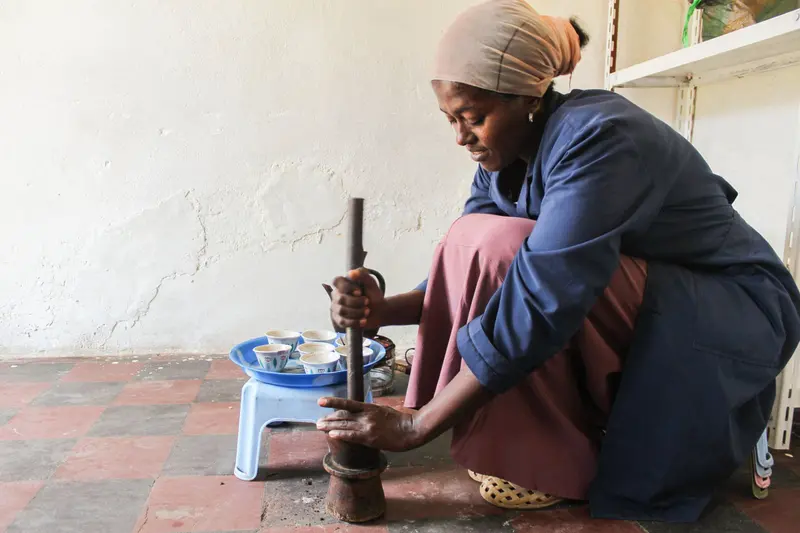
Preparation starts with the floor. Loose grass is spread around the seating area, often scattered with small yellow flowers, especially around the Meskel festival.3 The host sits on a small stool beside the rekebot, a low table that holds the small handleless cups, called sini (ስኒ).54
Green beans are roasted in a pan over an open flame or a small charcoal burner and stirred so they color evenly.5 The host then carries the smoking beans to the guests, who wave the aroma toward themselves.5 Next the beans are pounded in a mukecha, a wooden mortar, with a pestle called a zenezena.53
The grounds go into the jebena with water, and the pot sits directly on hot coals.4 When the coffee rises into the neck it is poured off to cool and returned, until it bubbles up again.4 The neck is narrow enough to act as a strainer, a plug of straw, cloth or clay keeps it from spilling, and Ethiopian jebenas, unlike most Eritrean ones, have a separate lower spout for pouring.4
A child carries the first cups to the eldest person present, then to the guests.5 The host pours from about a foot above the tray in one unbroken stream until each cup is full.3 Sugar is common, and in rural areas some people add salt or butter (niter kibbeh) instead.3 Cinnamon, cloves or cardamom sometimes go into the pot, though most coffee is brewed without spices.5
Incense usually burns while the coffee brews: itan (frankincense) laid on red-hot charcoal in a small clay burner, the girgira.5 Snacks come on the side, typically popcorn, peanuts, bread such as himbasha, or kolo, a mix of roasted barley, peanuts and seeds.356
Abol, tona and baraka: the three rounds
The coffee is served in three rounds from the same grounds. In Amharic they are abol, tona and baraka; the Tigrinya names are awel, kale'i and baraka.3 Baraka means to be blessed.3 Between rounds the jebena is topped up with water and brought back to the boil.56
Each round is weaker than the one before, and the three together usually take about two hours.4 In many households the ceremony traditionally happens three times a day, in the morning, at noon and in the evening.4 A guest who declines coffee is usually offered tea instead.3
The ceremony carries enough weight that Ethiopia issued a set of postage stamps on it in December 2011, illustrated by Bogale Belachew.5 The text that came with them describes the senior woman of a household inviting family and neighbors to drink buna one to three times a day.5
Macchiato and cafés in Addis Ababa
Italy's short occupation left the macchiato on Addis Ababa's menus, although strong black local coffee is still the norm.7 The address most associated with it is Tomoca, founded in February 1953; the name comes from Torrefazione Moderna Café, Italian for modern coffee roasting.8
Tomoca serves Italian-style coffee made from Ethiopian arabica, dark roasted by default, and sells packaged beans and ground coffee, including a dark-roasted Harar.8 It had 22 branches in the city by 2015, opened its first shop abroad in Tokyo that year and reached Two Rivers Mall in Nairobi in September 2020.8
Kaldi's Coffee, often described as Ethiopia's answer to Starbucks, opened its first outlet in 2005 and had more than 20 by 2015, in Addis Ababa and in Debre Zeyit, 45 km from the capital.9 After a shortage of roasted coffee in 2011 the chain began roasting its own, and it later opened a dairy processing plant.9
Some roasters bring the jebena into the café instead. In 2019 YA Coffee, a roastery on CMC Road, served only Ethiopian beans and brewed them only in a jebena, taking about ten minutes from measuring to cup; a serving is about double the volume of an espresso.10 Street vendors on many corners sell quick, cheap brewed coffee, often reheated for hours.10
Yirgacheffe, Sidama, Guji, Harar and Limu
Ethiopian coffee is sold by region. Yirgacheffe, whose woredas (districts) include Yirgacheffe, Kochere and Gedeb, prefers washed processing and is known for bright, citric acidity.14 Sidama, which broke away to become Ethiopia's 10th recognized region, grows coffee at 1,500 to 2,200 m with lemon and citrus notes and crisp acidity.142
Guji, in Oromia, produces both washed and natural coffees with complex, fruity cups.14 Limu, politically part of Jimma, mostly washes its coffee, which tastes sweet and smooth with subtle acidity.14 Harar is dry processed and sorted almost entirely by hand, and it is known for a fruity, winey flavor.2
Three of these names are trademarks. In 2004 Ethiopia began a trademarking and licensing initiative for Harrar (Harar), Sidamo and Yirgacheffe, and registered them in markets including the United States, the European Union, Japan and Canada.13 Before it, Ethiopia received about 6% of the retail price of its coffee.13 In the United States, Yirgacheffe was registered first and Sidamo followed in February 2008.13
Production, exports and home consumption
Smallholders grow about 90% of Ethiopia's coffee, often on less than half a hectare, and the Ethiopian Coffee and Tea Authority (ECTA) counts 5.9 million farmers in coffee.11 About 70% of the trees are old, some of them more than a century.11
Exports set a record in the 2024/25 Ethiopian fiscal year: 468,967 tonnes worth US$2.653 billion, according to ECTA, or 144% of the volume target.12 The USDA, counting by its own marketing year, put 2024/25 shipments at 7.43 million 60-kg bags worth US$2.89 billion.11 Saudi Arabia and Germany bought the most, and China rose to third after its purchases grew 264% to 670,000 bags.11
Demand at home keeps growing. The USDA's attaché forecast domestic consumption of 5 million bags for 2026/27, up 11.1%, against a crop of 12.1 million bags, and credited urban café growth and younger drinkers.11 Most of what Ethiopians drink is lower grade, because coffee above the export quality threshold has to be exported.10