 By Yannick Schroth
Coffee cultures · 5 min read · October 2026
In France, un café is both the place and the drink, and the drink is an espresso. In Paris it cost €2.32 on average across 58 bars in a price survey by the bar guide MisterGoodBeer in October 2026, with a median of €2.40 and a range from €1.30 at Au Grand Turenne in the 3rd to €4 at Bistro de l'Arc in the 16th.1
There are far fewer cafés than there once were. France had up to 500,000 bistrots in the first half of the 20th century, one for every 80 inhabitants, and about 38,800 now, with some 2,700 closing each year against 2,200 openings, according to a June 2025 parliamentary resolution backing a UNESCO bid for the country's cafés.2
Comptoir, salle, terrasse: three prices for one café
Every café has to post prices outside as well as inside. The outside list covers the most common drinks and food, with the volume served and the price including taxes and service, both au comptoir (at the counter) and en salle (seated inside).3 Inside, every item must appear with its price and volume on a list customers can read.3
Standing at the counter, which Parisians also call le zinc, is the cheapest choice because it takes no table and little service, while the terrace usually costs most.4 The terrace sits on public space the café rents from the city for an annual fee, which in tourist areas can reach several hundred euros per square meter a year.4 Some places add a fourth price in the evening or during televised matches.4
The consumer authority DGCCRF lists rights that hold in any café. Staff may not refuse to serve you just a coffee on the terrace, and they must replace a drink that is not hot or cold enough.3 You can ask for a bill for any amount, and above €25 the café must give you one unasked.3 Free drinking water must be available, and the menu or a sign has to say so.3
The Paris terrasse
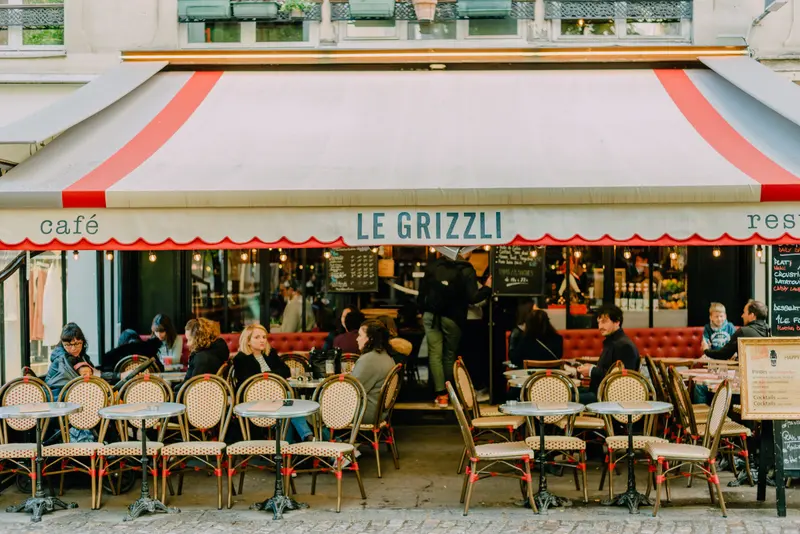
Paris had more than 22,800 terraces covering 244,328 m², according to a report by the regional audit court for Île-de-France covered by Le Bonbon in February 2025, and their number rose 26.5% between 2018 and 2023.5 About 45,000 m² of that area belongs to summer terraces, open from April to October.5
Those summer terraces may be set up from 1 April to 31 October and normally close at 22:00 to keep the peace for residents; from 21 June to 30 August the city has let them stay open until 23:00.6 They may not have heating, air conditioning or sound systems, and misters are allowed only when Météo-France puts Paris on an orange or red heat alert.6 Bookshops, florists and hotels can now apply for one too.6
Un café, noisette, crème and allongé
Un café, also called un express or un café noir, is a shot of espresso, often dark and bitter. A double is two shots, and a café allongé is espresso lengthened with water.7 A noisette is espresso with a spot of cream, named after the hazelnut its color recalls.7
For milky coffee, ask for a café crème; a cappuccino usually costs a little more and tastes about the same, according to Paris by Mouth.7 Milky coffee belongs to breakfast, and an espresso closes a meal after dessert.7 The café au lait, filtered coffee with milk in a large bowl, is mostly made at home, and cafés will usually bring a crème instead.7 Déca turns any of these into decaf.7
The café-tabac
A café-tabac (or bar-tabac) is a café that also holds the tobacco counter. Look for the carotte, a diamond-shaped sign fixed outside in red or in the French tricolor; only the red one may carry the word tabac.8
The tobacco side runs under a management contract with the customs administration, renewed every three years.8 After compulsory training, the buraliste (tobacconist) may also take payments of taxes, fines and bills.8 A tabac may close for at most two days a week, and its opening hours are declared to customs.8
Bistrots, brasseries and when to eat
The difference between a café, a bistrot and a brasserie is mostly food and hours. A bistrot is a small neighborhood place serving simple, traditional cooking, while a brasserie is usually larger and open all day, from morning to night, with continuous service.9 The brasserie has its roots in Alsace, where the first ones served beer brewed on site.9
The word bistrot is said to come from the Russian bystro, "quickly", shouted at innkeepers by Cossacks during the occupation of Paris in 1814, a story the 2025 resolution itself calls possibly legendary.2 From the 19th century the bistrot stood apart from the grand bourgeois café: a ballon de rouge (glass of red) or a petit noir at the counter, cards, the newspaper and politics.2
From Paris terraces to a UNESCO bid
The campaign started in Paris. In June 2018 an association presided by Alain Fontaine announced a bid to have the bistrots and terraces of Paris recognized as intangible heritage, and the deputy mayor for commerce, Olivia Polski, said the city was fully behind it.10
It then widened to the whole country. At the end of September 2024 the Ministry of Culture added "les pratiques sociales et culturelles dans les bistrots et cafés en France" to the national inventory of intangible cultural heritage, after a push by the association Bistrots et Cafés de France.11
That listing is the first step toward a UNESCO nomination, and the association is preparing the file for the ministry to examine.2 France can put forward only one nomination every two years, as the deputies behind the June 2025 resolution pointed out.2
Specialty coffee since 2010
Paris's specialty coffee bars are young. KB, on the corner of rue des Martyrs and avenue Trudaine in South Pigalle, opened in 2010 as Kooka Boora under Nicolas Piégay, a Frenchman back from Australia, according to a 2014 Le Figaro review quoted by Paris by Mouth.12
Coutume opened in 2011 at 47 rue de Babylone in the 7th, with a large roaster in the room. Co-founder Antoine Netien roasted the beans and had just been named best roaster in France by the Comité Français du Café.13 The reviewer who visited that October wrote that Paris had some of the worst coffee in the world and that most French cafés used ultra-pasteurized UHT milk.13
Télescope followed in March 2012 at 5 rue Villedo, near the Palais-Royal. Co-founder David Flynn later left for La Brûlerie de Belleville, while Nicolas Clerc, a former photographer, stayed on; by 2014 the café bought its beans from roasters in England and Sweden.14
Tip. Read the price board outside before you choose where to sit: it has to show the counter and seated prices of the common drinks, so you know what the table will add before you order.3