 By Yannick Schroth
How to order · 5 min read · October 2026
At a Singapore hawker centre or a Malaysian kopitiam, coffee is ordered in code. The base word is kopi, Malay for coffee, and every word added after it changes the milk, the sugar, the strength or the temperature, borrowed from Hokkien, Cantonese or Malay.1 The code is short because the queues are long: at The 1950s Coffee in Chinatown Complex, regulars are advised to have their order memorized before they reach the front.10
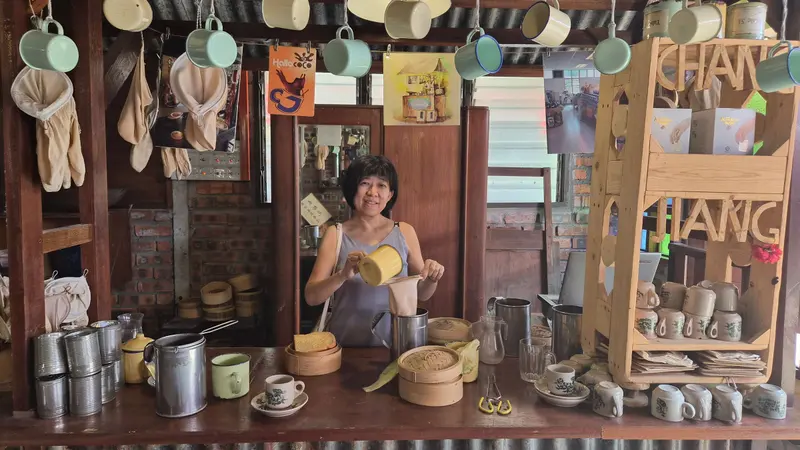
Behind the code is a particular kind of coffee: mostly robusta, roasted with margarine and sugar, strained through a cloth sock and softened with condensed milk.4 Teh, tea, uses the whole vocabulary too.5
The Nanyang roast and the kopi sock
Nanyang means south sea in Mandarin and refers to Southeast Asia.1 Nanyang coffee is the style Hainanese workers developed when they adapted British coffee habits to local taste, and after the Second World War, as the British left, many of them opened kopitiams of their own.3 By the 1950s an estimated 80% or more of Singapore's coffee shops belonged to Hainanese and Foochow owners.3
The beans are mostly robusta, which can hold up to twice the caffeine of arabica and tastes far more bitter.4 Hainanese roasters fried them with margarine and sugar for a caramelized color, then added salt midway and more sugar to offset the bitterness.4 Condensed milk finished the job: in the colonial period it was safer than fresh milk and about 50% cheaper.4
Brewing uses a cloth filter, the kopi sock. European records mention the sock technique as early as the 18th century, and it stayed in use here because metal and paper filters were expensive in Southeast Asia.4 Robusta for kopi is still largely imported from Indonesia and Vietnam.1
Not every stall roasts the old way. Generation Coffee at Tekka Food Centre roasts its own beans without sugar or margarine, blends robusta with arabica, and brews on an espresso machine instead of a sock.10
The kopi code: milk, sugar, strength, ice
Milk comes first. Plain kopi means sugar and condensed milk, kopi-O drops the milk (O is from the Hokkien 烏, black), and kopi-C swaps in evaporated milk with sugar.1 Nobody is sure where the C comes from: it may be the Carnation milk brand or the Hainanese word for fresh.1
Sugar comes next, and the words are mostly Cantonese: siew dai (少底, less base) for less sugar, siew siew dai for very little, gah dai (加底, more base) for extra.1 Kosong, Malay for empty, takes the sugar out.1 In Kuala Lumpur kopitiams, kopi min-tim is coffee made less sweet.2
Strength and temperature close the order. Gao (厚, thick) asks for a stronger brew, poh (薄, thin) for a weaker one, and di lo (直落, straight down) for no dilution at all; peng (冰) means ice.1 Coffee mixed with tea is yuan yang in Singapore and cham, Hokkien for mix, in Malaysian kopitiams.512
Stack the words in that order: base, milk, sugar, ice. Teh-C siew dai peng is iced tea with evaporated milk and less sugar.5 At Heap Seng Leong on North Bridge Road, in the same spot since the 1970s, kopi gu you comes hot with a cold slab of butter on top.10
Teh, teh tarik and tak kiu
Tea follows the coffee rules. Plain teh comes with condensed milk and sugar, teh-O with sugar only, teh-C with evaporated milk, and teh-O kosong is tea with nothing added.5 Teh halia, tea with ginger, is a regular order at Indian Muslim stalls.5
Teh tarik, pulled tea, is poured back and forth between two vessels, which cools it to drinking temperature, mixes in the condensed milk and raises a froth.14 Malaysia treats it as its national drink, both countries claim it, and in Singapore it often comes with prata.14 It goes back to Indian Muslim immigrants who, from the 1870s, ran stalls near rubber plantations selling masala chai to the workers.14
Milo has its own name. In coffee shops it is tak kiu, Hokkien for kick ball; Nestlé introduced the malted drink to Singapore in the 1950s and began making it locally in 1984.6 At The Hainan Story Coffee House, Three Treasures mixes kopi, teh and Milo in one cup.10
How drink stalls and kopitiams work
A kopitiam is a collection of stalls under one roof. Singapore has about 2,000, mostly in residential areas, and most lease out their stalls individually; the owner typically keeps either the drinks stall or a tze char (cooked-to-order dishes) stall.7
Many neighborhood kopitiams take cash and the PayNow and PayLah! payment apps, while traditional open-air shops rarely take cards; chains such as Ya Kun Kaya Toast, Nanyang Old Coffee and Killiney do.8 A packet of tissues on a table means the seat is taken, a habit locals call chope.8
For takeaway, add dabao at the end of the order.5 A takeaway cup can cost 20 cents extra, and most drink stalls waive the charge if you ask for your drink in a plastic dabao bag instead.8
Clear your table afterward. Singapore began enforcing tray and crockery return at hawker centres on 1 September 2021, and at coffee shops and food courts on 1 January 2022; first-time offenders get a written warning, repeat offenders a fine or a court charge.9 The return rate at hawker centres reached 93% in April 2024, up from 65% in August 2021.9
What kopi costs in 2025 and 2026
Hawker stalls charge about half what the kaya-toast chains do. In Eatbook's October 2025 ranking of 15 kopi stalls, a kopi-O cost S$0.90 at Hock Hai Coffee in Hong Lim Food Centre and S$1 at Soon Seng in Alexandra Village, against S$2 at Ya Kun Kaya Toast and S$2.10 at Killiney.10
Prices are creeping up. From April 2026 several coffee-shop operators added 10 to 30 cents a cup, and Kim San Leng, with more than 30 outlets, phased in rises of 20 cents to just under 40 cents from 15 April.11 The chairman of the Foochow Coffee Restaurant and Bar Merchants Association put the rise in operators' costs at about 20% since the start of 2026.11
Across the Causeway, Johor Bahru's newer kopitiams charge more for comfort. In 2026 a Padi Kopi C at Padi Kopitiam cost RM4.50 and the Signature Ice Kopiloco on Jalan Tan Hiok Nee RM4.20, while WonderLicious Kopi in Taman Melodies, air-conditioned under a glass roof, charged RM6.80 for an iced kopi.12
| Drink | Where | Price | Date |
|---|---|---|---|
| Kopi-O | Hock Hai Coffee, Hong Lim Food Centre, Singapore | S$0.90 | October 202510 |
| Kopi | Ah Seng (Hai Nam) Coffee, Amoy Street Food Centre, Singapore | S$1.20 | October 202510 |
| Kopi gu you (with butter) | Heap Seng Leong, North Bridge Road, Singapore | S$1.40 | October 202510 |
| Kopi-C siew dai | The 1950s Coffee, Chinatown Complex, Singapore | S$1.50 | October 202510 |
| Kopi-O | Ya Kun Kaya Toast (chain), Singapore | S$2 | October 202510 |
| Three Treasures (kopi, teh and Milo) | The Hainan Story Coffee House, Tampines Mall, Singapore | S$4.80 | October 202510 |
| Padi Kopi C | Padi Kopitiam, Johor Bahru | RM4.50 | 202612 |
| Iced kopi | WonderLicious Kopi, Taman Melodies, Johor Bahru | RM6.80 | 202612 |
Singapore prices in Singapore dollars from Eatbook's October 2025 ranking; some operators added 10–30 cents a cup from April 2026.1011 Johor Bahru prices in ringgit from a SETHLUI.com guide dated February 2026 and updated in August 2026.12
Malaysian differences: white coffee, cham and the mamak
The code crosses the Causeway mostly intact, with additions. A Kuala Lumpur kopitiam may list kopi-yin-yong-lai, coffee with both condensed and evaporated milk, and cham at roughly equal parts coffee and tea with a little condensed milk.2
Ipoh white coffee, from Ipoh in Perak, is the best-known regional style. The white refers to the roasting method, not to the color of the bean or the drink: the imported beans are roasted light with palm-oil margarine and no sugar, then served with condensed milk.13 Instant 3-in-1 and 2-in-1 mixes of it are sold widely, and some people drink it after dinner.13
Mamak stalls, run by Indian Muslims, are among the main places to drink teh tarik.14 Vendors make it sweet by default, so health-conscious drinkers order teh tarik kurang manis, Malay for less sweet.14 Ginger teh halia is most common in the cooler Cameron Highlands of Pahang.14
Johor Bahru keeps its own heritage names. Restoran Hua Mui, open since 1946, runs seven outlets, and its Tuk Tuk Ice, Milo topped with crunchy Nestum cereal, cost RM7.90 in 2026.12