 By Yannick Schroth
Coffee cultures · 5 min read · October 2026
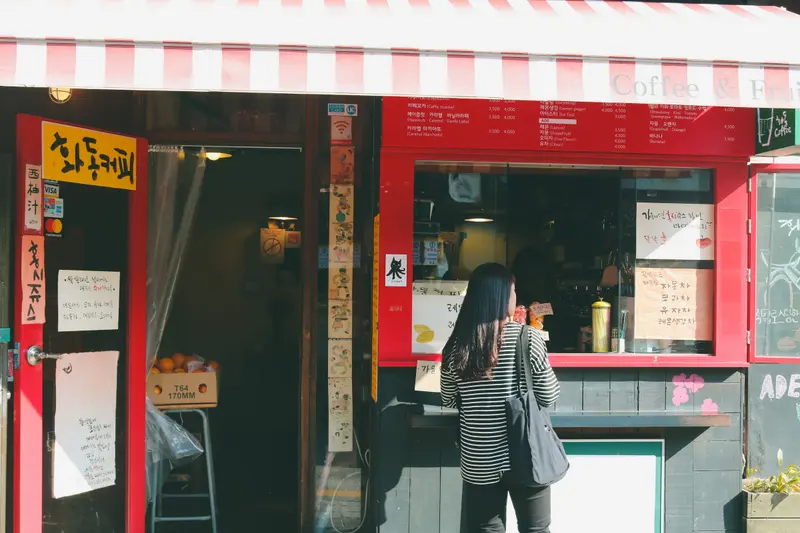
A Korean café visit usually starts at a touchscreen or a counter rather than at a table. You order and pay first, collect the drink yourself when it is ready, and in many places carry your own dishes back afterward.3 The default drink is cold in any season, and its vocabulary is built from first syllables: 아아 (ah-ah) for an iced americano, 뜨아 (tteu-ah) for a hot one.1
The rules around the cup keep moving. Paper cups were nearly banned for drinking in, reprieved in November 2023 and put back on the agenda in August 2026.6 Prices move too: in March 2026 Brew Da Coffee, one of the budget chains, raised its small americano from ₩1,000 to ₩1,300.5
Ordering at the kiosk, the counter or the app
Most cafés take your order in one of three places: at the counter, at a kiosk (키오스크, kioseukeu) near the door, or in the chain's app. Kiosks are part of a wider self-service habit. Korea had more than 9,000 unmanned stores of all kinds in 2024, unmanned cafés among them, and WikiTree's 2026 report on the trend noted that older customers and anyone unused to the screens often struggle with them.3
After paying you may be handed a 진동벨 (jindongbel), a vibrating pager that buzzes and lights up when your drink is waiting at the pickup counter. Starbucks Korea prefers to call out order numbers, which in Korea are alphanumeric codes rather than names; it added coaster pagers in 2024, and only in large or multi-floor stores.2
Ordering ahead is common at the chains. Starbucks Korea's app-based Siren Order, launched in 2014, had passed 500 million orders by 2024.2 In 2025 the same company was preparing touchscreen kiosks for busy branches with many foreign visitors, citing the language barrier, which would make Korea the first country with kiosks in Starbucks stores.2
Ah-ah, tteu-ah and eol-juk-a
Café slang shortens drink names to their first syllables. 아아 comes from 아이스 아메리카노 (iced americano), and 뜨아 from 뜨거운 아메리카노, a hot americano.1 얼죽아 (eol-juk-a) compresses 얼어 죽어도 아이스 아메리카노, roughly "iced americano even if I freeze to death", and names both the preference and the people who keep it up through winter.1
The habit shows in the sales figures. AFP, citing Starbucks Korea, reported in 2023 that during a January cold wave iced americanos outsold hot ones by about 10%.1 The explanations WikiTree gathered in 2026 are practical: strong indoor heating, a taste some people prefer as the ice melts, and a drink that can sit on a desk through hours of work.1
Coffee is also a social verb. 커피 한잔하자 (keopi hanjan haja, let's have a coffee) often means let's take a break or let's talk, with the drink almost beside the point.1
Sizes and prices in 2024–2026
Size names follow the chain. At Starbucks Korea a short holds 237 ml, a grande 473 ml and a venti 591 ml, with the tall in between. In August 2024 the company cut short prices by ₩300, which put a short americano at ₩3,700, while grande and venti drinks rose by ₩300 and ₩600.4
Budget chains keep raising their floor. In March 2026 Brew Da Coffee took its small café latte from ₩2,100 to ₩2,400, and Vanapresso had already moved its iced americano to go up to ₩2,000 in January; its decaf americano went from ₩3,000 to ₩3,500.5 Some Paik's Dabang stores charge ₩2,000 for a hot americano, and seasonal specials at these chains pass ₩5,000.5
The scale explains the price war. By the end of 2025 Mega MGC Coffee had passed 4,000 stores and Compose Coffee 3,000, while Starbucks had 2,114, according to Herald Economy.5
| Item and where | Price | As of |
|---|---|---|
| Short americano (237 ml), Starbucks Korea | ₩3,700 | August 20244 |
| Small americano, Brew Da Coffee | ₩1,300 | March 20265 |
| Small café latte, Brew Da Coffee | ₩2,400 | March 20265 |
| Iced americano to go, Vanapresso | ₩2,000 | January 20265 |
| Decaf americano, Vanapresso | ₩3,500 | March 20265 |
| Hot americano, some Paik's Dabang stores | ₩2,000 | March 20265 |
| Dubai chewy cookie (dujjonku), Seoul cafés | ₩5,000 to over ₩10,000 each | January 202613 |
Prices in Korean won, from The Korea Times (2024), Herald Economy (2026) and Kyunghyang Shinmun (2026).4513
Cups for here, cup charges and tumbler discounts
Say your drink is 매장 (maejang, for here) and it should come in a mug or glass: disposable plastic cups have been barred for customers drinking inside under a rule dating from 2003.6 Paper cups escaped. The government planned to add them to the ban, then withdrew the plan in November 2023 after pushback from small business owners and customers.6
The question returned in 2026. In August the climate and environment ministry said it would restrict paper cups for drinking in, starting with cafés above a certain floor area and widening to smaller ones, with the schedule to be fixed by the end of the year.6 A December 2025 draft went further: from about 2027, cafés would charge separately for disposable cups, at prices owners set and expected to be ₩100–200, and the ₩300 cup deposit would end.7
A tumbler (텀블러, teombeulleo) pays for itself. In Seoul, cafés in the city's personal-cup program take at least ₩500 off a drink served in your own cup, ₩100 or more from the shop and ₩400 from the city, and participating stores are marked on the Smart Seoul Map at map.seoul.go.kr.8 Each can also hold a monthly Tumbler Day with ₩2,500 off per drink, for up to 50 cups.8
One drink each, and how long it lasts
The seat comes with the drink, and many independent cafés post 1인 1음료 (one person, one drink). In July 2026 a party of four adults and a toddler who had ordered about ₩67,100 of sandwiches, soup, cake and three coffees was told to buy a fourth drink; online opinion split between calling the café rigid and saying a posted rule should be followed.10 Owners argue that groups otherwise order little and stay long.10
Long stays have their own etiquette. Since 6 August 2025 Starbucks Korea has barred power strips and desk partitions, restricts monopolizing shared tables and asks customers to take their belongings when they leave a seat for long.9 In a survey of 2,037 young job seekers by the recruiting platform Jinhaksa Catch, 70% studied in cafés at least once a week; the habit they disliked most was holding a seat for hours (29%), and most thought two to three hours per drink was fair.9
Birthday cafés and the end of raccoon cafés
Some concept cafés exist for a day or two. For a K-pop idol's birthday, fans rent a café, decorate it with photos and hand out limited goods, usually first come, first served; small cafés often agree if the merchandise is sold bundled with their drinks.12 The custom began in the early 2000s with fans of TVXQ, and the events cluster near Coex and Gangnam Station, in Hongdae and in Seongsu, close to the entertainment agencies.12
Animal cafés are narrowing. Since 14 December 2023, displaying wild animals outside a registered zoo or aquarium has been illegal, which covers the raccoon and meerkat cafés; existing ones may operate without penalty until 13 December 2027.11 Touching or climbing on the animals was banned straight away, with a ₩1.5 million fine, while dog and cat cafés fall outside the law.11
Dessert queues and bakery trips
Desserts set the queues. In January 2026 the line was for 두쫀쿠 (dujjonku, short for Dubai chewy cookie): kadaif pastry toasted in butter and pistachio cream folded into marshmallow dough, rolled into a ball and coated in chocolate powder, chewier than a cookie and closer to tteok (rice cake).13 Seoul cafés sold them for ₩5,000 to more than ₩10,000 each, sold out soon after opening and posted one-per-customer limits, since the kadaif and pistachios are mostly imported.13
Bakery cafés draw trips of their own. Sungsimdang, founded in 1956 in front of Daejeon Station, had ₩262.9 billion in sales in 2025, and its operating profit of ₩64.3 billion exceeded that of Paris Baguette and Tous les Jours combined.14 Daejeon counted 90.94 million visits that year, 48.1% of them for food.14