 By Yannick Schroth
How to order · 5 min read · October 2026
In Italy the place for coffee is the bar, and the order starts with two words. Ask for un caffè and you get an espresso: dense, dark, without milk, a single dose and served not too hot.1 Almost everything else on the board is a variation on that cup, made with less water or more, with milk or cocoa, shaken over ice or spiked with grappa.
Prices keep climbing. An espresso at the bar averaged €1.29 across 60 provincial capitals in 2026, according to a study by the consumer association Assoutenti and the Centro di formazione e ricerca sui consumi.2 Rome is among the cheaper big cities: Altroconsumo, another consumer group, put the cup there at €1.19 in June 2026, up from €0.95 in 2021.3
At the bar: al banco, al tavolo and the cassa
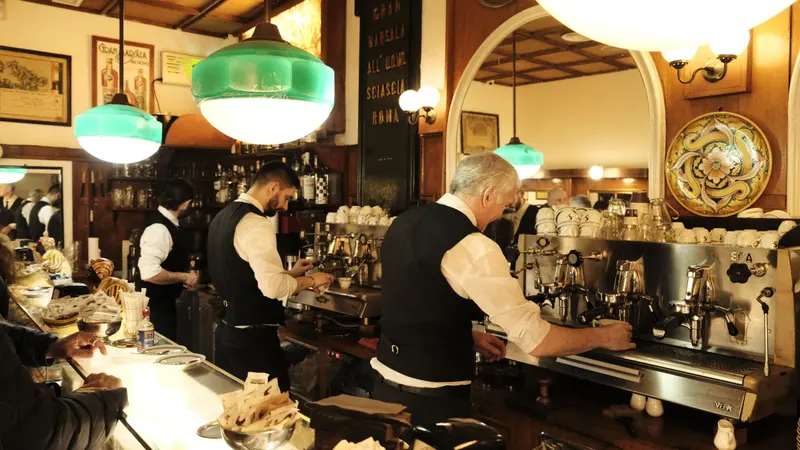
The same cup usually has two prices, one for standing and one for sitting, though bars in small towns and the countryside tend to charge a single price.4 Each bar sets its own gap. In August 2025 I dolci di Patrizio Cosi, a historic pastry shop in central Florence, began charging €1 more per person at its tables: a coffee went from €1.30 at the counter to €2.40 seated, and a cappuccino from €1.70 to €3.5
The owner, Riccardo Camporesi, described the surcharge as a deterrent, saying tables often stayed occupied for 45 minutes.5 If all you want is a quick espresso, stand at the counter and the question never comes up.
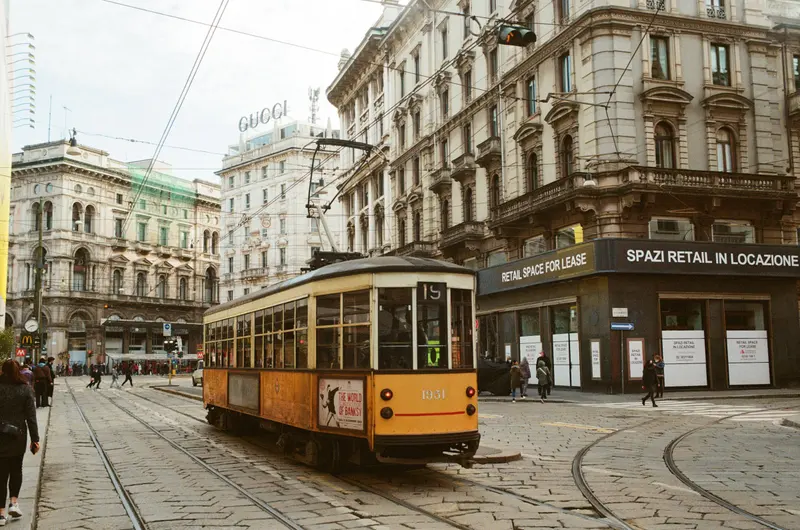
Busy bars often want payment before the coffee. You tell the cassa (till) what you want, pay, and carry the scontrino (receipt) to the counter for the barista.4 A sign reading Si prega di fare lo scontrino alla cassa asks you to do exactly that.4 In Milan this order is the norm: once the coffee is paid for, the barista behind the counter makes it.1
What an espresso costs in 2026
The cheapest cups are in the south and the dearest in the north-east. Of 19 cities compared by Altroconsumo in June 2026, Catanzaro in Calabria was the cheapest at €1.08 and Bolzano the most expensive at €1.51.3 In most of the 19, a cup cost between €1.20 and €1.40.3
Milan, at €1.27, ranked 34th of 60 provincial capitals in the 2026 Assoutenti study, just under the national average.2 The steepest rises came from low starting points: Naples went from €0.90 in 2021 to €1.24, and Pescara from €1 to €1.49.3
| City | Espresso at the bar, June 2026 | June 2021 |
|---|---|---|
| Bolzano | €1.51 | €1.21 |
| Pescara | €1.49 | €1.00 |
| Trieste | €1.44 | €1.14 |
| Turin | €1.38 | not given |
| Venice | €1.36 | not given |
| Bologna | €1.35 | not given |
| Milan | €1.27 | €1.04 |
| Naples | €1.24 | €0.90 |
| Rome | €1.19 | €0.95 |
| Catanzaro | €1.08 | €0.80 |
Counter prices from the Ministry of Enterprises' price observatory, as compared by Altroconsumo and reported by Sky TG24 (October 2026).3
Ristretto, lungo and caffè americano
A ristretto uses the same amount of ground coffee as an espresso but less water, and a lungo is an espresso with a splash of hot water added.1 How full the cup is depends on where you are. In Naples the ristretto, under 30 ml, is the standard measure, and the volume grows the further north you go, according to the coffee expert Mauro Illiano.6
Say caffè americano rather than just americano. The Treccani dictionary defines an americano as an aperitif of vermouth and bitters, lengthened with soda water and flavored with lemon peel.7
Macchiato, cappuccino, caffellatte and marocchino
A caffè macchiato is an espresso with a touch of hot, foamed milk to soften it, and a cappuccino is equal parts espresso, milk foam and steamed milk.1 Order a latte and you will be handed milk, since that is all the word means; ask for a caffellatte or a latte macchiato instead.
The cappuccino is a morning drink. Many Italians have it before 11:00 and never after a meal.1 After lunch the order is an espresso or, at most, a macchiato, as an AGI report on tourists' mistakes at the Italian table put it in July 2026.8
The marocchino is a mini-cappuccino in a small warm glass with cocoa powder, and in Piedmont, where it was born, many bars have their own version, some with a spoonful of Nutella at the bottom.9 Linkiesta traces it to the early 1900s at the long-gone Caffè Carpano in Alessandria, opposite the Borsalino hat factory; the name came from the color of the leather band inside the hats.9 In the south a similar drink may be called a vetrino or espressino.9
Shakerato, corretto and orzo
On a hot afternoon, order a caffè shakerato: espresso shaken with ice and sugar until it develops a light foam.1 A caffè corretto is "corrected" with a splash of grappa, sambuca or another liqueur of your choice.1
Caffè d'orzo is not coffee at all but a drink of roasted, ground barley, naturally free of caffeine.10 To get it, order your usual drink and add d'orzo, as in un macchiato d'orzo.10 Italians took to it widely in the 1930s, when sanctions against the Fascist regime made imported coffee scarce, and it stayed popular through and after the Second World War.10
The glass of water and the sugar
Water with the espresso is normal from Rome southward and much rarer in the north, Luca Iaccarino wrote in a 2018 Dissapore column; he asks for caffè e acqua anyway.11 Drink it first, to rinse your mouth: a Neapolitan barista asked him why anyone would wash away the taste of a good espresso afterward.11 A 2026 explainer by Sale&Pepe notes that in Milan the espresso does come with a small glass of sparkling water.1
Raffaele Ferrieri, who ran a coffee bar near Piazza del Plebiscito in Naples, described the traditional Neapolitan cup in 2012: sugar in a scalding cup before the coffee goes in, so the two give a caramel-like effect.12 He added that European rules requiring sugar to be served in closed sachets make the method impossible in bars.12
Trieste's nero and Naples' caffè sospeso
Trieste renames the menu. An espresso is a nero; the writer Mauro Covacich, quoted by Gambero Rosso, explained that what you order elsewhere as un caffè is called black there.13 A capo is espresso with milk foam, the local answer to a marocchino or espressino: in a cup it is a capo in a, in a small glass a capo in b. A gocciato is coffee with a drop of milk froth.13
Two warnings for Trieste. A standard cappuccino is hard to find, and ordering a caffè macchiato brings a coffee with a small pot of cold milk on the side.13
Naples has the caffè sospeso, a "suspended" coffee: one customer pays for two and the second is kept for someone who cannot afford one.14 Accounts of its origin differ. Some link it to the hard years after the Second World War, while the writer Riccardo Pazzaglia traced it to friends competing to pay at the bar and leaving the extra for the next customer.14 The Rete del caffè sospeso and other associations set up a national day for it, held each 10 December.14
Tip. If the bar has a cassa by the door, pay there before you queue at the counter and keep the scontrino: in Milan the barista starts your espresso only once it has been paid for.1