 By Yannick Schroth
How to order · 4 min read · October 2026
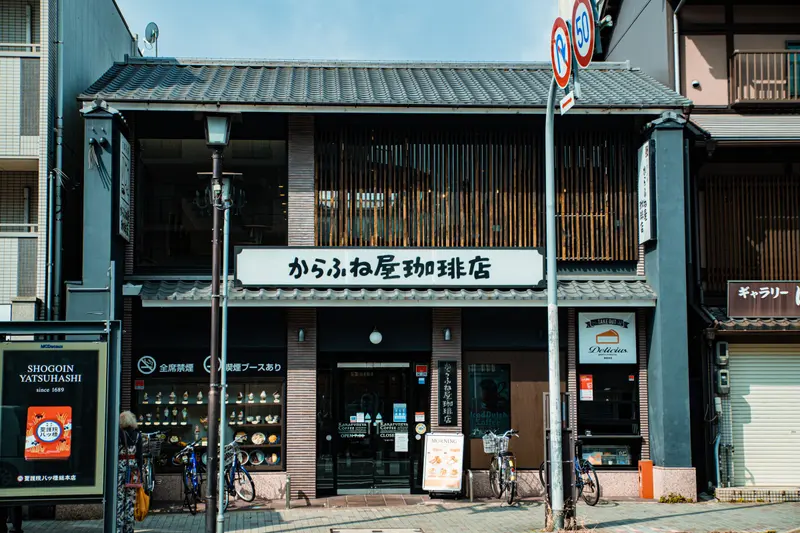
Ordering coffee in Japan takes only a handful of words, and most of them are borrowed from English: burendo, hotto, aisu. The setting decides the rest. A kissaten (喫茶店, an old-style coffee house) is a sit-down room, a chain counter will ask whether you are staying, and a convenience store sells you an empty paper cup that you fill yourself at a machine.39
Prices have climbed quickly. Seven-Eleven raised its regular coffee from 120 to 140 yen in July 2025, blaming record bean prices, and Doutor's small blend reached 300 yen in July 2026.67 At a kissaten, a cup averaged 637 yen across Tokyo's 23 wards in August 2026.8
Burendo, sutorēto, hotto: the menu words
On a coffee-house menu you will meet burendo (ブレンド), the house blend, and sutorēto (ストレート) coffees listed by origin. A UCC Coffee Academy instructor defines a straight as beans from one origin, such as a single farm or cooperative, and a blend as beans from several origins mixed in fixed proportions.1 A blend may carry an origin's name on the label, as with a Blue Mountain blend, only if that origin makes up at least 30% of the beans.1
Temperature comes next, and both words are English loans. Hotto (ホット) means hot, and on its own it also means a hot coffee; Jisho, the dictionary built on the JMdict project, lists both senses.2 Aisu (アイス) is iced. A counter order can therefore be as short as the drink and the temperature, with onegaishimasu (please) on the end.
Sizes, milk and sugar
Size names change from chain to chain. Seven Café, Seven-Eleven's in-store coffee, comes in R (regular) and L (large): since July 2025 a hot R costs 140 yen and a hot L 220 yen, while iced coffee is 140 yen for R and 250 yen for L.6 Doutor prices its blend by size, and on 23 July 2026 the small went from 280 to 300 yen and a small café latte from 380 to 400 yen.7
At a convenience store, milk, sugar and lids sit on a shelf near the coffee machine, and you add your own after the cup is full.3 Gamushiroppu (ガムシロップ) is gum syrup, a liquid sweetener for iced drinks. Burakku (ブラック) is the word for black, no milk and no sugar.
Kissaten, chain counter or konbini machine
The kissaten is the expensive option, and the gap between cities is wide. Japan's Retail Price Survey tracks a cup of coffee at a kissaten, leaving out self-service shops and coffee stands. In August 2026 it averaged 637 yen in Tokyo's 23 wards, 603 yen in Kyoto, 485 yen in Nagoya and 470 yen in Osaka.8
At chain counters the first question after your order is usually whether you are drinking in or taking away, and it is a tax question. Food and drink taken out are taxed at the reduced 8% rate, while anything eaten or drunk in the shop's seating area is taxed at 10%, so staff have to ask.9 Answer tennai (店内, in the shop) or teikuauto (テイクアウト, to go).
Convenience-store coffee reverses the usual order. You pay at the register first and receive a branded cup, place it in the machine and press the button for your drink and size.3 Cups for iced coffee, already packed with ice, wait in the store freezer; you take one to the register to pay before filling it.3
The morning set: toast with your coffee
Mōningu (モーニング), the morning set, means food that comes free with a drink. The Nagoya Meshi Promotion Council, backed by Aichi Prefecture and Nagoya City, describes toast, boiled eggs and similar items handed out with a drink order, and says the further you go into the suburbs of Owari and Mikawa, the more generous the extras get.5 One theory credits coffee shops in Ichinomiya that served toast and peanuts to regulars from the textile trade; another credits Toyohashi.5
At Komeda's Coffee, from opening until 11:00, any drink order comes with a free slice of toast or Komeda's round robe bread, topped with a boiled egg, egg paste or the house sweet red-bean paste, plus a spread such as butter or strawberry jam.4 Extras such as homemade coleslaw (200–260 yen) or yogurt with honey (170–230 yen) cost more, and are sold only until 11:00.4
Cash, cards, IC cards and no tips
Cash no longer dominates. Japan's trade ministry calculates that 58.0% of consumer spending was paid without cash in 2025. Credit cards carried 82.7% of that, code (QR) payments 10.2%, electronic money 3.7% and debit cards 3.4%.10
For a coffee, the transit IC card in your pocket is often the quickest way to pay. Suica, PASMO, ICOCA and the other regional cards are accepted at convenience stores, vending machines and many shops, and work interchangeably across the country.11 Visitors can buy a Welcome Suica from 1,000 yen, valid for 28 days from purchase.11
Don't tip. Japan's national tourism organization says it is not common to tip for service in cafés, bars, restaurants, taxis or hotels.12 The exception it names, a private guide used to foreign customs, does not apply at a coffee counter.12
Smoking sections and what the signs mean
Since 1 April 2020, smoking has been banned inside most restaurants and cafés nationwide, heated tobacco included. A venue may build a sealed smoking room, but you can't eat or drink in it; rooms reserved for heated tobacco are the exception, and food and drink are allowed there.13
Some small existing bars and restaurants are exempt, and they must post a sign at the entrance saying smoking is allowed; staff under 20 may not serve in smoking areas.13 Tokyo's own ordinance is stricter, limiting the exemption to places run by the owner alone or with family, and the city expected about 84% of its roughly 160,000 restaurants and bars to become non-smoking.13
Tip. Before 11:00 at a Komeda's Coffee, order just a drink: the toast and the boiled egg or bean paste come with it at no extra charge.4