الفلمنكي
Al Falamanki
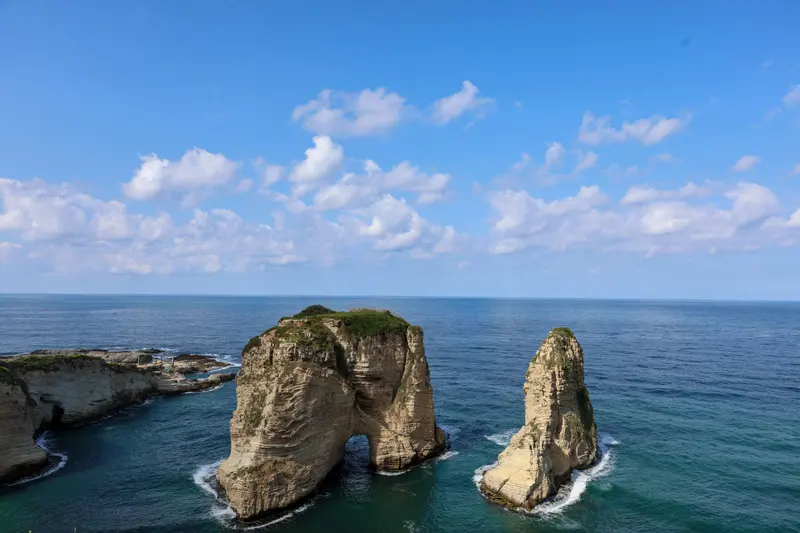
Cliff-top cafés by Pigeons' Rock, Café Rawda's garden on the Manara corniche and Chatila Street's late tables.
Photo: Antoun Boustani, Pexels License
Raouché (الروشة) takes its name from the French rocher, rock, after the two formations off its coast known as Pigeons' Rock.1 It is a residential and commercial district of upscale apartment blocks, restaurants and cliff-side cafés along the Corniche.1 The shore here has also yielded the oldest evidence of human life in the area: flints and simple stone tools, now shown in the AUB Archaeological Museum.1
North of the rock, on the Manara stretch of the corniche, قهوة الروضة (Café Rawda) is one of the last two old seaside coffeehouses still standing, next to Arous al-Bahr.2 Between the two, Chatila Street holds the late tables.
Local tip: Walk north from Pigeons' Rock and watch for the side turning to Café Rawda; the garden sits back from the corniche road.2
Al Falamanki
Petit Café
Dbaibo
Nothing matches those filters here. See all cafés in Beirut.
Rawda is reached by a side turning off the Manara corniche road, away from the traffic noise. Its decor is plain: wooden tables and chairs on the western side of a garden set around an old fountain.2
Families come to eat and pass the time, while writers, artists and journalists come almost daily to write, trade news, play backgammon or smoke argileh (the water pipe).2 The Chatila family, who own it, have turned down investors who wanted the site, though in 2025 they would not rule out a sale.2 In its heyday it received stars such as Abdel Halim Hafez, Warda and Nour El-Sherif, and the writer Ziad Kaj traces its history in his book Maqha al-Rawda, published by Dar Nelson.2
Al Falamanki (الفلمنكي) opened its second Beirut branch by the Raouché rocks in June 2017, with a terrace over the view; the first, opened in 2008, had a garden for 600 people.3 The owners pitch it as a village in the city, with cards, backgammon, Fairuz in the background and manakish (flatbreads) from the oven.4 On Chatila Street it opens daily 09:00–03:30.
Also on Chatila Street is قهوة صغيرة (Petit Café). On Raouché Street, cafe lucy at No. 123 never closes and has Wi-Fi, air conditioning and outdoor seats.
Farther north, where the corniche bends toward Ras Beirut, Kahwat Ras Beirut, Funjan Qahwa, Palace Cafe and You. sit within a few hundred meters of each other. Kalei Coffee Co. has a Ras Beirut branch with courtyard seating, much calmer than its Mar Mikhael house, and Starbucks has branches nearby.5
In 2001 the corniche's 76 cement benches were replaced with benches faced in colored ceramic by the artist Lena Kelekian, who also designed a giant chessboard on the widest stretch of sidewalk, on Avenue de Paris.6
The corniche grew out of the Avenue des Français, built along the seafront under the French Mandate.6 Today it draws walkers, joggers and cyclists, and some of its palm trunks are still pocked with bullet holes from the civil war.6 In the afternoon and evening the prevailing wind blows in from the Mediterranean, and at night it reverses and blows out to sea.7
In Raouché & Manara, also browse: Wi-Fi Open late Outdoor seating
Café Rawda (قهوة الروضة), reached by a side turning off the Manara corniche road, is one of the last two old seaside coffeehouses in Beirut, beside Arous al-Bahr. It has wooden tables in a garden around an old fountain, where regulars play backgammon or smoke argileh.
Al Falamanki on Chatila Street in Raouché opens daily 09:00–03:30, with cards, backgammon and manakish. Cafe lucy at No. 123 Raouché Street never closes and has Wi-Fi, air conditioning and outdoor seats.
Al Falamanki opened its Raouché branch, by the Pigeons' Rock, in June 2017, with a terrace facing the view. It was the brand's second branch in Beirut; the first opened in 2008 with a garden for 600 people.
Free listings are free for good. A featured page gives you photos, a menu and your own URL, in your café's own design, for less than a coffee a day.