 By Yannick Schroth
How to order · 4 min read · October 2026
A Thai coffee order has three parts: the drink, hot or iced, and how sweet. Leave out the last one and a street stall will make it the way it always does, which on most carts means sugar and ice.7 Two words, wan noi (หวานน้อย, a little sweet), fix most of that.1
Prices run from 29 baht for an iced coffee in a Bangkok mall to as much as 250 baht for a premium single-origin pour-over at a Chiang Mai roaster.79 In between is a growing group of specialty cafés that keep a cup under 100 baht.10
Kafae boran, oliang and the cloth filter
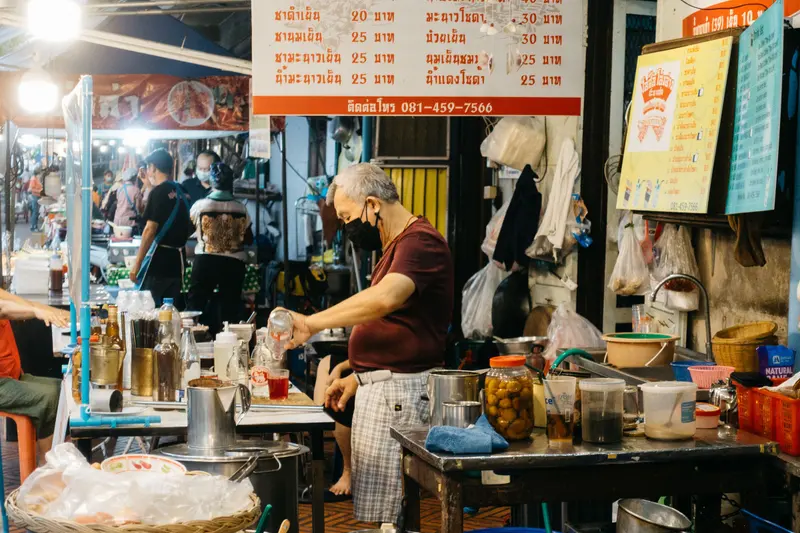
Kafae boran (กาแฟโบราณ, old-style coffee) is a way of brewing more than a single drink. The ground coffee is often stretched with other roasted ingredients, such as tamarind seeds or corn, which lowers the cost and changes the taste.4 The grounds sit in a cloth filter, hot water goes through, and the brewer may pour the coffee back through the same filter several times to make it stronger.4 It is sweetened with sugar, sweetened condensed milk or unsweetened evaporated milk, and served hot or over ice.4
Oliang (โอเลี้ยง) is the iced black version.3 Its blend is robusta ground with brown sugar plus grains and seeds, from cardamom to soybeans and sesame, steeped in a tungdtom, a cloth sock on a metal ring with a handle, for about ten minutes.3 Milk and syrup can go in afterward, to taste.3 The same counters sell oyua (โอยั๊วะ), hot black coffee, and yok lor (ยกล้อ), black coffee with evaporated milk.4
Thai iced coffee, condensed milk and cha yen
Ask for kafae yen at a stall and expect sweetened condensed milk and a good deal of sugar unless you say otherwise; that is the standard Thai way to serve coffee.5 At a modern café, the same word order works for espresso drinks: name the drink, then add ron (ร้อน, hot) or yen (เย็น, iced), as in latae yen for an iced latte.1
Cha yen (ชาเย็น, literally cold tea) is Thai iced tea. Its orange color comes from ground tamarind seed added while the tea is cured, or these days from artificial coloring.5 It is always very strong and very sweet, usually finished with a dash of condensed and evaporated milk; ask for cha dam yen to get it without milk.5
Sweetness levels, ice and cup size
Sweetness has its own small vocabulary. Wan pakati (หวานปกติ) is normal sweetness, wan noi is a little sweet, mai wan (ไม่หวาน) is not sweet, and mai wan loei (ไม่หวานเลย) is not sweet at all.1 Staff may ask wan pakati mai, normal sweetness?, before they start, and mai sai nam tan (ไม่ใส่น้ำตาล) means no sugar added.1
The same mai sai, don't add, works for anything else you want left out. Nam khaeng (น้ำแข็ง) is ice, so mai sai nam khaeng asks for none, and nam khaeng noi for less.2 Cups come as kaeo lek, kaeo klang and kaeo yai, small, medium and large; kaeo is also the counting word for drinks, so nueng kaeo is one cup.1
Street carts, malls and specialty cafés
Street coffee is not always the cheapest in Bangkok. A September 2026 Bangkok coffee guide found a mall iced coffee at Siam Paragon for 29 baht and food-court drinks at Gaysorn Amarin for 40–60 baht, while a vendor near Ekkamai pulled iced americanos for 50 baht.7 The same guide finds that above 150 baht, price stops tracking quality.7
In Chiang Mai, a basic iced coffee at a local spot costs 30–50 baht and a specialty cup 60–120 baht, according to a guide updated in September 2026.8 Cheaper specialty coffee is where the growth is: in LINE MAN Wongnai data from 2025, sales of specialty cups priced under 100 baht rose 46% at existing shops in and around Bangkok and 19% in the provinces.10
Ordering northern arabica in Chiang Mai
Chiang Mai's roasters buy from hills that are low by arabica standards: the northern highlands average about 1,000–1,200 m, against the 1,800 m where the plant grows naturally.12 Coffee reached them in the 1970s through the Royal Project as a replacement for opium, and it is farmed by Akha, Hmong, Lahu, Lisu, Yao and Karen communities.12
At the roasters, a filter coffee runs about 100–180 baht and an espresso 80–120 baht as of 2026.9 Akha Ama sources through an Akha community in Mae Chan Tai, in Chiang Rai province, while Terroir uses coffee from Doi Inthanon.9 Hmong Doi Pui Family Coffee serves coffee grown and roasted by its own Hmong community.8
If a filter menu lists a process next to the farm, it may be one developed in Thailand. Thai processors have built four of their own, semi-carbonic maceration, yeast, Coffivino and Brixter, which between them have won 13 international awards.12 Farms keep placing in competition too: a grower from Nan Province came third in the natural category of the 2024 Cup of Excellence Best of Thailand.12
Paying, service charges and tipping
Electronic payment has overtaken cash at coffee shops: Department of Business Development figures reported in August 2025 put e-payments at more than half of all payments to coffee businesses.11
Tipping is not a Thai habit. Locals sometimes leave the change at restaurants, though even that is rare, and Wikivoyage advises never giving more than 50 baht where you do tip.5 Sit-down restaurants may add a service charge, often around 10%, which is not clearly mandated by law; with one on the bill, an extra tip is optional, and at street stalls none is expected.6
Value-added tax stays at 7% including local tax: in August 2026 the cabinet endorsed extending the reduced rate, due to expire on 30 September 2026, by another year.13