 By Yannick Schroth
Coffee cultures · 6 min read · October 2026
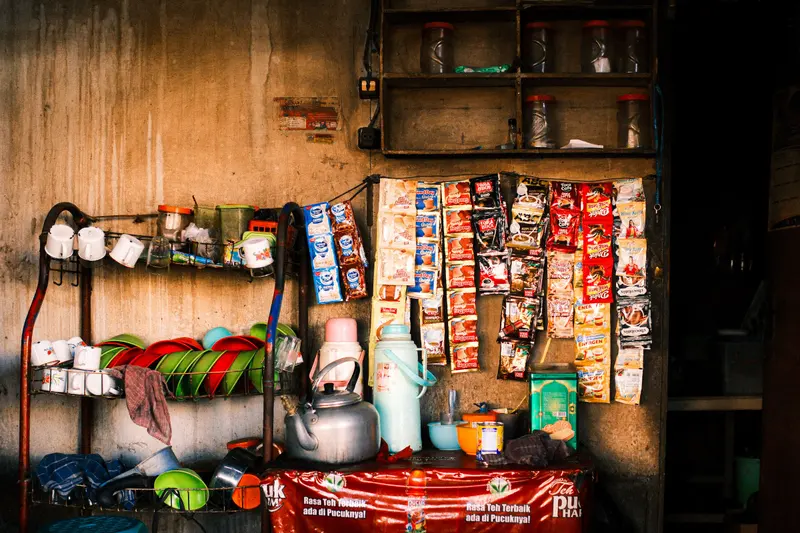
The traditional Indonesian cup is made the simplest way: hot water poured onto ground coffee in a glass, often with sugar, then left until the sludge sinks.12 It is served at the warung, the small family-run stall or shop, and in the countryside a host will more often pour coffee for a guest than tea.2
Since 2015 a second habit has grown beside it: es kopi susu, iced milk coffee sweetened with liquid palm sugar.34 One chain built on that drink, Kopi Kenangan, counted 1,351 outlets by the end of June 2026.5 A survey by AEKI, the coffee exporters’ association, had already found domestic consumption up 36% between 2010 and 2014.2
Kopi tubruk: the unfiltered glass
Tubruk is Javanese for a collision, and the name describes the method: boiling water meets the grounds directly in the glass, with no filter between them.1 It is counted as the oldest way of brewing coffee in Indonesia, common first in Java and Bali and carried across the archipelago as people moved. CNN Indonesia credits Middle Eastern traders with bringing it during the colonial period.1
The Jakarta Post’s basic recipe is two teaspoons of coffee and two of sugar, the sugar optional, usually with beans from Java and Bali.2 For a better glass, CNN Indonesia recommends a medium grind and water at 93–96°C. Wait two to five minutes for the grounds to sink, stir, then let it rest again, because a freshly poured tubruk tastes bitter.1
Habits vary by region. In East Java many drinkers tip the coffee onto the saucer to cool it before sipping.2 In Yogyakarta and Central Java the glass comes with a meal or a snack at the warung, where customers of every generation sit and talk over it.2
Kopi joss: a live coal in Yogyakarta’s coffee
Yogyakarta’s signature cup is sweetened black coffee with a burning piece of charcoal dropped in just before serving.6 It belongs to the angkringan, the street carts and stalls of the city, rather than to cafés.6
The recipe began as a workaround. Kopi kothok, the drink that railway workers from East Java kept requesting near Tugu station, is made by boiling coffee, sugar and water together in one pot.6 The stallholder, Lik Man, did not make it, so he put a glowing coal into the glass instead; customers took to it, and other vendors copied the trick.6
Angkringan Lik Man sits near Tugu station on a road lined with angkringan, and it is an evening stall: the provincial tourism office listed it from 18:00 to midnight in 2019, with food and drinks from Rp1,000.7 Next to the coffee you will find nasi kucing, a small portion of rice wrapped in banana leaf with tempeh or anchovies, and skewers of quail egg, chicken or intestine.7
Warung kopi and Aceh’s sanger
The coffee shop is a fixture of Banda Aceh, at the northern tip of Sumatra, and they serve Aceh Gayo, the arabica grown in the highlands of Central Aceh.2 Their house milk coffee is sanger. Kompas described it in 2013 as three parts coffee to one part sweetened condensed milk, the coffee strained through a cloth filter by a barista saring (filter barista) rather than pulled from an espresso machine.8
Nearly every warung kopi in the city serves sanger, and regulars drink it hot or iced.8 The name comes with a student story. Sarbaini, a former filter barista at Warung Kopi Jasa Ayah in Solong Ulee Kareng, told Kompas that sanger appeared around 1990, when students short of money asked for coffee with a little milk.8
The students asked the owners for sama-sama ngerti, “we both understand”, and the phrase was shortened to sanger. Because they paid little, the milk filled only about an eighth of the glass, topped with filtered coffee that the barista pulled from a height.8 A glass cost Rp8,000 in 2013.8
Es kopi susu gula aren and the kopi kekinian chains
The drink behind the newer chains is es kopi susu gula aren: iced coffee with fresh milk and gula aren (palm sugar) in place of the condensed milk of older kopi susu. The style is called kopi kekinian, literally “present-day coffee”.4 Starbucks, which arrived in 2002, is credited by many urban drinkers with starting the modern coffee-shop culture.2
Tuku, which opened its first shop in Cipete, Jakarta, is widely named as the pioneer of palm-sugar milk coffee from 2015, although the company prefers to call itself an explorer.3 Its founder, Andanu Prasetyo, tried supermarket and market sugars before borrowing the liquid palm sugar that cendol sellers use in their iced dessert drink.3 Another account credits a shop called Kopi Temu with the same drink in 2015.4
Tuku’s Kopi Susu Tetangga (“the neighbor’s milk coffee”) sells fast enough to be pre-mixed in large containers each day. In 2023 its Bintaro branch sold up to 2,000 glasses a day, and the 42 branches together 42,000–50,000 cups.3
Kopi Kenangan opened in 2017 in a 12 m² space near Menara Standard Chartered in South Jakarta and priced its first drink at Rp15,000; its founders judged a Rp40,000 cup unreasonable for the market.9 The chain had 1,173 outlets at the end of 2025 and added 178 in the first half of 2026.5 Fore Coffee had 217 outlets in 43 cities by September 2024, with beans from Aceh Gayo, Toraja and West Java.10
| Drink | Where | Price | Year |
|---|---|---|---|
| Sanger | Warung kopi, Banda Aceh | Rp8,000 a glass | 20138 |
| Food and drinks at an angkringan | Angkringan Lik Man, Yogyakarta | from Rp1,000 | 20197 |
| First Kopi Kenangan drink | South Jakarta | Rp15,000 | 20179 |
| Coffee at Tuku | Greater Jakarta and Surabaya | Rp18,000–34,000 | 20233 |
| Mini coffee at Tuku | Greater Jakarta and Surabaya | Rp10,000 | 20233 |
Prices in Indonesian rupiah, as reported in the year shown.
Gayo, Toraja, Kintamani and Java: the origins on the menu
Gayo coffee grows on the hills around Takengon and Lake Laut Tawar in Aceh, where it was first planted in 1924.11 It is a registered Geographical Indication, Kopi Arabika Gayo, in Indonesia, the European Union and the United Kingdom, and it tastes higher-toned and lighter-bodied than the Lintong and Mandheling coffees grown further east.11
Much of that character comes from giling basah (wet hulling). Farmers pulp the cherries, hold the mucilage-coated beans for up to a day, wash them and sell them only partly dried.11 The method is standard on Sumatra, Sulawesi, Flores and Papua, and Sumatran green beans have a bluish tint, put down to the processing and to iron-poor soil.11 In Sulawesi, Toraja coffee is grown alongside the Enrekang district and traded through the town of Kalosi; seven larger estates grow about 5% of the island’s coffee and smallholders the rest.11
Java’s arabica now comes mainly from the Ijen Plateau at the island’s eastern end, above 1,400 m, where the five largest estates, Blawan, Jampit, Pancoer, Kayumas and Tugosari, cover more than 4,000 hectares. Some estates age part of the crop for up to five years in burlap sacks and sell it as Old Java or Old Brown.11 Many of Kintamani’s growers in Bali belong to subak abian farming groups, which follow Tri Hita Karana, the Hindu principle of harmony with God, other people and the environment.11
Kopi luwak and the civet cages
Kopi luwak is made from beans that have passed through the common palm civet, a shy, nocturnal animal that eats ripe coffee cherries but cannot digest the seeds.12 Tony Wild, who as coffee director of Taylors of Harrogate imported the first kilogram into the West in 1991, wrote in 2013 that genuine wild kopi luwak had become practically impossible to find.12
Most of it comes from caged civets instead. Wild estimated world output at 50 tonnes or more a year, against the 500 kg often claimed in marketing, and cited one Indonesian farm producing 7,000 kg a year from 240 caged animals. Retail prices then ran at about US$200–400 a kilo, and he launched a campaign to end the trade he had helped start.12
The clearest evidence comes from Bali’s tourist plantations. Researchers from World Animal Protection and Oxford University’s Wildlife Conservation Research Unit scored the housing of 48 wild-caught palm civets at 16 plantations on eight factors, including mobility, hygiene, food, water and social contact.1314 Every plantation failed basic welfare requirements.14
The team found cages it compared to rabbit hutches, many soaked in urine and droppings, and civets standing and sleeping on wire mesh that causes sores.14 Many had no clean water, some were thin from a diet of coffee cherries alone, and the nocturnal animals were exposed to daytime traffic and tourist noise.14 The authors note that these harms do not apply to the traditional collection of droppings from wild civets.13
Tip. If black kopi is too strong for you in Banda Aceh, order a sanger: three parts cloth-filtered coffee to one part condensed milk, served hot or iced at almost any warung kopi in the city.8