 By Yannick Schroth
Coffee cultures · 4 min read · October 2026
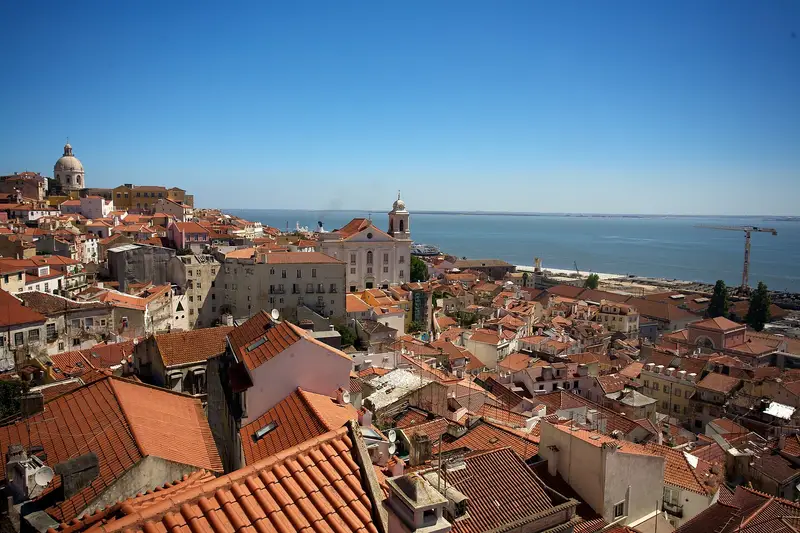
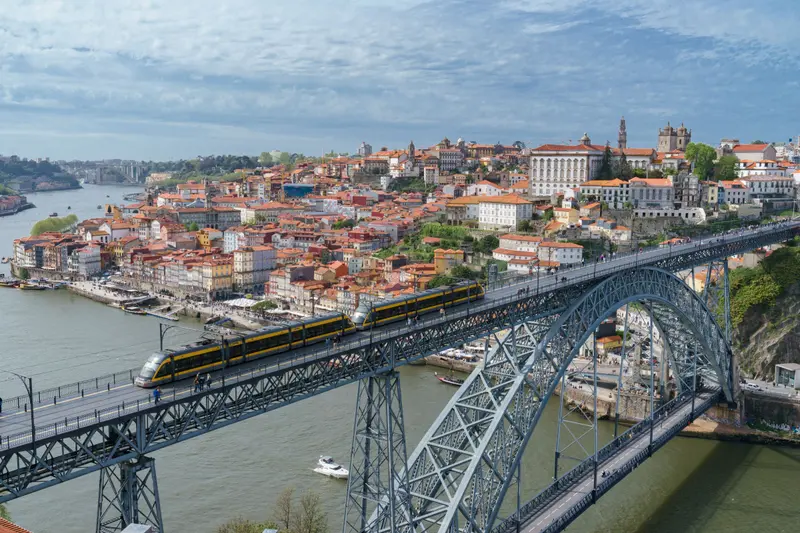
Coffee in Portugal is ordered in two or three words and drunk in a few minutes. The base is always an espresso; a dozen or so terms then set how much water goes in, how much milk, and whether it arrives in a cup or a glass.13 Some of those words change between Lisbon and Porto.1
The settings matter as much as the drink: the pastelaria, where coffee comes with something from the pastry case, and the grand cafés of Chiado, Rossio and Rua de Santa Catarina. In Lisbon, a bica under €1 had become hard to find by late 2025.5
Bica and cimbalino
Bica literally means spout, and in Lisbon it means an espresso.2 Porto's word for the same cup, cimbalino, comes from Cimbali, the Italian maker of espresso machines.14 Neither is required: plain um café gets you an espresso anywhere in the country.1
A Brasileira in Chiado holds a place in the drink's Lisbon history. Adriano Telles opened it on Rua Garrett in 1905 to sell coffee from Minas Gerais, which few Lisbon households then liked. Anyone who bought a kilo of ground coffee, at 720 réis, got a cup free, and the shop became the first to sell the bica, a small cup of strong coffee.9 Telles had opened his first shop in Porto two years earlier.9
Galão, meia de leite, pingado and the rest
Most variations adjust milk or water, not the coffee. Milk runs from a single drop in a pingado to equal parts in a meia de leite, and more than that in a galão, which comes in a glass.1 The galão is a morning drink and an afternoon one, popular again around 16:00–17:00.3
Water works the same way. A standard café is not filled to the top, so add cheio for a fuller cup; curto makes it shorter, and an italiana is the shortest of all, close to a ristretto.13 Porto has its own names here too: the lengthened espresso Lisbon calls an abatanado is an americano in the north.3
Two orders change more than strength. Café com cheirinho comes with a splash of bagaço, the strongest Portuguese spirit, and café sem princípio skips the first drops from the machine, the strongest part, for a lighter and less bitter cup.1 For something savory alongside, the counter name for a toasted ham-and-cheese sandwich is tosta mista.1
| Order | What arrives |
|---|---|
| Um café / uma bica / um cimbalino | An espresso; bica in Lisbon, cimbalino in Porto and the north1 |
| Café cheio / café curto | An espresso with more water, or with less13 |
| Italiana | A very short espresso, close to a ristretto13 |
| Pingado | An espresso with a drop of milk1 |
| Garoto | A milder small coffee, roughly half espresso and half milk3 |
| Meia de leite | Coffee and milk in equal parts12 |
| Galão | Coffee with more milk than a meia de leite, in a tall glass1 |
| Abatanado | An espresso lengthened with hot water; americano in Porto13 |
| Carioca | A weak coffee made by running water through grounds already used for an espresso2 |
| Café sem princípio | An espresso without the first drops from the machine, lighter and less bitter1 |
| Café com cheirinho | An espresso with a splash of bagaço, a strong Portuguese spirit1 |
Terms vary by region; um café works everywhere.1
Counter, table and terrace prices
Where you drink can change what you pay. A café may charge different prices depending on where it serves you, including a surcharge for the esplanada (the outdoor terrace), as long as the price list shows it before you order.4 Price lists must be in Portuguese and posted both at the entrance and inside. A surcharge that turns up only on the receipt can be disputed, and if that fails, written up in the Livro de Reclamações, the official complaints book.4
Prices climbed through 2025. DECO, the consumer association, found that a 250 g pack of ground coffee cost €5.13 in November 2025, against €3.81 on 1 January, a rise of 35%.5 In December 2025, ProVar, the national restaurant association, expected the price of a bica to stay unchanged through 2026.6
Specialty bars price by origin and size. In 2017 Porto's Café Progresso, on Rua Actor João Guedes, charged €0.80 for its house espresso and €1.80 for a 200 ml Ethiopian long black.14
The pastelaria and the pastel de nata
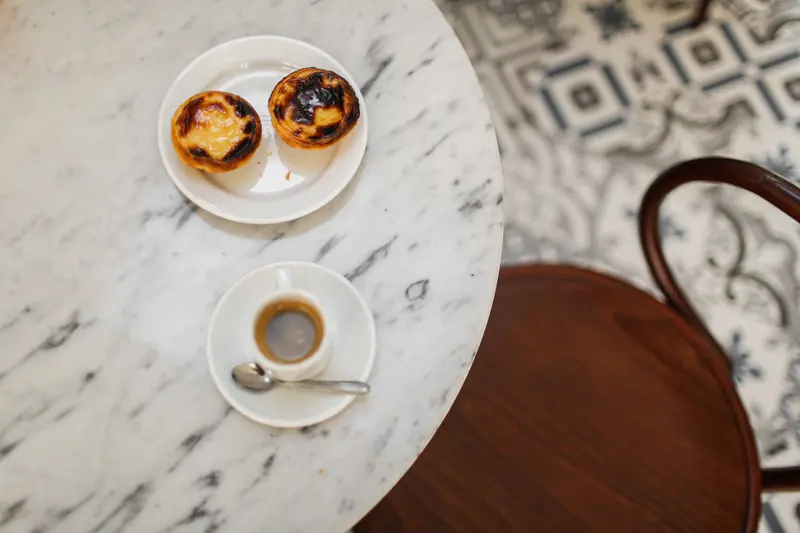
The pastelaria is where much of Portugal's coffee is drunk. It sells cakes, pastries and savory snacks, and many also serve lunch, dinner and alcohol; quality varies widely from one to the next.3
The pastel de nata, a custard tart in flaky pastry, traces back to the Jerónimos Monastery in Belém. Convents used egg whites to starch religious habits, and the leftover yolks went into sweets.8 After the religious houses were shut in 1834, someone from the monastery sold the pastries in a shop attached to a sugar refinery next door. Belém was then well outside Lisbon, reached mostly by steamboat, and in 1837 the refinery began baking Pastéis de Belém.7
The recipe is still passed only to master bakers who work in a secret room.7 The tart can be dusted with cinnamon, and in a 2011 public vote it was named one of Portugal's Seven Wonders of Gastronomy.8
Delta, Nicola and the grand cafés
Delta Cafés started in Campo Maior with three workers and two 30 kg roasters. Its founder, Rui Nabeiro, born in 1931, built it into a group with about 3,000 employees and some 47,000 direct retail clients; he died in 2023.12 Lisbon's Café Nicola on Rossio counted the poet Bocage as its best-known regular, and its Art Deco look dates from a 1935 rebuild designed by Raul Tojal.11
A Brasileira's interior, fitted out by Manuel Joaquim Norte Júnior in 1908, was redesigned by José Pacheco in 1922, and its walls changed with its customers. From 1925 it showed work by painters who drank there, José de Almada Negreiros among them; that collection was sold in 1969 and replaced in 1971 with new paintings by artists such as Nikias Skapinakis.9 Fernando Pessoa's bronze has sat outside since 1988, though his own favorite was Martinho da Arcada, on Praça do Comércio since 1782.9
Porto's Majestic opened in December 1921 under the name Elite and became the Majestic in 1922.10 The writers José Régio and Teixeira de Pascoaes and Leonardo Coimbra were regulars.13 Like other grand cafés it declined from the 1960s; it was listed as a property of public interest in January 1983 and reopened after restoration in July 1994.10
Tip. In Porto, ask for an americano rather than an abatanado, and add cheio if you want the cup filled to the top.3