 By Yannick Schroth
Coffee travel · 5 min read · October 2026
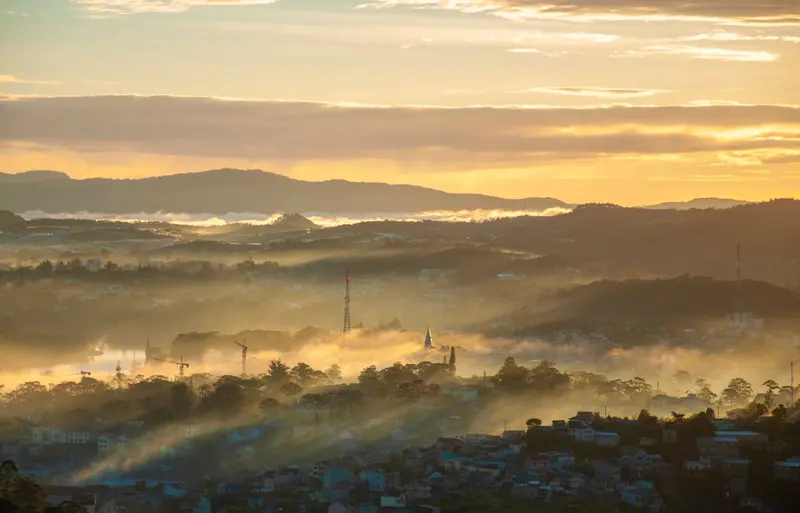
Vietnam's coffee country is the Central Highlands, and a visit splits into two trips. Around Đà Lạt, arabica grows on cool slopes; Cầu Đất, the best-known growing area, lies at 1,600–1,650 m.1 On the plateau to the north, Đắk Lắk province, with Buôn Ma Thuột as its center, grows around 30 percent of the country's coffee on basalt soil at 400–800 m and is known for its robusta.4
The two make different visits. Đà Lạt's are farm-scale, such as a cooperative of K'Ho families, one of Vietnam's 54 ethnic groups, that walks visitors through the process from cherry to cup.2 Buôn Ma Thuột has the set pieces: a coffee museum built by Trung Nguyên, the company founded in the city in 1996, and a coffee festival whose next edition opens in December 2026.1076
Cầu Đất: arabica above Đà Lạt
Cầu Đất lies in Xuân Trường ward, about 25 km from central Đà Lạt, roughly 100 m higher than the city's average altitude.1 The French founded the first tea station in Indochina here in 1927, and the area was where they first trialed tea and coffee on the plateau.1 Arabica has grown on these slopes since the 1920s.1
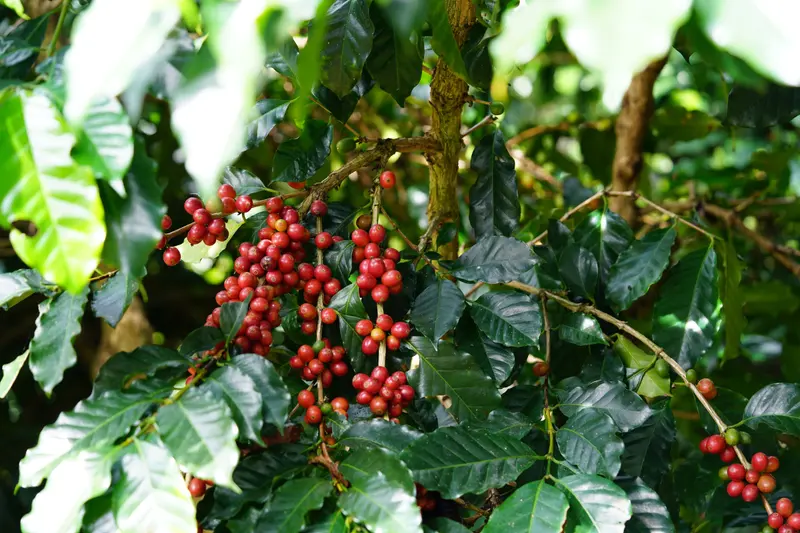
The Công bằng Cầu Đất cooperative, công bằng meaning fair, was founded in 2015 with 30 members and joined the international Fairtrade system in 2016.1 Its certified 46 ha are planted with three arabica lines: Typica, Bourbon (locally Bòn Bon) and Catimor.1 Visitor numbers in the area have risen sharply in recent years.1
K'Ho coffee on Langbiang mountain
The K'Ho farmed the land around Langbiang mountain before the French arrived, and the colonists enlisted them to tend the first coffee trees.2 In the 1940s a K'Ho farmer, Brai Co Lieng, got hold of arabica seed and planted it on his family's land at the foot of the mountain.2 His descendants now run K'Ho Coffee from Bonneur'C village, about 10 km from Đà Lạt.2
The half-day workshop follows at least 15 steps from tree to cup.2 Visitors taste the fruit, learn the washed, natural and honey methods, and watch beans hand-picked, wet-milled, fermented and dried for up to 20 days, then hulled with a wooden mortar and pestle, winnowed and sorted by hand.2 It ends with roasting, grinding, cupping and brewing your own coffee.2
The farm's coffee scores 84 to 89 in cupping tests, inside the specialty range.2 Its garden café and gift shop open 08:00–16:00, Monday to Saturday.2
Buôn Ma Thuột, the robusta capital
Buôn Ma Thuột is known as Vietnam's coffee capital, and in June 2026 National Geographic put it on its Best of the World 2026 list of culinary destinations.4 Buôn Ma Thuột Coffee is a geographical indication protected in more than 30 countries.4 Trung Nguyên was founded here by Đặng Lê Nguyên Vũ and Lê Hoàng Diệp Thảo.10
The company also built the World Coffee Museum (Bảo tàng Thế giới Cà phê), which opened on 23 November 2018.7 The architects, a21studĩo, drew its form from the longhouses of the Ê Đê and other highland peoples, and the building covers nearly 2 ha.7 Many of its more than 11,000 artifacts came from the Kaffeemuseum Burg in Germany.7
As of December 2024 the museum opened 07:00–17:45 daily, with tickets at 150,000₫ for adults and 40,000₫ for children, a cup of specialty coffee included.8 It stands on Nguyễn Đình Chiểu street, inside the Thành phố Cà phê (Coffee City) development.8
About 2 km north of the center, Ako Dhong is an Ê Đê village settled in 1956, with stilted longhouses and 26 ha of coffee; Arul Café there draws visitors and residents alike.9 Further out, farm-to-cup trips let visitors pick, roast and brew their own coffee, and Ê Đê families show how they roast it by tradition.4
The Buôn Ma Thuột Coffee Festival
The Lễ hội Cà phê Buôn Ma Thuột (Buôn Ma Thuột Coffee Festival) has been held every two years since 2005.5 Its ninth edition, from 9 to 13 March 2025, drew about 120,000 visitors; most of the city's hotels were full, and hundreds of cafés gave coffee away.5
The tenth edition is planned as a long season, from 15 December 2026 to 4 April 2027, with the main events in March and early April.6 Organizers aim for 1.3 million visitors.6 The draft program includes a Vietnam Specialty Coffee Week, a farmers' contest, a Buôn Ma Thuột Coffee Street and an international conference titled Buôn Ma Thuột, Robusta Capital of the World.6
Events will also spread beyond the city, to Buôn Đôn, Lắk Lake, Ea Kao Lake and the coastal city of Tuy Hòa.6 The dates were still awaiting final government approval in October 2026.6
Weasel coffee and caged civets
Cà phê chồn (weasel coffee) is made from coffee cherries that civets have eaten and passed, and Đà Lạt has farms that produce it.12 In 2013 VnExpress reported on one at Trại Hầm that kept about 120 civets in enclosures, fed each around 200 g of cherries a day, and sold the coffee at 20 million₫ a kilo, or 200,000₫ a cup.12
The best evidence on welfare comes from Indonesia. A 2016 study in the journal Animal Welfare, led by Neil D'Cruze of Oxford University's Wildlife Conservation Research Unit with World Animal Protection, assessed 48 caged civets at 16 plantations on Bali.11 It found small wire-floored cages, little natural light, built-up waste, diets mostly of coffee cherries and, for many animals, no clean water; all had probably been caught in the wild.11
The researchers' advice is plain: do not visit a plantation where you can see civets in cages, since beans from wild and caged animals are hard to tell apart.11 Trung Nguyên also sells Legendee, made with synthetic enzymes that imitate the civet's digestion; civets in Vietnam are endangered through overhunting.10
Getting to Đà Lạt and Buôn Ma Thuột
Flights reach Liên Khương airport, about 30 km south of Đà Lạt, in 50 minutes from Ho Chi Minh City and 1 hour 50 minutes from Hanoi.3 The drive into town takes 40–50 minutes; as of 2026 the airport shuttle costs 60,000₫ and a Grab or Xanh SM car 350,000–450,000₫.3 Fog occasionally closes the airport in the November–March dry season.3
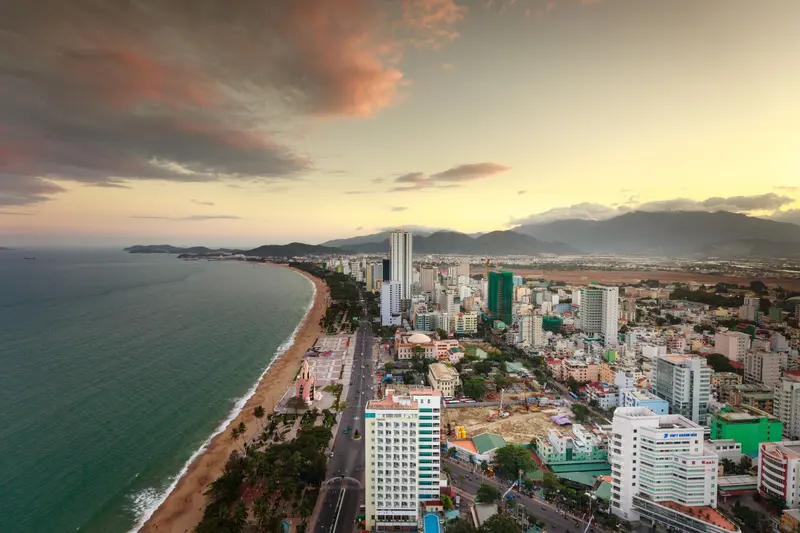
Sleeper buses cover the roughly 300 km from Ho Chi Minh City in 6–8 hours, and buses take about 3.5 hours over the 140 km from Nha Trang.3 Buôn Ma Thuột is about an hour's flight from Ho Chi Minh City on Vietnam Airlines or VietJet; by sleeper bus the 322 km take between 8 hours 45 minutes and 9.5 hours.14
| Route | Mode | Time | Fare (2026) |
|---|---|---|---|
| Ho Chi Minh City to Đà Lạt | Sleeper bus (Phương Trang) | 6–8 h | 280,000–350,000₫3 |
| Nha Trang to Đà Lạt | Bus | 3 h 30 – 4 h | 160,000–250,000₫3 |
| Liên Khương airport to Đà Lạt | Shuttle bus | 40–50 min | 60,000₫3 |
| Ho Chi Minh City to Buôn Ma Thuột | Sleeper bus | 8 h 45 – 9 h 34 | 350,000–360,000₫14 |
Fares as listed in August and October 2026, before booking fees.314
Harvest season and weather
Around Đà Lạt, coffee cherries ripen from October to January.12 The rainy season there runs from May to October, and November to March brings the driest weather and the clearest mountain views.3
Across the highlands, the 2024–25 harvest ran late because of unseasonal rain, yet more than 70 percent of the area had been picked by mid-January, and about 90 percent was expected before Tết, the lunar new year.13 On 16 January 2025, coffee traded at 114,500₫ a kilo in Đắk Lắk.13
Tip. If you plan to go for the 2027 festival, book a room early: during the March 2025 edition, most hotels in Buôn Ma Thuột were fully booked.5