 By Yannick Schroth
Working from cafés · 5 min read · October 2026
Chiang Mai and Bali both run on remote workers' coffee orders, but the working day looks different in each. Chiang Mai is one compact city, with its work cafés packed along Nimmanhaemin Road and in the lanes in and around the old moat. In Bali they are spread over beach villages and hill towns, with Canggu on the south-west coast and Ubud inland, and the roads between them are slow.
The bigger differences are paperwork, bandwidth and weather. Thailand's Destination Thailand Visa asks for 500,000฿ in savings; Indonesia's remote-worker visa asks for a foreign income of at least US$60,000 a year.46 Thailand's median fixed-line download was 303.68 Mbps in September 2026, against 52.62 Mbps in Indonesia.89 And the months to avoid fall at opposite ends of the year: smoke in northern Thailand peaks in March and April, while Bali's heaviest rain comes from December to March.1213
Nimman and the Old City against Canggu and Ubud
Nimmanhaemin Road, Nimman for short, lies a few blocks west of the walled Old City and is believed to have the highest density of coffee shops in Thailand.1 Ristr8to, which the barista Arnon Thitiprasert opened there in 2011, helped make it so, and Cathay Pacific's magazine described the street's crowd as local students, expats and visiting coffee enthusiasts.1
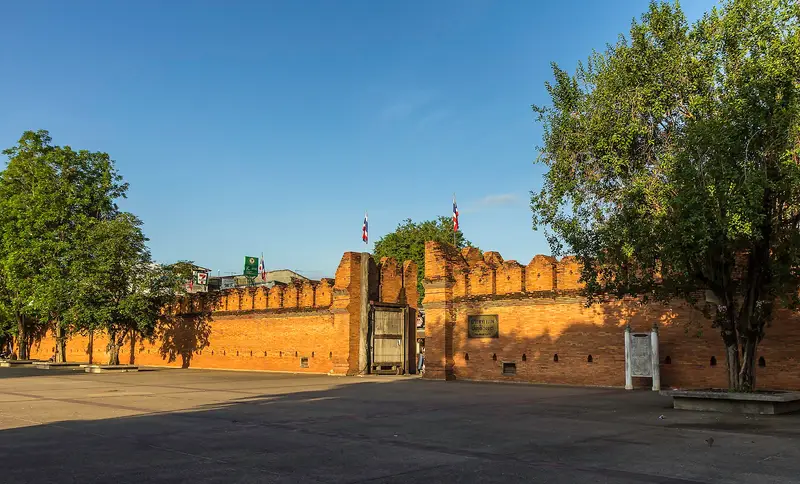
Around the moat the work cafés are smaller. Brewginning Coffee, at 260 Chang Moi Road about five minutes' walk from Tha Phae Gate, has power outlets at most tables, opens 07:00–19:00 and charged 65–95฿ for coffee in a September 2026 review.2 North of the moat in Chang Phueak, Ombra Caffe on Ratchaphruek Road has plenty of plugs and fills up with remote workers, so arrive early.2 Not every café wants laptops: Goodsouls Kitchen on Singharat Road discourages them to keep the room social.2
In Bali the line between café and coworking space is thin. In Canggu, ZIN@Work opens 06:30–00:00 and Tribal Bali in Pererenan 08:00–22:00, and a July 2026 survey found that neither charges for a seat if you order from the café.11 Ubud's desks are spread between the center and the villages of Nyuh Kuning, Penestanan and Andong, where Outpost and Ubud Coworking have their rooms.11
Distances matter more on the island. In June 2026 The Nightly reported that a 5 km trip around Canggu, normally 10 to 15 minutes, could take more than an hour in peak season.3 Choose lodging within walking distance of the café or desk you plan to use most.
Visas: Thailand's DTV and Indonesia's E33G
Thailand's Destination Thailand Visa (DTV) is valid for five years with multiple entries, and each entry allows up to 180 days.4 Its “workcation” category covers digital nomads, remote workers and freelancers, who show an employment contract or a portfolio, a bank balance of at least 500,000฿ and a criminal record certificate.4 The Thai embassies in Helsinki and Budapest, which updated their checklists in August 2026, charge €350, and fees vary by consulate.45
Each stay can be extended once, by another 180 days, at a Thai immigration office; after that you leave and re-enter.4 The DTV does not make you a local employee: holders cannot get a Thai work permit, work for companies in Thailand or freelance for Thai clients.5
Indonesia's E33G is listed on the immigration e-visa portal for employees of companies abroad who work remotely from Indonesia, and allows a stay of up to a year for Rp7,000,000.6 Applicants need a passport valid for six months, a personal bank statement showing at least US$2,000 over the past three months and proof of income of at least US$60,000 a year. Holders may not sell goods or services or be paid by anyone in Indonesia.6
Shorter stays run on visitor visas. The visa on arrival (B1) costs Rp500,000 for 30 days and can be extended once for 30 more, while the C1 visitor visa costs Rp1,000,000 for 60 days and bars “profit-making activities in any form”.6 A visa agency describes the C1 as the current form of the older B211A and wrote in June 2025 that it can be extended twice, for up to 180 days in all.7
Internet speeds and the backup line
Ookla's Speedtest Global Index for September 2026 ranked Thailand 8th in the world for fixed broadband, with a median download of 303.68 Mbps and 6 ms latency, and 29th for mobile, at 133.71 Mbps.8 Indonesia ranked 112th for fixed broadband, at 52.62 Mbps, and 65th for mobile, at 70.77 Mbps.9
Those are national medians rather than café readings, but they point to different habits. In Indonesia the median mobile connection was faster than the median fixed line, so a local SIM with a data plan is a realistic backup when a café router struggles on a video call.9 In Thailand it runs the other way: the fixed-line median was more than twice the mobile one.8
Coworking desks and what they cost in 2026
In Chiang Mai, a September 2026 roundup listed Yellow at 429฿ for a visitor day pass, 1,890฿ a week and 5,990฿ a month, from a price sheet dated May 2025; visitors can use it 09:00–18:00 and members around the clock.10 Alt charged 320฿ a day or 1,600฿ a week, and RealSpace 300฿ a day with a monitor, or 4,000฿ a month for a hot desk, open 09:00–00:00.10
As of July 2026, Tropical Nomad in Canggu started at about Rp260,000 a day and Rp1,500,000 a month, and Puco Rooftop in Tibubeneng at Rp200,000 a day and Rp2,000,000 a month.11 In Ubud, Outpost started at Rp2,460,000 a month and lets first-timers try it free on Mondays, while Ubud Coworking in Andong was the cheapest listed in town, from about Rp130,000 a day.11
Chiang Mai's smoke season
Northern Thailand's haze comes mostly in March and April. In 2026, NASA's Earth Observatory noted, fire activity was small in January, spread in February and peaked in March and April; fires usually fade by May, when the rains return.12 One estimate attributes about 70% of Chiang Mai's April PM2.5 to biomass burning, most of it from small farm and forest fires.12
Geography makes it worse: the city sits in a valley where the surrounding mountains block airflow and temperature inversions trap the smoke.12 On 27 March 2026 the ASEAN Specialised Meteorological Centre raised its transboundary haze alert to level three, the highest on its scale, and on 22 April ground sensors still showed “unhealthy” to “very unhealthy” readings across the region.12 For those weeks, an indoor desk with filtered air beats a garden table.
Bali's rainy season
Bali's wet months run from December to March, when the west monsoon brings heavy showers and high humidity, though the rain usually falls in the afternoon or evening and passes quickly.13 From June to September humidity is low and evenings can be cool, and the Bukit peninsula in the south gets far less rain than the rest of the island.13
The 2026/27 season is running late. A forecaster at the regional office of BMKG, Indonesia's meteorology agency, told RRI in October 2026 that only a small part of Bali's 20 season zones would see the rains begin in November and most in December, with the peak in February 2027.14 He expected a shorter season than usual, the result of a very strong El Niño combined with a positive Indian Ocean Dipole.14 In the wet months, put calls in the morning, before the afternoon showers.13
Tip. For a Chiang Mai stay in March or April, book a desk with filtered air: a September 2026 listing notes air purifiers at both Yellow and Punspace, which has branches at Wiang Kaew and Tha Phae Gate.10