Guadalajara · Centro Histórico
Cafés in Centro Histórico
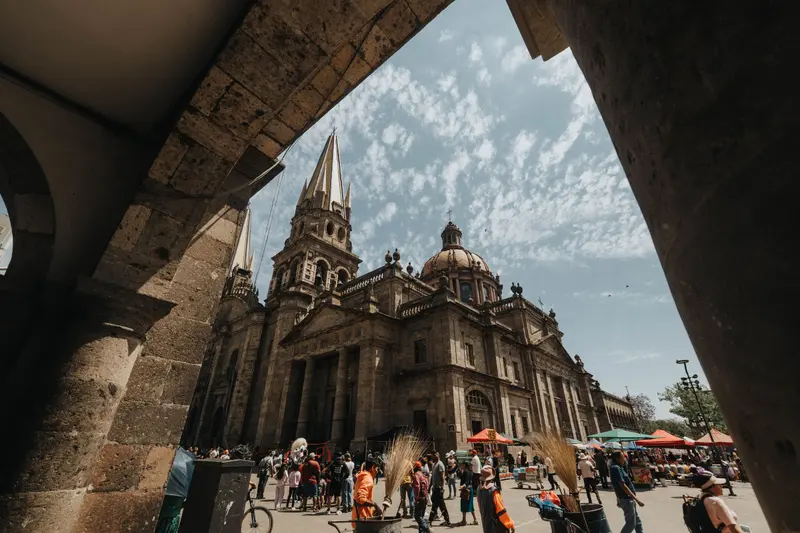
The cathedral blocks, Paseo Alcalde and the old barrio of Capilla de Jesús, where La Flor de Córdoba began.
Photo: Alejandro JV, Pexels License
The Centro Histórico is the Guadalajara of the cathedral, the Plaza de Armas and the Hospicio Cabañas, built between 1796 and 1810 to designs by the architect Manuel Tolsá and inscribed as a UNESCO World Heritage Site in 1997.1 Inside are José Clemente Orozco’s murals, the best known being The Man of Fire, painted in 1936–39.1 Paseo Alcalde, a four-kilometer walkway on Avenida Alcalde and 16 de Septiembre, links the district from north to south.2
Coffee here is old-fashioned. La Flor de Córdoba started in 1938 as El Dromedario, a cousins’ roasting shop at the corner of Santa Mónica and Independencia, and the Centro still has expendios that sell coffee by weight and a market café in the Mercado Corona.34 Most Centro cafés sit north of the cathedral, toward Capilla de Jesús and Avenida Alcalde.
Local tip: On a Sunday, La Flor de Córdoba on Calle Cruz Verde opens at 07:00 while Piloncillo and Santuario de la Bicicleta stay closed; the Mercado de la Capilla de Jesús is on the same street.5
At a glance
50Cafés listed
2With opening hours
09:00Earliest opening
22:00Latest closing
- Opens earliest: Piloncillo, from 09:00 (Mon–Sat 09:00–21:00).
- Closes latest: Santuario de la Bicicleta, until 22:00 (Mon–Sat 09:00–13:00, 17:00–22:00).
- Most common features: wi-fi (4%), toilets (2%), open late (2%).
Santuario de la Bicicleta
Alcatraz Cafetería
Antiguo Café Reforma
Arce's Café Express
Café Benito Sala Juárez
Café Bonachon
Café Centenario
Cafe Galeano
Cafe Garage Guadalajara
Cafe Ixca
Cafe la Estancia
Cafe Madoka
- Brunch
Café Moka Centro
Café Monína
Café Norte
Café Santa Mónica
Café Tostado
CafeLand
Cafeteria Baraka
Cafetería Café Trujillo Galeana
Cafetería D'George
Cafetería marych
Centro Cultural André Breton
Delicoffee
Finca Riveroll
Fragante Café
Good Tea Gdl
Hüzün
La Posada
Las Jacarandas Nevería y Café
Lechoso café
Louis Café
Lupo's
Nube Negra
Oca-fe
Nothing matches those filters here. See all cafés in Guadalajara.
Coffee chains in Centro Histórico
Chain
Starbucks
Chain
Café la Flor de Córdoba
- Av. Alcalde 157
- Av. Ramón Corona 172
- Calle Cruz VerdeDaily 07:00–22:00
Chain
La Borra del Café
Chain
Chai
Chain
Café San Pedro
Chain
Livin' Cafe
Getting around on Line 3 and Paseo Alcalde
Light-rail Line 3 opened on 12 September 2020 and runs 21.5 km from Arcos de Zapopan to the Central de Autobuses in Tlaquepaque. Through the Centro it runs underground for about 5.3 km beneath Paseo Alcalde and 16 de Septiembre, with stations at La Normal, Santuario, Guadalajara Centro (the transfer to Line 2), Independencia and Plaza de la Bandera.6
Above it, Paseo Alcalde runs about four kilometers from the Glorieta La Normal past the cathedral and the Plaza de Armas to the entrance of Parque Agua Azul. Half of it is fully pedestrian; the last one-kilometer stretch, on 16 de Septiembre between La Paz and Washington, was finished in February 2024 and still carries cars.2 Piloncillo is on the paseo itself, at 600 Avenida Fray Antonio Alcalde, open Monday to Saturday from 09:00 to 21:00.
Capilla de Jesús and its 1942 market
The barrio of Capilla de Jesús grew after the War of Independence, when families fleeing violence in Los Altos de Jalisco settled beyond the old city limits. Its market, the Mercado Cuarto Centenario, better known as the Mercado de la Capilla de Jesús, stands between Garibaldi, Jesús and Cruz Verde. The city built it in 1942 for Guadalajara’s 400th anniversary, in a mix of neocolonial and Art Deco styles.5
Inside are menudo stalls, family fondas (simple eateries) and cremerías (dairy shops), and the old Panadería Fénix bakes just outside.5 La Flor de Córdoba’s branch on Calle Cruz Verde opens daily from 07:00 to 22:00, one of the earliest starts in the Centro.
Cultural café-bars north of the cathedral
Centro Cultural André Breton is at Juan Manuel 175, two blocks north of the Plaza de la Liberación; in 2017 the Guadalajara Reporter called its café the sine qua non of the city’s jazz bars.7 Santuario de la Bicicleta, at 466 Calle Jesús González Ortega, keeps split hours: Monday to Saturday from 09:00 to 13:00, then 17:00 to 22:00. Ortográfika is at 620 Calle Juan Álvarez.
Coffee by the kilo in the Centro
Expendios here sell roasted coffee by weight. In March 2025 a regular at Café Moka, an expendio in the Centro, paid MX$215 for half a kilo, up from MX$200. A café in the Mercado Corona said its supplier had raised the price per kilo by MX$20 in January and again two weeks before the report, from MX$240 the year before.4
Prepared drinks rose too. A Centro branch of La Flor de Córdoba charged MX$45 for an americano, up from MX$40, and staff said other drinks had gone up by MX$5–10. A café worker quoted in the same report said its beans come from Chiapas, Oaxaca and Veracruz, with the harvests blended.4
Sources
- Hospicio Cabañas, Wikipedia, accessed October 2026
- Four-kilometer Paseo Alcalde finally finished, The Guadalajara Reporter (February 29, 2024), accessed October 2026
- RETROVISOR – Café La Flor de Córdoba, el menú de tradición de Guadalajara, Players of Life Guadalajara, accessed October 2026
- Aumentan precios del café en Guadalajara, El Informador (March 12, 2025), accessed October 2026
- El Mercado Cuarto Centenario, un patrimonio vivo de Guadalajara, Milenio (August 1, 2026), accessed October 2026
- Línea 3 del Tren Ligero de Guadalajara, Wikipedia, accessed October 2026
- The best jazz fixes in Guadalajara, The Guadalajara Reporter (May 11, 2017), accessed October 2026
Keep exploring
More of Guadalajara
FAQ
Centro Histórico cafés: questions
Where did La Flor de Córdoba start in Guadalajara’s Centro Histórico?
La Flor de Córdoba started in 1938 as El Dromedario, a small roasting shop opened by two cousins at the corner of Santa Mónica and Independencia in the Centro Histórico. Its branch on Calle Cruz Verde, the street of the Mercado de la Capilla de Jesús, opens daily from 07:00 to 22:00.
How do you reach Guadalajara’s Centro Histórico by light rail?
Line 3, open since September 2020, runs underground for about 5.3 km beneath Paseo Alcalde and 16 de Septiembre, with stations at La Normal, Santuario, Guadalajara Centro, Independencia and Plaza de la Bandera. Guadalajara Centro is the transfer to Line 2. Above ground, Paseo Alcalde is a four-kilometer walkway, half of it fully pedestrian.
How much is an americano in Guadalajara’s Centro Histórico?
In March 2025 a La Flor de Córdoba branch in the Centro Histórico charged MX$45 for an americano, up from MX$40, and staff said other drinks had risen by MX$5–10. Coffee by weight rose too: half a kilo at Café Moka, a Centro expendio, cost MX$215, up from MX$200.
For café owners
Own a café in Centro Histórico?
Free listings are free for good. A featured page gives you photos, a menu and your own URL, in your café's own design, for less than a coffee a day.