Dubai · Al Fahidi, Al Seef & Meena Bazaar
Cafés in Al Fahidi, Al Seef & Meena Bazaar
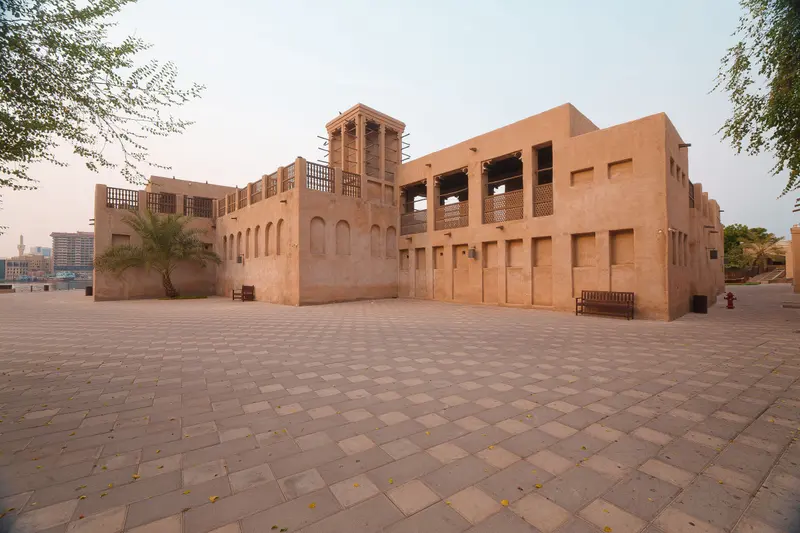
Wind-tower lanes of the old Bastakiya, the Coffee Museum, the Al Seef creekfront and Meena Bazaar.
Photo: Walid Ahmad, Pexels License
Al Fahidi Historical Neighbourhood is the restored quarter of courtyard houses on the Bur Dubai bank of the creek, next to the Ruler's court.1 Its houses, built of stone, gypsum, teak, sandalwood and palm fronds, carry barjeel (wind towers) and show how Dubai lived from the mid-19th century to the 1970s.1 The quarter dates from around 1900 and was long called Al Bastakiya; it took its current name in 2012.2
This is where the city keeps its coffee history on display. The Coffee Museum sits in the old alleys, and the Arabian Tea House has served in a pearl trader's house since 1997.53 Beyond the quarter, Al Seef runs along the water and Meena Bazaar fills the streets inland, with chai counters on Khalid Bin Waleed Road.
Local tip: Arrive by abra at Al Fahidi station, walk the wind-tower lanes from 07:00, when the quarter opens, to the Coffee Museum, and finish with karak chai on Khalid Bin Waleed Road.
At a glance
16Cafés listed
1With opening hours
09:30Earliest opening
00:00Latest closing
- Opens earliest: Zaharat Al Sharq, from 09:30 (Mon–Thu 09:30–00:00 · Fri 10:00–00:00 · Sat–Sun 09:30–00:00).
- Most common features: open late (6%), wi-fi (6%), air-con (6%).
Go Sip
Gupshup Chai Pe Cafe LLC
Zaharat Al Sharq
DYT
Treat Corner
Shaker New Cafeteria
- Air-con
- Indoor seating
- Card payment
- Vegetarian options
- Partial wheelchair access
- Smoke-free indoors
Top Tea Spot
Badshah Cafe
Baker and Spice
Caffe' Trucillo UAE
Coffeöl
Haleeb O Heil
MAZMi Coffee and More
Tea Junction Cafe, Bur Dubai
Bonjour Bonsoir Live Cafe
Carters Blue Cafeteria
Nothing matches those filters here. See all cafés in Dubai.
Coffee chains in Al Fahidi, Al Seef & Meena Bazaar
Chain
Starbucks
Chain
Costa Coffee
Chain
Tim Hortons
Chain
Second Cup
Chain
Joe & The Juice
Wind towers and the old Bastakiya
The quarter is open daily 07:00–20:00. Its houses now hold art galleries, specialized museums and cultural associations, among them the Sheikh Mohammed Center for Cultural Understanding.1
A study of the Bukhash house and six others found the towers did their best work in the afternoon, when families rested on cushions around the room where the air moved and the draft helped sweat evaporate.2
The Coffee Museum and the Arabian Tea House
The Coffee Museum was built by Khalid Al Mulla of the green-coffee importer Easternmen & Co from his own collection, modeled on the Kaffeemuseum in Hamburg. Its rooms are set up to show how coffee is brewed in Ethiopia, Turkey, Egypt and Yemen, and its library holds an original 1784 encyclopedia by Johann Friedrich von Pfeiffer with more than 170 pages on coffee.4
The museum opened in 2014 and still runs on two floors; as of May 2026, visitors were greeted with Arabic coffee and offered another cup at the end of the tour.5
Ali Al Rais opened the Arabian Tea House in 1997, after about 20 years in aviation, in a house a pearl trader built in the early 1920s, with a central courtyard, wind towers and a well. He first called it Basta Art Café. The menu runs from karak chai and Dubai Tea to a full Emirati breakfast.3
Al Seef and the abra stations
Al Seef is a 1.8 km creekside promenade by the developer Meraas, begun in 2012 and finished in 2017. Its heritage section, Souk Al Seef, reworks the creekside souks of the 1950s with wind towers and arish (palm-frond) shelters, and its alleys lead west into the historic quarter. Abras moor at the souk's marina.6
From Al Fahidi station, route CR4 crosses to Al Sabkha and CR5 to Deira Old Souq, each AED 2; CR6 runs from Al Seef to Baniyas, 07:30–23:45 Monday to Saturday. Route CR7 was on hold, and the electric abra TR10 charges AED 60 per 30 minutes, 16:00–23:00.7 Caffe' Trucillo, Coffeöl and Haleeb O Heil sit near the water at Al Seef.
Meena Bazaar and the chai counters
Meena Bazaar took its name from the signboard of Sarda Trading, a textile shop that opened at the entrance of the lane in 1973 and closed in 2010. Ram Buxani, one of the first traders to move into the lane, said the name recalled the Meena Bazaar of Delhi's Red Fort, and that it strictly means one street. Textiles boomed from the late 1970s to the 1990s; jewelers, who could pay the rents, now dominate.8
Gupshup Chai Pe Cafe is at 124 Khalid Bin Al Waleed Road, in the Bank Street building, and Top Tea Spot is on the same road; Cafe Lemon Spice is at 33 Sheikh Khalifa Bin Zayed Street. Zaharat Al Sharq stays open until 00:00 every day, opening at 09:30, or 10:00 on Fridays.
Sources
- Al Fahidi Historical Neighbourhood, Dubai Culture & Arts Authority, accessed October 2026
- Uncovering secrets of Al Bastakiya's windtower houses, Gulf News (updated July 4, 2022), accessed October 2026
- Ali Al Rais travelled the world for decades, then turned his eye to celebrating Dubai's old quarter, Gulf News (updated July 9, 2022), accessed October 2026
- This Amazing Dubai Coffee Museum Allows Guests to Sip in Cultural Context, Daily Coffee News (October 29, 2014), accessed October 2026
- Wake up and smell the Coffee Museum's rich history, Aletihad (May 25, 2026), accessed October 2026
- Al Seef, Wikipedia, accessed October 2026
- Dubai Creek Abra, Roads and Transport Authority (RTA), accessed October 2026
- How Bur Dubai's Meena Bazaar got its name, Gulf News (updated November 5, 2018), accessed October 2026
Keep exploring
More of Dubai
Deira
130 cafés
Bur Dubai & Karama
71 cafés
Downtown, DIFC & Business Bay
110 cafés
Al Quoz & Alserkal Avenue
43 cafés
Jumeirah, Satwa & City Walk
115 cafés
Umm Suqeim & Al Sufouh
55 cafés
Dubai Marina, JBR & JLT
40 cafésIn Al Fahidi, Al Seef & Meena Bazaar, also browse: Open late Wi-Fi
FAQ
Al Fahidi, Al Seef & Meena Bazaar cafés: questions
When did the Arabian Tea House open in Al Fahidi, Dubai?
Ali Al Rais opened the Arabian Tea House in 1997, after about 20 years in aviation. It occupies a house built by a pearl trader in the early 1920s, with a central courtyard, wind towers and a well. He first called it Basta Art Café. The menu runs from karak chai and Dubai Tea to Emirati breakfast.
What can you see at the Coffee Museum in Al Fahidi, Dubai?
Khalid Al Mulla opened the two-floor museum in 2014 from his own collection, modeled on Hamburg's coffee museum. Rooms show brewing methods from Ethiopia, Turkey, Egypt and Yemen, and the library holds a 1784 encyclopedia with more than 170 pages on coffee. As of May 2026, visitors were welcomed with Arabic coffee and offered another cup at the end.
How much does the abra cost from Al Fahidi or Al Seef in Dubai?
Commuter abras from Al Fahidi station cost AED 2: route CR4 crosses to Al Sabkha and CR5 to Deira Old Souq. CR6 runs from Al Seef to Baniyas for the same fare. The electric abra TR10, a private boat for up to eight people, costs AED 60 per 30 minutes and runs 16:00–23:00. Cash, nol and bank cards are accepted.
For café owners
Own a café in Al Fahidi, Al Seef & Meena Bazaar?
Free listings are free for good. A featured page gives you photos, a menu and your own URL, in your café's own design, for less than a coffee a day.