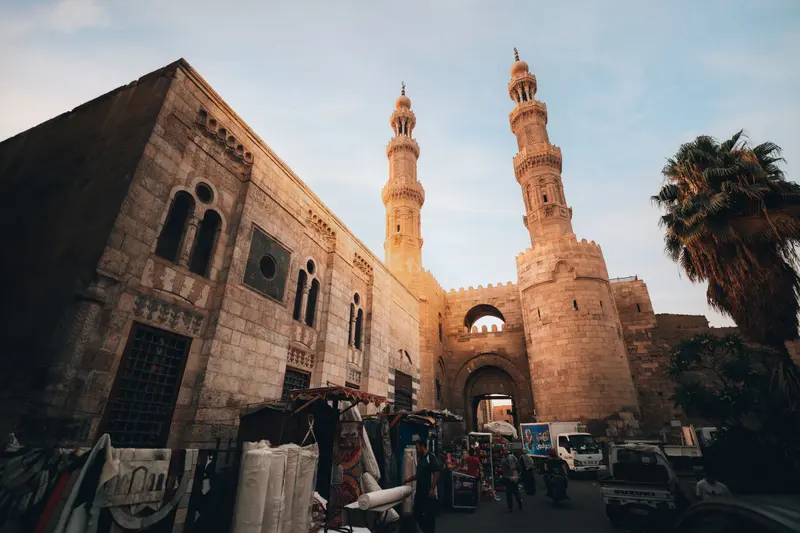
Cairo · Islamic Cairo & Khan el-Khalili
Cafés in Islamic Cairo & Khan el-Khalili
El Fishawy's mirrored alley, Sikkat al-Badistan and the ahwa of al-Muizz Street.
Photo: Abd Ulrahman Mohamed, Pexels License
Khan el-Khalili is bounded by al-Muizz Street to the west, al-Muski Street to the south and the al-Hussein Mosque to the east, with al-Azhar Mosque and University next door.1 Its buildings are multi-storied khans and wikalas (merchant hostels) around courtyards, with shops at street level, and its coffeehouses are small and traditional, serving Arabic coffee and usually shisha.1
The cafés here follow the bazaar's lanes rather than any main road. El Fishawy holds the alley at 1 Sikkat Khan el-Khalili, the Naguib Mahfouz Café is on El Badestan Lane, and smaller ahwa sit on al-Muizz Street, al-Mashhad al-Husseini Street and the haras (lanes) behind al-Azhar.
Local tip: At El Fishawy, order karkade, a hibiscus infusion served from an enamel pot on a copper tray, and sit on the carved benches inside for the mirrors.2
At a glance
21Cafés listed
0With opening hours
–Earliest opening
–Latest closing
ElFishawy
Najib Mahfouz Cafe
Zainab Khaton
كافيه ابو السعود ٢
لؤلؤة الحسين كافيه
مطعم وكافية - صاحب السعادة
وكالة السحيمي
Al Lord Cafe
kampung Cafe
Space kafe and resto
Zone Coffe
Abo Mazen Cafe كافيه ابو مازن
Mahony Khan Cafe
Share3 Elmo3ez Restaurant & Cafe - شارع المعز مطعم & كافيه
بيت القاضي
فيبي بوفيه
كوفى شوب المملكة
ليالي الحسين cafe
مقهى نادي الازهر
مقهى ولى النعم
Nothing matches those filters here. See all cafés in Cairo.
El Fishawy's alley
El Fishawy is still run by descendants of its founder, who have refused to add a television. Its room is lined with latticed woodwork and large framed mirrors, with long carved seats inside and tables facing the alley.2 Drinks arrive in enamel teapots on copper trays: tea, coffee, mint tea and karkade, a hibiscus infusion, with fruit-flavored shisha; an oud player performs inside.2
Two corners carry names. One belongs to Naguib Mahfouz, whose portrait hangs on the walls, and one to the lyricist Ahmad Rami.2 A brass plaque inside dates the café to 1710; historians give 1773 or 1797.2
Sikkat al-Badistan and the Naguib Mahfouz Café
Sultan al-Ghuri's early 16th-century rebuilding left two carved stone gates on Sikkat al-Badistan: Bab al-Ghuri to the east and Bab al-Badistan to the west.1 The Naguib Mahfouz Café, at 5 El Badestan Lane, opened in 1989 as Khan El Khalili and was renamed for the writer after his frequent visits and his Nobel Prize.3
Mahfouz had a favorite table; after his death the owner put his picture on it with some of his books.3 The room is decorated in the style of the Fatimid era, and the menu runs from Egyptian dishes such as koshary and mombar to traditional hot drinks and juices.3
Al-Muizz Street, from Bab al-Futuh to Bab Zuweila
Al-Muizz Street runs about 1 km through the walled city, from Bab al-Futuh in the north to Bab Zuweila in the south, and takes its name from the fourth Fatimid caliph.4 Restoration from 1997 turned it into an open-air museum: about 34 monuments on the street were restored, taller buildings were lowered and the paving was relaid in the old style.4
On the northern stretch stands Bayt al-Suhaymi, a house built between 1648 and 1796.4 The café Wekalet al-Suhaymi (وكالة السحيمي) is at 8 Darb al-Asfar, and Sahib al-Saada (صاحب السعادة) is at 57 al-Muizz Street.
Courtyards and lanes behind al-Azhar
Beit Zeinab Khatoun, a house from 1486 with Ottoman additions, is now a protected heritage site with a courtyard café.5 It takes its name from Zeinab Khatoun, wife of al-Sharif Hamza al-Kharboutly, who sheltered wounded fighters during the resistance to the French occupation of 1798.5 The café is at 3 Mohamed Abdo Street.
Nearby, Kampung Cafe is at 14 Haret al-Batneya and Zone Coffe at 12 al-Fawatem Street, while Lu'lu'at al-Hussein (لؤلؤة الحسين) faces the shrine side at 6 al-Mashhad al-Husseini Street. Summer afternoons are hot, with July highs averaging 35 °C, and rain falls on about 11 days a year.6
Sources
- Khan el-Khalili, Wikipedia, accessed October 2026
- More than two centuries of brewing and smoking, Gulf News (Ramadan Al Sherbini, November 1, 2018), accessed October 2026
- Naguib Mahfouz Café: A Relic of the Past Standing Tall, Cairo 360 (December 5, 2018), accessed October 2026
- Muizz Street, Wikipedia, accessed October 2026
- 5 Historic Cafés to Visit in Cairo, History Hit, accessed October 2026
- Cairo: Climate, Wikipedia, accessed October 2026
FAQ
Islamic Cairo & Khan el-Khalili cafés: questions
What is El Fishawy café in Khan el-Khalili like inside?
El Fishawy in Cairo's Khan el-Khalili has latticed woodwork, large framed mirrors and long carved seats, plus tables facing the alley. Descendants of its founder run it and have refused to add a television. Tea, coffee, mint tea and karkade come in enamel teapots on copper trays, and an oud player performs inside.
When did the Naguib Mahfouz Café in Khan el-Khalili open?
The Naguib Mahfouz Café on El Badestan Lane in Khan el-Khalili, Cairo, opened in 1989 under the name Khan El Khalili. It was renamed for the writer after his frequent visits and his Nobel Prize. His favorite table carries his picture and some of his books.
How long is al-Muizz Street in Islamic Cairo?
Al-Muizz Street in Islamic Cairo runs about 1 km through the walled city, from Bab al-Futuh in the north to Bab Zuweila in the south. Restoration from 1997 made it an open-air museum, with about 34 monuments restored on the street, including the house Bayt al-Suhaymi.
For café owners
Own a café in Islamic Cairo & Khan el-Khalili?
Free listings are free for good. A featured page gives you photos, a menu and your own URL, in your café's own design, for less than a coffee a day.