 By Yannick Schroth
How to order · 6 min read · October 2026
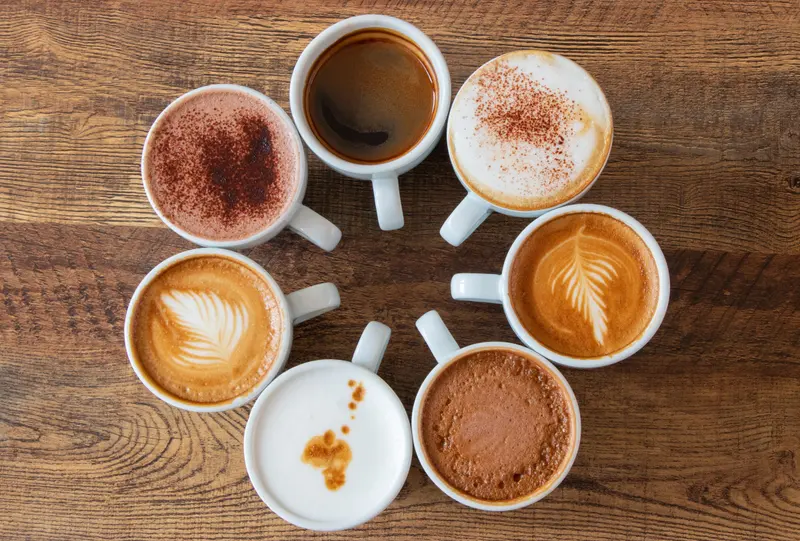
An espresso menu is mostly one shot of coffee rearranged. Change how much water runs through the grounds and you get a ristretto or a lungo; add water afterward and it becomes an americano; add milk by the drop, the splash or the jug and you move from macchiato to cortado to latte.12
The names do not travel cleanly. Latte is simply Italian for milk, so ordering one in Italy can get you a glass of milk, and a macchiato in Melbourne arrives in a glass half-filled with water.73 One drink, the Gibraltar, is even named after the glass it is served in.5
Espresso, ristretto, lungo and doppio
The Istituto Nazionale Espresso Italiano (INEI) defines its certified espresso as 7 g of ground coffee, water leaving the machine at 88 °C and entering at 9 bar, about 25 seconds of extraction and 25 ml in the cup, crema included.1 No universal standard exists, and other institutions publish their own definitions.1
A ristretto stops at about 20 ml, roughly half a normal shot, and drinks fuller and less bitter.113 A lungo goes the other way, about 60 ml with all of the water run through the coffee; in French it is an allongé.113 A doppio is a double shot, made with about 14 g of coffee.1
Crema, the foam on top, is oil from the ground coffee emulsified under pressure.1 Achille Gaggia patented a hand-pulled piston in 1938 and sold lever machines from 1948 under the name crema caffè.1
| Drink | What's in it | Where you'll meet it |
|---|---|---|
| Espresso | About 7 g of coffee, 25 ml in the cup1 | Everywhere; simply caffè in Italy |
| Ristretto | Same dose, about 20 ml1 | Italy and specialty bars |
| Lungo | About 60 ml, all of it brewed through the coffee113 | Italy; allongé in France13 |
| Doppio | A double shot, about 14 g of coffee1 | Everywhere |
| Americano | Espresso topped with hot water, about 1:3 to 1:42 | Chains worldwide; iced, it is South Korea's ah-ah2 |
| Long black | Hot water first, espresso poured on top2 | Australia and New Zealand2 |
| Red eye | Drip coffee with a shot of espresso13 | United States |
| Caffè macchiato | Espresso with a little milk, 5–10 g in one recipe3 | Italy; the "mac" in Australia3 |
| Latte macchiato | Espresso poured into steamed milk, in a glass7 | Italy |
| Caramel macchiato | Milk, vanilla syrup, espresso on top, caramel sauce4 | Starbucks, since 19964 |
| Cortado | Espresso with about the same amount of steamed milk5 | Spain; tallat in Catalonia5 |
| Gibraltar | About 60 ml double espresso and 75 ml steamed milk in a 135 ml glass5 | San Francisco5 |
| Piccolo | A single shot topped up with steamed milk in a macchiato glass5 | Australia5 |
| Noisette | Espresso with a dash of milk, 3–5 cl in all10 | France10 |
| Cortadito | About 30 ml espresso with heated sweetened condensed milk5 | Cuba and Miami5 |
| Cappuccino | Espresso, steamed milk and foam in thirds, 150–180 ml6 | Italy, at breakfast6 |
| Flat white | Like a latte but smaller, with less microfoam13 | Australia and New Zealand |
| Caffè latte | Espresso and steamed milk, about 230 ml7 | Worldwide |
| Café con leche | Strong coffee and scalded milk, about equal parts9 | Spain and Latin America9 |
| Café au lait | Coffee with hot milk, often in a bowl; drip coffee in the US8 | France; New Orleans8 |
| Galão | Espresso and milk at about 1:35 | Portugal5 |
| Pingado | Espresso with a drop of milk3 | Portugal3 |
| Mocha | Espresso, steamed milk and chocolate11 | Chains worldwide |
| Affogato | Gelato with espresso poured over it12 | Italy, as a dessert12 |
| Café bombón | Espresso over condensed milk, about 2:114 | Valencia region, Spain14 |
| Egg coffee | Coffee under egg yolk whipped with sugar and condensed milk13 | Hanoi13 |
Ratios are coffee to water or milk unless stated, from the sources cited in each row.15
Americano, long black and red eye
A caffè americano is espresso lengthened with hot water at about 1:3 to 1:4, typically 120–180 ml of water per shot.2 The popular story credits American soldiers in wartime Italy who watered espresso down to taste like coffee at home. The Oxford English Dictionary instead traces the name to Central American Spanish, where café americano was a mid-1950s put-down for weak coffee; it first appeared in English in a Jamaican newspaper in 1964.2
The long black of Australia and New Zealand reverses the order: water goes into the cup first and the espresso is poured on top, which helps keep the crema intact.2 Melbourne's further variations, the magic among them, are in the Australian flat white guide.
In the United States the extra shot often lands in filter coffee instead. A red eye is drip coffee with espresso added, and Starbucks calls coffee with two shots a black eye and with three a dead eye.13
Three macchiatos: Italian, latte and caramel
Macchiato means stained or spotted. A caffè macchiato is an espresso marked with a little milk, usually foamed; one recipe uses 5–10 g heated to 60–66 °C, which gives it the highest ratio of coffee to milk of any drink made from the two.3 Portugal's name for much the same cup, café pingado, means coffee with a drop.3
The latte macchiato turns that around. It is steamed milk stained with espresso, the coffee poured in after the milk, and it comes in a glass.7
The caramel macchiato is a chain invention. Starbucks product developer Hannah Su and a small team created it in 1996 for the company's 25th anniversary, as a limited item that stayed on the menu: milk and vanilla syrup, espresso poured on top, then caramel sauce.4 Sprudge describes it as a lightly sweet vanilla latte, built in the reverse order from the company's own latte.4
Australia keeps its own scale. In Perth a long mac topped up is a double shot with the glass filled with textured milk, while in Melbourne a macchiato is a double shot in a glass half-filled with water, with a dash of textured milk on top.3
Cortado, Gibraltar, piccolo and noisette
Cortado comes from cortar, to cut: an espresso cut with roughly the same amount of warm milk, steamed but not frothy.5 In Catalonia it is a tallat and in the Basque Country an ebaki.5 Spanish ordering words, from cortado to lechero, are collected in the guide to ordering coffee in Spanish.
The Gibraltar is a cortado defined by its glass. About 60 ml of double espresso goes under about 75 ml of foamy steamed milk in a 135 ml Libbey Gibraltar tumbler, a format Blue Bottle Coffee started in San Francisco and Ritual Coffee Roasters followed.5 Australia's piccolo is a single shot in a macchiato glass, filled with steamed milk as for a latte.5
In France, ask for a noisette. It is an espresso in an espresso cup with a dash of milk, no more than a third of the cup and 3–5 cl in all, and the name refers to its hazelnut color rather than any flavoring.10 Cuba's cortadito is about 30 ml of espresso cut with heated sweetened condensed milk, often in a glass with a wire handle; Cuban Americans brought it to Miami's Little Havana in the 1960s.5
Cappuccino, flat white, latte and the breakfast coffees
A cappuccino is espresso, steamed milk and milk foam in roughly equal thirds. In Italy the shot is 25 ml and the cup holds no more than 180 ml, so the drink comes to 150–180 ml, while some US chains serve 360 ml or more.6 Italians drink it mainly at breakfast and rarely order one after 11:00.6
The name refers to the brown of Capuchin habits. Vienna's Kapuziner, coffee with a few drops of cream, appeared on coffeehouse menus in the late 1700s, and the Italian word cappuccino turns up in the 19th century for black coffee with a little milk or cream.6
A flat white is close to a latte but smaller, with less microfoam.13 A caffè latte is the milkiest and mildest of the three, served in a glass or cup of about 230 ml against a cappuccino's 140 ml cup.7 The argument over whether Sydney or Wellington poured the first flat white is laid out in the Australian flat white guide.
Spain's café con leche is strong coffee, usually espresso, with scalded milk in about equal amounts; ask for it manchado or clarito for more milk, oscurito for less.9 In France, café au lait is breakfast coffee with hot milk, often a large serving in a bowl without handles.8 American coffeehouses make it with drip or press coffee and steamed milk, and New Orleans uses chicory coffee and scalded milk, served with beignets at Café du Monde.8
Portugal's galão is espresso and milk at about 1:3.5 The rest of the Portuguese scale, from pingado to meia de leite, is in the guide to Portuguese coffee.
Mocha, affogato, bombón and Vietnamese coffee
A mocha is a latte with chocolate, typically one third espresso and two thirds steamed milk, sweetened with chocolate syrup or cocoa and sugar.1311 The name comes from Mokha, the Yemeni port that was a major hub of the coffee trade from the 15th to the 17th century.11 Turin had combined the three ingredients earlier: its bicerin, coffee, chocolate and cream layered in a small clear glass, took shape in the 18th century.11
An affogato, drowned, is a scoop of gelato, usually fiordilatte or vanilla, with espresso poured over it. Italy classes it as a dessert, cafés elsewhere often list it with the drinks, and English dictionaries have recorded the word since 1988.12
Condensed milk makes the sweetest versions. A café bombón, from the Valencia region, is espresso poured over sweetened condensed milk in a clear glass, usually two parts coffee to one of milk, so the two layers show until you stir.14 The Canary Islands' barraquito adds a layer of liqueur, and the café asiático of Cartagena, in Murcia, is much the same.14
Vietnam pairs condensed milk with ground coffee rather than espresso, at different ratios from the bombón, and serves it over ice as cà phê sữa đá.13 Hanoi's egg coffee tops the cup with egg yolk whipped with sugar and condensed milk.13 Both are covered in the guide to Vietnamese coffee.
Tip. For less milk than a latte without going black, order by glass size: a cortado or piccolo holds roughly equal parts coffee and milk, and a Gibraltar, where a café offers one, is fixed at about 60 ml of espresso to 75 ml of milk.5