Café Avellaneda
- Wi-Fi
- Outdoor seating
- Indoor seating
- Card payment
- Open late
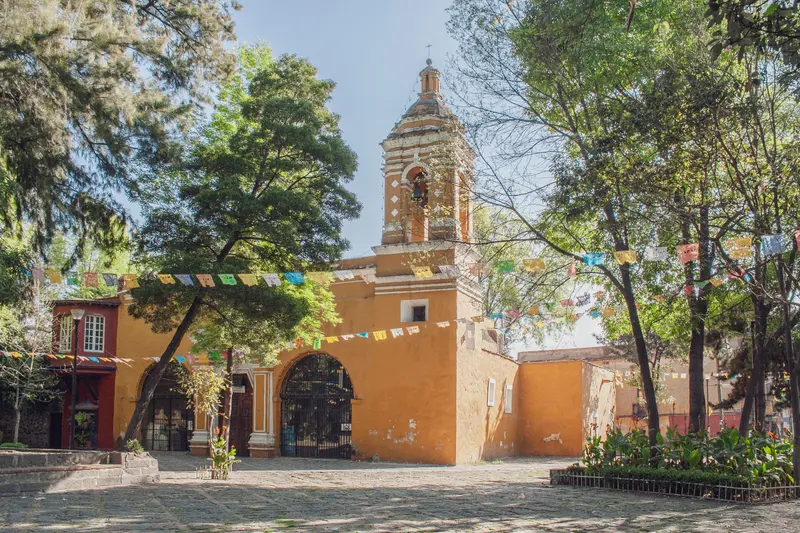
The Jardín Centenario, Francisco Sosa and El Jarocho’s counters, south to the bookshop cafés of Miguel Ángel de Quevedo and Copilco by the UNAM.
Photo: Noemí Jiménez, Pexels License
Coyoacán comes from the Nahuatl Coyōhuahcān, usually translated as “place of coyotes”. The Spanish used it as their headquarters during the conquest of Tenochtitlan, it served as the first capital of New Spain from 1521 to 1523, and it became a borough of the city in 1928. Its two central plazas, the Jardín Hidalgo and the Jardín del Centenario, cover about 24,000 square meters, and the Centenario has a bronze fountain of two coyotes.1
The borough counts about 70,000 visitors to the historic center each weekend.1 Its cafés run from the plazas of the old village to Copilco on the edge of the university campus. El Jarocho has several branches: on Calle Cuauhtémoc, on Malintzin and on Avenida División del Norte.
Local tip: For coffee before 07:00, the El Jarocho on Malintzin opens at 06:00 and the one at División del Norte 2761 never closes; the original corner on Cuauhtémoc has no seating, so take your cup to the Jardín Centenario.2
Marabunta coffee + books
Nothing matches those filters here. See all cafés in Mexico City.
Gil Romero and Bertha Paredes ran a shop on Calle Aguayo that sold seeds, grains and fruit brought from Veracruz.3 Gil gave neighbors coffee in ceramic cups before deciding to sell it, and the first El Jarocho opened in 1953 at the corner of Cuauhtémoc and Allende.2 Their son Víctor Romero, who had watched the coffee vendors in the Zócalo, decided the city needed coffee bars, and the business got one of the first industrial coffee machines in Mexico.3
It had four tables by 1970 and switched from ceramic cups to disposable ones around 1980. The original branch still has no seating, and a queue forms outside.2 In 2017 Chilango reported that it roasted coffee every morning, sold about 5,000 drinks each weekend and kept sixty teas and tisanes alongside tortas de milanesa.3 The El Jarocho on Malintzin opens daily from 06:00 to 23:00, and the one at División del Norte 2761 is open 24 hours.
Francisco Sosa, the old Calle Real, was renamed Santa Catarina and then Benito Juárez before taking its present name, and INAH, the national heritage institute, has catalogued 65 historic structures along it.1 Aurelia is at number 202. Near the Centenario, El Mundo del Café at Calle Centenario 33 opens daily from 07:00 to 23:00.
Café Avellaneda, at Higuera 40, is run by Carlos de la Torre and Yarismeth Barrientos, who have won awards in Mexico and abroad, and is counted among the pioneers of specialty coffee in Mexico.6 It works with Mexican growers, serves horchata with cold brew, and sells bags of coffee from producers across the country under its Café con Jiribilla project.6 It opens daily from 08:00 to 22:00, as does Café Ruta de la Seda at Aurora 1 Bis, which a 2018 guide recommended for its teas, matcha drinks and desserts.7
The first Librería Gandhi opened on 27 June 1971 at Miguel Ángel de Quevedo 128, in 150 square meters, founded by the theater promoter Mauricio Achar. It soon added a café, a gallery and a theater forum, and by 2021 the chain had 43 bookshops in 13 states.5
The avenue still pairs books with coffee. Marabunta café + librería, at number 485c, served Veracruz coffee and artisan chocolate in a literary setting in 2018, and Cafetzalli, at 616, specialized in coffee from Chiapas and was recommended for its café de olla.7 Marabunta opens Monday to Saturday from 07:00 to 23:00. Café La Victoria and El café de los sentidos are on the same avenue.
The Ciudad Universitaria of the UNAM was built in the 1950s on El Pedregal, an old lava field in Coyoacán, and completed in 1954. It became a World Heritage Site in 2007, and Juan O’Gorman’s murals cover every side of the Biblioteca Central. Copilco is one of the two Metro stations that lead to the campus, and print shops near it bind students’ theses.4
Copilco has early openers. Café Rébora, on Calle Odontología, opens at 07:00 on weekdays and stays open until 21:30, and the Cooperativa Las 400 voces on Alfonso Pruneda opens from 07:00 to 21:00, Monday to Saturday. Café y Té Quiero is on Calle Arquitectura, and El Gato Literato is on Avenida Copilco.
Metro Line 3 runs south through the borough with stations at Coyoacán, Viveros/Derechos Humanos, Miguel Ángel de Quevedo, Copilco and Universidad; the stretch from Zapata to Universidad opened on 30 August 1983.8 The Museo Frida Kahlo, the Casa Azul, is on Calle Londres, in the house where Kahlo was born in 1907.1 On weekends, Café del Barrio stays open until 23:00 on Fridays and Saturdays.
In Coyoacán, also browse: Wi-Fi Outdoor seating Open late Bakery cafés Brunch
The first El Jarocho opened in Coyoacán in 1953 at the corner of Cuauhtémoc and Allende, founded by Gil Romero and Bertha Paredes, who ran a shop selling produce from Veracruz. The original branch still has no seating. The El Jarocho on Malintzin opens daily from 06:00 to 23:00, and the one at División del Norte 2761 is open 24 hours.
Avenida Miguel Ángel de Quevedo is Coyoacán’s book street. The first Librería Gandhi opened there in 1971 and soon added a café. Marabunta café + librería, at number 485c, pairs books with Veracruz coffee and opens Monday to Saturday from 07:00 to 23:00, and Cafetzalli, at 616, specializes in coffee from Chiapas.
Copilco, on the edge of the UNAM’s Ciudad Universitaria in Coyoacán, has Café Rébora on Calle Odontología, open from 07:00 to 21:30 on weekdays, and the Cooperativa Las 400 voces on Alfonso Pruneda, open Monday to Saturday from 07:00 to 21:00. Copilco Metro station on Line 3 is one of the two that lead to the campus.
Free listings are free for good. A featured page gives you photos, a menu and your own URL, in your café's own design, for less than a coffee a day.