Federal
- Vegetarian options
- Wheelchair access
- Open late
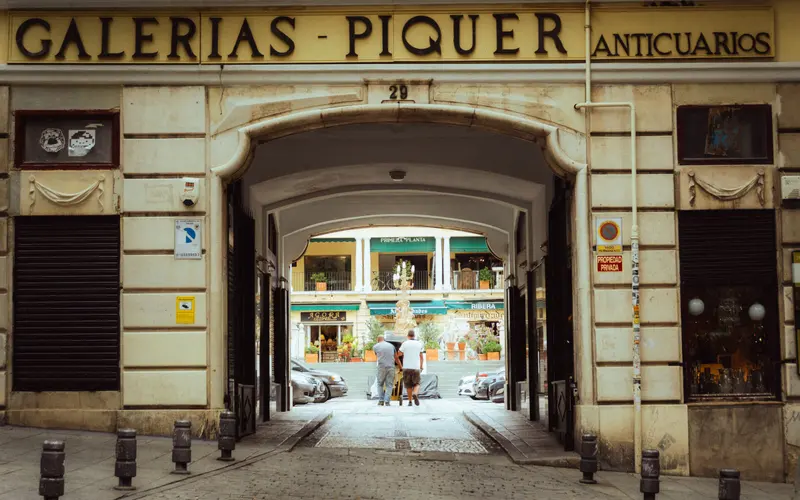
Cava Baja, the San Francisco dome and the top of the Sunday Rastro at Plaza de Cascorro.
Photo: Altamart, Pexels License
La Latina is not an official ward: almost all of it lies in the Palacio ward of the Centro district, between Calle de Segovia to the north, the Ronda and Puerta de Toledo to the south, Calle de Toledo to the east and Calle de Bailén to the west.1 Its name probably comes from a hospital founded in 1499 by Beatriz Galindo, called La Latina, a lady-in-waiting to Isabel the Catholic.1
East of Calle de Toledo the streets drop toward the Rastro, the Sunday flea market, which begins at Plaza de Cascorro.2 Cafés follow that edge: terraces on Cascorro, bars at the top of Calle de Embajadores, and brunch places on Calle del Almendro and Calle de San Millán.
Local tip: On a Sunday, walk down Ribera de Curtidores soon after 09:00, before the crowds, and come back up to Plaza de Cascorro for coffee; the stalls pack up at 15:00.
Nothing matches those filters here. See all cafés in Madrid.
La Latina metro station is just north of the Rastro, and Tirso de Molina, Puerta de Toledo and Embajadores also serve the market; Cercanías line C5 stops at Embajadores.3
The Basílica de San Francisco el Grande, built in 1761–1784, stands where Calle de Bailén meets Carrera de San Francisco.4 Its dome, 33 meters across inside, is the third-largest circular dome in Christendom after the Pantheon and St Peter's, and a 1784 Goya, San Bernardino de Siena preaching before Alfonso V of Aragon, hangs in one of its chapels.4
Cava Baja and Cava Alta, two nearly parallel streets, mark old access points to passages dug under the city wall; in the 17th century inns for merchants coming to the market opened along them.1 Plaza de la Paja was the center of the old town's market in the 13th century.1
The Mercado de la Cebada opened in 1875; health problems in the mid-20th century led to its replacement by a concrete building on Plaza de la Cebada.1 From spring to autumn the terraces in the barrio fill, and weekend nights are busy.1
The Rastro runs every Sunday and public holiday from 09:00 to 15:00, with up to 3,500 stalls on Plaza de Cascorro, Ribera de Curtidores and the streets between Calle de Embajadores and the Ronda de Toledo.3 The name means the trail, probably from the tanneries on Ribera de Curtidores and the blood left by cattle driven to a slaughterhouse near today's Puerta de Toledo.3
Nine streets meet at Plaza de Cascorro, which has carried that name since 1941, after a siege in the Cuban war of independence.2 The bronze soldier holding a petrol can is Eloy Gonzalo, the hero of Cascorro in 1896, by Aniceto Marinas, unveiled in June 1902.2
Calle de Embajadores and Plaza de Cascorro have the most cafés in La Latina. On the plaza, Mafrens at number 12 opens at 09:30 on Sundays, L'Adoré is at number 20, and Mamúa at number 7 has a terrace and stays open until 02:30 on Saturday and Sunday nights. Mansilla, at 26 Calle de Embajadores, opens at 09:30 on weekdays.
Calle del Almendro has Café Dude at number 19, open from 09:30 on weekdays, and Cocuiza Brunch and Coffee at number 22; Chiripa Coffee & Bakery, at 3 Calle de San Bruno, closes on Tuesdays. For specialty coffee, RUDA on Calle de la Ruda was the first specialty bar in the Rastro, and Muá! Specialty Coffee & Brunch is at 26 Ronda de Segovia.5
In La Latina, also browse: Specialty coffee Terraces Open late Bakery cafés Wi-Fi Brunch
The Rastro runs every Sunday and public holiday from 09:00 to 15:00. Up to 3,500 stalls fill Plaza de Cascorro, Ribera de Curtidores and the streets between Calle de Embajadores and the Ronda de Toledo. La Latina station is just north of the market, and Tirso de Molina, Puerta de Toledo and Embajadores also serve it.
The name probably comes from a hospital founded in 1499 by Beatriz Galindo, known as La Latina, a lady-in-waiting to Isabel the Catholic. La Latina is not an official ward: nearly all of it lies in the Palacio ward of the Centro district, between Calle de Segovia, Calle de Toledo, Calle de Bailén and the Ronda de Toledo.
On Plaza de Cascorro, at the top of the Rastro, Mafrens at number 12 opens at 09:30 on Sundays, and Mamúa at number 7 has a terrace and stays open until 02:30 at weekends. RUDA, on Calle de la Ruda, was the first specialty coffee bar in the Rastro, and Muá! Specialty Coffee & Brunch is on Ronda de Segovia.
Free listings are free for good. A featured page gives you photos, a menu and your own URL, in your café's own design, for less than a coffee a day.