Nghé Coffee Hội An
- Wi-Fi
- Outdoor seating
- Vegetarian options
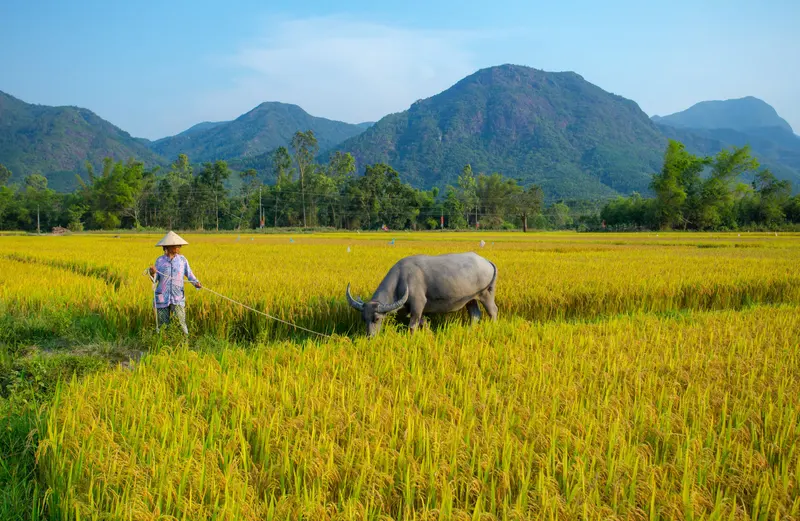
Cẩm Thanh, Trà Quế and Cẩm Hà: cafés on the edge of paddies and vegetable gardens.
Photo: Võ Văn Tiến, Pexels License
Hội An turns into farmland within a few kilometers of the Old Town. Trà Quế, about 2.5 km north of the center, has grown vegetables and herbs for more than 300 years, and to the east Cẩm Thanh keeps a 57-hectare forest of water coconut palms about 5 km from the old streets.13 Between and around them are rice paddies, and along their edges a scattering of cafés.
Coffee out here is mostly about the view over the fields and a breeze you won't get in town. The rice-field cafés fall into two clusters, one north toward Trà Quế and Cẩm Hà, the other east toward Cẩm Châu and Cẩm Thanh, and all of them are within cycling distance of the Old Town.
Local tip: Ask your homestay for a bicycle before you rent one, since many include it, and start with Trà Quế: it is only about 2.5 km north of the center.
Nothing matches those filters here. See all cafés in Hội An.
Trà Quế was settled more than three centuries ago by the Phạm, Mai, Nguyễn and Lê families, who fished before they farmed. Today 207 households grow about 55 kinds of vegetables and herbs on 18 hectares, among them coriander, basil, perilla and mustard greens, fertilized with green manure made from seaweed out of the Trà Quế lagoon and the Đế Võng river.1
The greens go into local dishes such as cao lầu, Hội An's noodle bowl.1 In 2024 the UN World Tourism Organization named Trà Quế one of its Best Tourism Villages.2
The Bảy Mẫu water-coconut forest in Cẩm Thanh covers 57.68 hectares about 5 km east of the Old Town. It served as a hideout for Hội An's revolutionary forces during the wars, and today visitors are paddled through it in thúng chai, round basket boats.3
Forbes named Cẩm Thanh one of the world's 50 most beautiful villages in 2025, the only Vietnamese village on the list. Since the 2025 merger, Cẩm Thanh and the vegetable village of An Mỹ belong to Hội An Đông ward of Da Nang.4
Hội An's farmers plant two main rice crops. The winter-spring crop goes in early in the 11th lunar month and is cut in the 3rd lunar month of the following year; the summer-autumn crop is planted in the 5th lunar month and harvested in the 8th.5 In the solar calendar that means roughly December to April and June to September.
An Mỹ held its lễ xuống đồng, the festival that opens the planting season, on 4 January 2026 for the 2025–2026 winter-spring crop.4 The weeks after it are when the paddies turn green, and February to April is also the mildest weather of the year, with daytime highs of 26–31°C.6
A rental bicycle costs 30,000–50,000₫ a day from shops near the Old Town as of 2026, and many homestays include one in the room rate.7
Nghé Coffee down Hẻm 32 Lê Thánh Tông is open 08:00–20:00 with Wi-Fi and outdoor tables, and Niem Khuc is at 169/2 on the same street. Thạch Thảo (186) and Cafe Nguyên Ly (141) are on Nguyễn Duy Hiệu. Yesh! at 198 Nguyễn Phan Vinh serves brunch from 07:30 to 14:30, and Miss Hoi An opens 07:00–19:00.
In Rice fields & villages, also browse: Outdoor seating Open late Wi-Fi Brunch
Trà Quế vegetable village is about 2.5 km north of Hội An's center, a short bicycle ride from the Old Town. It has grown vegetables for more than 300 years, today with 207 households farming about 55 kinds of vegetables and herbs on 18 hectares. In 2024 the UN World Tourism Organization named it a Best Tourism Village.
Hội An's rice fields carry two main crops. The winter-spring crop is planted early in the 11th lunar month and cut in the 3rd, roughly December to April; the summer-autumn crop runs from the 5th to the 8th lunar month, roughly June to September. February to April also brings the mildest weather, with highs of 26–31°C.
The Bảy Mẫu water-coconut forest is in Cẩm Thanh, about 5 km east of Hội An Old Town, and covers 57.68 hectares. Visitors are paddled through it in thúng chai, round basket boats. Forbes named Cẩm Thanh one of the world's 50 most beautiful villages in 2025, the only Vietnamese village on the list.
Free listings are free for good. A featured page gives you photos, a menu and your own URL, in your café's own design, for less than a coffee a day.