APPLE FARM
- Smoke-free indoors
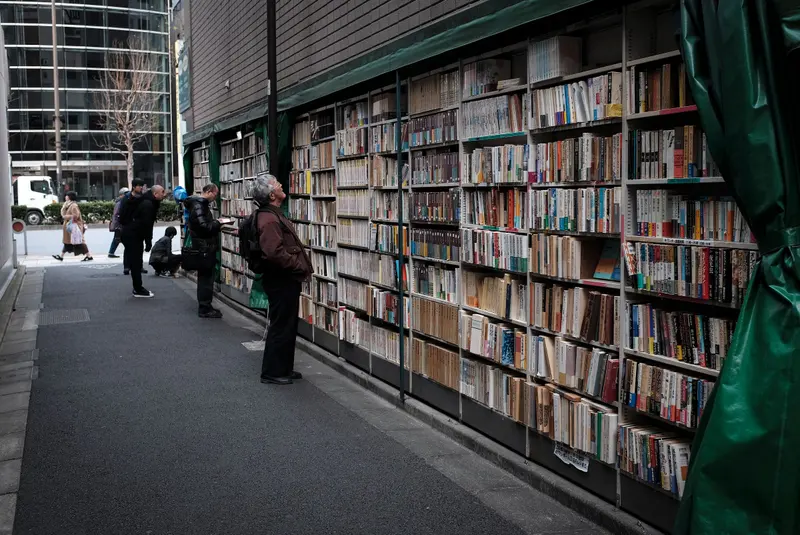
Tokyo's secondhand-book town, with postwar kissaten in its lanes and Akihabara to the east.
Photo: Hakan Nural, Pexels License
Jimbōchō is a district of Chiyoda ward that once belonged to the old ward of Kanda, and it is Tokyo's center for secondhand bookshops and publishers.1 After a large fire destroyed much of the area in 1913, the former teacher Shigeo Iwanami opened a bookstore here, the start of the publisher Iwanami Shoten.1 The Chiyoda tourism association counts roughly 120 secondhand bookshops in the district and calls it the largest such quarter in the world.2
Books and coffee grew up side by side. The kissaten (喫茶店, old-style coffee houses) sit in basements and narrow lanes a few steps off Yasukuni-dōri, close enough to carry a bag of finds to the table. East of the book town the neighborhood runs to Kanda Station and north into the Sotokanda blocks of Akihabara, where Neko JaLaLa, a cat café at 3-5-5 Sotokanda, and Akiba Fukurou, an owl café, sit among the electronics shops.
Local tip: Order the ウインナーコーヒー at Ladrio, the drink it is credited with bringing to Japan, before the evening, when the café turns into a bar.3
Saboul
Neko JaLaLa
LADRIO
KANDA BURAJIRU
Nothing matches those filters here. See all cafés in Tokyo.
Ladrio opened in 1949, and its name is the Spanish word for brick.3 It is known as the first café in Japan to serve ウインナーコーヒー (Vienna coffee, black coffee under whipped cream), which cost ¥650 in October 2024, and after dark it works as a bar.3 Weekday hours run 11:30–22:30, with a shorter 12:00–19:00 day on weekends.
Saboru, on the next lane, has been part of the neighborhood since 1955. Its walls carry tiki-style carvings, crafts left by regulars and decades of graffiti, and the menu runs to cream soda in seven colors and a twice-baked pizza toast.4 Saboru 2, its restaurant next door, takes the heavier plates, such as Napolitan spaghetti and ginger pork, and both are closed on Sundays.4
Kanda Burajiru (神田伯剌西爾, "Brazil" written in old-style kanji) opened in 1972 in a basement at 1-7 Kanda-Jimbōchō. It roasts its own beans from around the world and drips each cup by hand, and a Mandheling cost ¥600 in January 2024.5 It opens 11:00–21:00 Monday to Saturday and closes at 19:00 on Sundays.
Koseto, a gallery coffee shop, serves a charcoal-roasted house blend and single-origin coffees under paintings and a large mural, with curry and cake on the side.8 It opens daily 10:00–20:00. Coffee Erika is at 1-32 Kanda-Jimbōchō. For lighter, newer roasting, Glitch opens at 08:00 on weekdays and 09:00 at weekends, with seats inside and out, and Rec Coffee opens at 07:30 Monday to Friday.
South of Jimbōchō, the blocks of Kanda Sudachō keep a run of prewar wooden restaurants. Takemura, a three-story timber building of 1930 known for its shiruko (汁粉, sweet red-bean soup), is on Tokyo's list of selected historic buildings; the same list includes the soba house Kanda Matsuya, built in 1925, and Botan, built in 1929.6 Takemura opens Tuesday to Saturday, 11:00–20:00.
Near Kanda Station, Cafe Ace (珈琲専門店エース) has served coffee at 3-10-6 Uchikanda since 1971.7 Its known dish is nori toast: thin toast layered with toasted seaweed, soy sauce and butter, an idea taken from the nori bentō with bread in place of rice.7
Jimbōchō Station, on the Hanzōmon, Mita and Shinjuku subway lines, sits under the middle of the district.1 Each autumn the Kanda Secondhand Booksellers Association sets more than 100 book wagons along Yasukuni-dōri, a corridor about 500 m long. The 66th Kanda Furuhon Matsuri runs from 23 October to 1 November 2026, 10:00–18:00, closing at 17:00 on the last day.2
For an evening coffee, Vault Coffee stays open until 22:00 every day, and Base Camp and Cafe Chales serve until midnight. Korokoro Dou, a board-game café, opens until 23:00 all week.
In Kanda & Jimbōchō, also browse: Specialty coffee Open late Wi-Fi Outdoor seating Bakery cafés
The 66th Kanda Furuhon Matsuri runs from 23 October to 1 November 2026, 10:00–18:00, closing at 17:00 on the final day. More than 100 book wagons line Yasukuni-dōri in a corridor about 500 m long. Jimbōchō Station, on the Hanzōmon, Mita and Shinjuku subway lines, is under the middle of the district.
Ladrio, which opened in 1949, is known as the first café in Japan to serve ウインナーコーヒー, black coffee topped with whipped cream. Its name is the Spanish word for brick. The drink cost ¥650 in October 2024, and after dark the café works as a bar.
Ladrio dates from 1949 and Saboru from 1955, both near Jimbōchō Station. Cafe Ace near Kanda Station has served coffee and nori toast since 1971, and Kanda Burajiru opened in a basement in 1972 and roasts its own beans. Takemura in Kanda Sudachō, a sweet shop, occupies a wooden building from 1930.
Free listings are free for good. A featured page gives you photos, a menu and your own URL, in your café's own design, for less than a coffee a day.