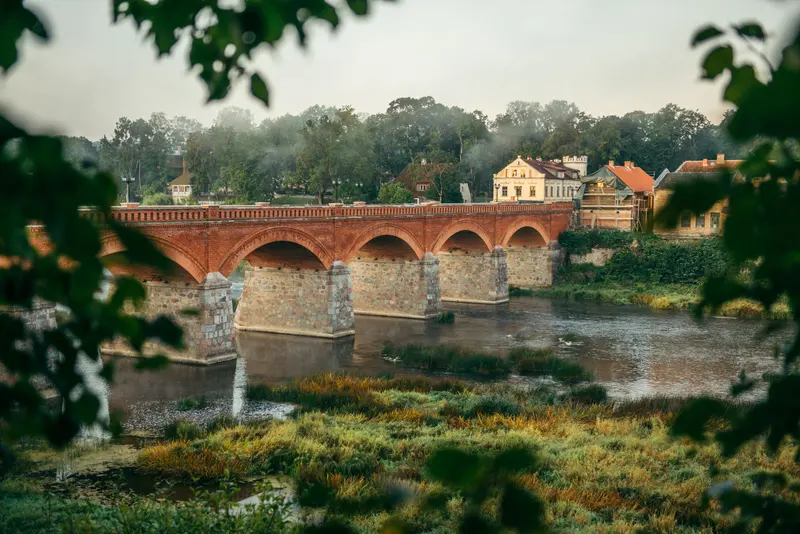
Cafés in Latvia Riga
Riga's Old Town and Art Nouveau Quiet Centre, roasters on Miera iela, Āgenskalns market, and black balsam stirred into coffee.
Photo: Santa Atte, Pexels License
The first coffee beans reached Latvian soil in the 17th century, in the Duchy of Courland and Semigallia.1 Latvia grows none, but roasting has become an export trade: the country had 36 tea and coffee producers in 2024, twice as many as a decade earlier, and its roasted coffee exports passed €54 million in 2025, a record.1
Coffee in Latvia also carries an excise duty of €142.29 per 100 kg,3 which neighboring Lithuania does not charge.4 About 6,280 tonnes were released for consumption in Latvia in 2025, against about 6,400 tonnes in 2024, and the excise on it came to €8.9 million.2 In September 2025 coffee cost 35.1% more than a year earlier, the largest single driver of food inflation, by the Central Statistical Bureau's figures.5
Latvia's café cities
From chicory to the Kaza
A coffee-tasting culture grew up during Latvia's first two decades of independence after 1918, alongside elegant cafés and the production of chicory coffee.1 The country's first coffee producer, Liepājas Kafijas fabrika, did not start until 1972.1
Under Soviet rule a café could be a refuge. In the 1960s a small nameless café in Riga's Old Town, which everyone called Kaza (the Goat), was the meeting place of young nonconformists, hippies and beatniks. Many of them became writers, poets, musicians, directors and politicians of independent Latvia, and Laima Žurgina's 2019 documentary Kaza kāpa debesīs (The Goat Who Climbed to Heaven) gathers them back.7
Kafejnīca or café
Latvian has its own word for the old neighborhood place, the kafejnīca (café). In 2005 the journalist Tim Ochser described kafejnīcas on Stabu and Barona streets with plastic ferns, floral wallpaper, slot machines and brandy poured in 50 g measures, and mourned their loss to new chains spelled with a C, such as Coffee Nation and Double Coffee.6
In the early 2000s most people ordered black coffee or coffee with milk, and few places made espresso, cappuccino or latte. International chains such as Costa Coffee and Caffeine changed those habits.1 All Cappuccino opened on Antonijas iela in 2004 and later added a second café on Vīlandes iela.8
Two spoons in a cup, then the roasters
As late as 2016, the coffee most Latvians drank was two teaspoons of pre-ground coffee in a cup, according to Mārtiņš Dzenis of Rocket Bean, who also said more cafés were opening in Riga while total coffee volume stayed flat.9
Rocket Bean began roasting in 2014 in its own café, and KALVE Coffee Roasters was founded in Riga in 2017; KALVE opened its first shop abroad, in Düsseldorf, in 2023. Smaller roasters now work in Rēzekne, Kuldīga, Gulbene and Sigulda.1
Black balsam and the konditoreja
Latvia's herbal liqueur often ends up in the cup. Riga Black Balsam goes back to Abraham Kunze, a Riga pharmacist who began developing a medicinal tonic in 1752; after the Second World War, former employees rebuilt the recipe from memory in 1950.12 Riga's tourist board calls a splash in coffee or tea perhaps the most common way to drink it, and the balsam shops also sell an Espresso flavor.12
Cake comes from the konditoreja (pastry shop), or in the regional word, the beķereja, a bakery or pastry shop.13 Chocolate is local too: Laima, Latvia's oldest chocolate factory, dates from 1870 and is the last of the old factories still working on Miera iela.10
Riga, from Vecrīga to Āgenskalns
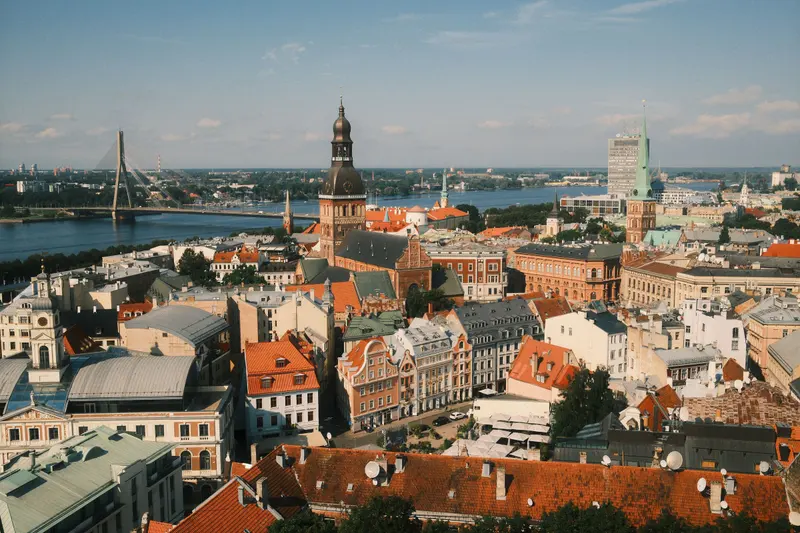
Vecrīga, the Old Town, is where the Kaza stood.7 North of it, the Quiet Centre (Klusais centrs) holds the core of Riga's Art Nouveau: the city has about 800 Art Nouveau buildings, mostly in the center and along Alberta iela, where the Art Nouveau Museum at number 12 keeps an architect's apartment as it was in 1903.11
Miera iela (Peace Street) began as a path to a graveyard outside the city limits and became a street when factories arrived in the late 19th century. Art Nouveau and National Romantic tenements followed in the early 20th, and some now have cafés on the ground floor.10 Rocket Bean opened its roastery café at Miera iela 29, across from the Laima factory, in 2015.9
Across the Daugava, Āgenskalns Market has traded since 1898. Its pavilion was renovated from 2018 and reopened in May 2022, with local produce and street food.14
Sources
- Latvian Specialty Coffee Roasteries (12 February 2026), Investment and Development Agency of Latvia (latvia.eu), accessed October 2026
- Kafijas un bezalkoholisko dzērienu aprite, 2. pielikums: Kafijas aprite (March 2026), Valsts ieņēmumu dienests (State Revenue Service), accessed October 2026
- Excise duty rates (updated 16 December 2025), State Revenue Service of Latvia, accessed October 2026
- Akcīzes nodokļa ietekme uz Latvijas kafijas tirgu / The Impact of the Excise Tax on the Latvian Coffee Market (Pašina, Stepaņenko, Zeimale, Jurušs, Hudenko, 2024), Riga Technical University, accessed October 2026
- Coffee in Latvia has increased in price by 35% over the year (8 October 2025), BB.lv, accessed October 2026
- The sad story of how "K" became "C" (Tim Ochser, 5 August 2005; first published in Rīgas Laiks), Eurozine, accessed October 2026
- The Goat Who Climbed To Heaven (Kaza kāpa debesīs), dir. Laima Žurgina, 2019, Latvian National Centre for Culture (nkc.gov.lv), accessed October 2026
- Riga's legendary café All Cappuccino celebrated its 20th anniversary (25 September 2024), L'Officiel Baltic, accessed October 2026
- Rocket Bean Riga: A Coffee Star Rises In Latvia (Daniel Scheffler, 3 February 2016), Sprudge, accessed October 2026
- The peace is deceptive: the history of Riga's hippest street (Agita Salmiņa, 25 November 2017), Deep Baltic, accessed October 2026
- Art Nouveau Museum, Live Riga (official Riga tourism portal), accessed October 2026
- Everything you've wanted to know about Riga Black Balsam, Live Riga (official Riga tourism portal), accessed October 2026
- beķereja, Tēzaurs.lv (University of Latvia, Institute of Mathematics and Computer Science), accessed October 2026
- Markets, Live Riga (official Riga tourism portal), accessed October 2026
Cafés in Latvia: questions
Is there a tax on coffee in Latvia?
Yes. Latvia charges an excise on coffee of €142.29 per 100 kg, which neighboring Lithuania does not. About 6,280 tonnes of coffee were released for consumption in Latvia in 2025, and the excise on it came to €8.9 million. In September 2025 coffee cost 35.1% more than a year earlier.
What is a kafejnīca in Latvia?
A kafejnīca is the Latvian word for a café, and it often means the older neighborhood kind. In 2005 a journalist described kafejnīcas with plastic ferns, floral wallpaper, slot machines and brandy in 50 g measures, then being replaced by chains such as Coffee Nation and Double Coffee. Espresso drinks were still rare in Latvia in the early 2000s.
Do people in Latvia put black balsam in coffee?
Yes. Riga's tourist board calls a splash of Riga Black Balsam in coffee or tea perhaps the most common way to drink it, and there is also an Espresso-flavored version. The herbal liqueur goes back to the Riga pharmacist Abraham Kunze, who began developing it as a medicinal tonic in 1752.
Your café deserves better than a pin someone else dropped
Free listings are free for good. A featured page gives you photos, a menu and your own URL, in your café's own design, for less than a coffee a day.