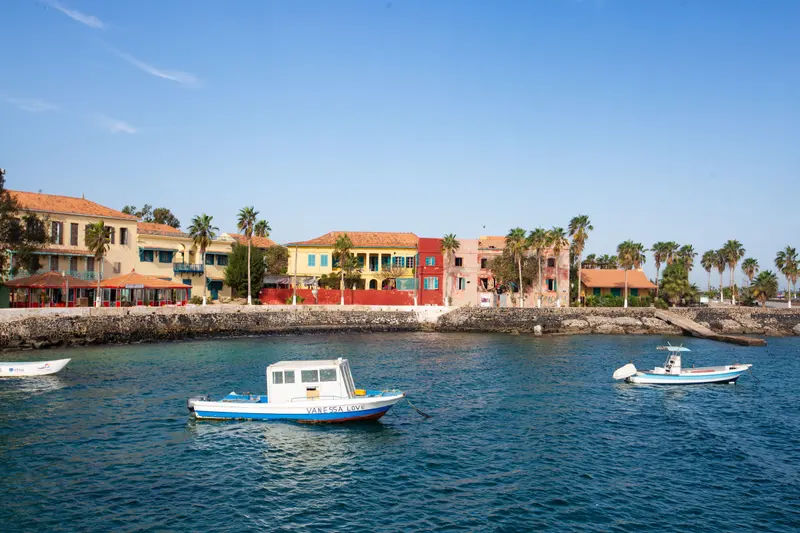
Cafés in Senegal Dakar
Café Touba spiced with djar, the Mouride story behind it, tangana stalls at dawn, ataya tea, and Dakar's Plateau and Almadies cafés.
Photo: Emeka Mbaebie, Pexels License
Senegal's own coffee is a blend of beans and spice. In café Touba, the beans go into the roaster together with djar (in Wolof; in English, grains of Selim), a peppery dried fruit from the Xylopia aethiopica tree, and sometimes with cloves. Spice and coffee are ground as one powder and dripped through a filter.2 An estimated two in three Senegalese drink it.1
The beans themselves are bought abroad. Most vendors use robusta imported from Côte d'Ivoire,1 and a 2018 APA report on the Dakar trade also named Benin as a source.3 In the same report, the journalist Elimane Ndao, who wrote his thesis on café Touba, said Senegal's coffee imports had multiplied ninefold in a short period, with the spiced drink speeding the rise.3
Senegal's café cities
Sheikh Amadou Bamba and the Mourides
Touba, the town that gave café Touba its name, is the spiritual center of the Mourides, a Sufi order; the name comes from the Hassaniya Arabic Ṭūbā, "felicity".2 It lies about 200 km from Dakar.3 Sheikh Amadou Bamba founded the order in 1883 and the city in 1887.1 The French colonial authorities sent him into exile in Gabon on 12 August 1895; he stayed there until 1902 and was then held in Mauritania from 1903 to 1907.6
Mourides credit him with the recipe. In the version APA recorded in Dakar in 2018, he saw colonists in exile drinking a local coffee to stay alert for work and decided it would serve his disciples in work and prayer.3 Every year the Grand Magal pilgrimage marks the day his exile began; in 2018 the crowd in Touba ran to hundreds of thousands, and some observers put it at about three million.6
How a Mouride drink went national
For close to a century café Touba remained mostly a drink of the brotherhood.1 The turn came with the 2008 financial crisis, which made imported coffee dearer and pushed the cheap local blend into the mainstream; a 2012 World Bank report, Living Through Crises, treated its spread as a social phenomenon.1
It also became a statement. A 2017 essay in Roads & Kingdoms cast each cup as a small, forceful refusal of imported goods like Nestlé's instant coffee and milk powder.10 Instant sales did fall in West Africa, and Nestlé brought out Nescafé Ginger & Spice,2 copying café Touba's ratio of roughly one part spice to four parts coffee.1 In neighboring Guinea-Bissau, where it was little known a few years earlier, café Touba is now the most popular drink.2
Café Touba at the tangana
Most café Touba is sold from tangana kiosks, small roadside counters that open at dawn and also serve breakfast; in March 2026 an omelette sandwich, peas and a café Touba there came to a few hundred CFA francs.8 Dakar has thousands of them.1 One seller told Africanews in 2016 that he starts brewing at 04:30 or 05:00 for customers who arrive at 06:00.5
The price per cup has crept up. Le360 Afrique found small cups at 50 CFA francs in 2022, with Ivorian beans roasted and ground at the Keur Massar market;4 by 2026 New Lines Magazine put a cup at 100 CFA francs, roughly 18 US cents.1 In 2018 a Grand-Yoff street vendor paid 1,200 CFA francs for 500 g of ground coffee, enough for a 20-litre bucket.3 The cup traditionally takes at least a few spoonfuls of sugar.10
Ataya, the after-meal tea
Coffee shares the day with ataya, the Wolof name for Senegalese tea. Chinese green tea, water and sometimes mint are boiled over a charcoal stove, sugared, and poured back and forth between a small metal pot and glasses to raise a foam.7 The words for the tea, the pot and the mint are mostly borrowed from Arabic, which points to a Moorish origin.7
The same leaves are brewed three times, and the first glass is the most bitter. The long preparation is the point: ataya is offered to friends and visitors after meals, and more than 80% of Senegalese aged 15 to 60 drink tea.7
Dakar: the Plateau, the Mamelles and the Almadies
Dakar sits on the Cap-Vert peninsula and is the westernmost city on the African mainland.9 The Plateau is its historic heart and the seat of most ministries; the French set up a military post at Ndakaaru in 1857, and the seat of government of French West Africa moved to Dakar from Saint-Louis in 1902.9 The district keeps a café and bistro culture, with French-style bakeries and newer coffee shops within a short walk of street stalls.8
The Mamelles district takes its name from two hills in Ouakam, Dakar's only real elevation; a lighthouse built in 1864 stands on one of them.9 The Almadies is where Dakar goes for seaside restaurants with ocean views, and its prices follow the setting.8
Sources
- How a Sufi Saint's Coffee Recipe Took Senegal by Storm, New Lines Magazine (Ryan Biller, April 24, 2026), accessed October 2026
- Café Touba, Wikipedia, accessed October 2026
- Café Touba, la boisson spirituelle des Sénégalais, Seneweb / APA (April 12, 2018), accessed October 2026
- Sénégal: le café Touba, une source de revenus pour de nombreux jeunes, Le360 Afrique (September 22, 2022), accessed October 2026
- Senegal: Touba coffee touching hearts in Dakar, Africanews (April 28, 2016), accessed October 2026
- Sénégal: des millions de mourides ont célébré le "Grand Magal" de Touba, Le360 Afrique (October 29, 2018), accessed October 2026
- Senegalese tea culture, Wikipedia, accessed October 2026
- Food and dining in Dakar, Expat.com (Julien Faliu, March 24, 2026), accessed October 2026
- Dakar, Wikipedia, accessed October 2026
- Resist Colonialism with Instant Coffee, Roads & Kingdoms (Angelica Calabrese, September 1, 2017), accessed October 2026
Cafés in Senegal: questions
What is café Touba from Senegal?
It is Senegalese coffee whose beans are roasted and ground together with djar (grains of Selim) and sometimes cloves, and the powder is dripped through a filter. The name comes from Touba, holy city of Senegal's Mouride brotherhood, whose founder Sheikh Amadou Bamba is credited with the recipe. An estimated two in three Senegalese drink it.
Does Senegal grow its own coffee for café Touba?
The beans used for café Touba in Senegal are imported, mostly robusta from Côte d'Ivoire, with Benin also named as a source. The djar spice is added in Senegal, where the beans are roasted and ground in markets such as Keur Massar. Coffee imports multiplied ninefold in a short period as the drink spread.
How much does a café Touba cost in Senegal?
A cup from a tangana street kiosk cost 100 CFA francs (roughly 18 US cents) in 2026, up from 50 CFA francs for a small cup in 2022. Tanganas open at dawn and also sell breakfast; in March 2026 an omelette sandwich, peas and café Touba came to a few hundred CFA francs.
Your café deserves better than a pin someone else dropped
Free listings are free for good. A featured page gives you photos, a menu and your own URL, in your café's own design, for less than a coffee a day.