 By Yannick Schroth
Coffee cultures · 4 min read · October 2026
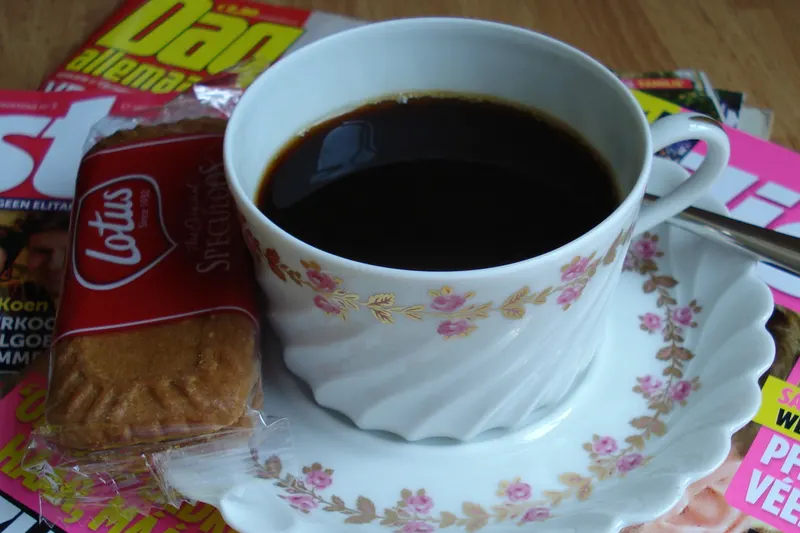
Order a coffee in a Belgian restaurant and something usually sits on the saucer beside it: a small speculoos biscuit or a piece of chocolate, which a respectable restaurant serves, according to the blendmaster Manuel DeMets.2 The coffee itself should be short and carry a lasting crema; a cup without one, he told the Brussels Times in 2022, is a catastrophe.2
Belgians drink 5.7 kg of roasted coffee per person a year, and almost 87% drink it daily, about four cups each, according to a market study by CBI, the Dutch government's import-promotion center, updated in March 2026.1 They tend to sit down with it rather than carry it away, and Tom Wuyts of the trade body Horeca Belgium sums up the setting: the country has a very strong bar culture.2
Speculoos, the biscuit on the saucer
The biscuit is most often a Lotus. The company dates its history to 1932, when Jan Boone Sr. baked a caramelized biscuit from natural ingredients and named it after the lotus flower, a symbol of purity.3 He set up the bakery in the Flemish village of Lembeke, aiming at the traditional Flemish speculoos given to children on Sint-Niklaas (Saint Nicholas) Day, 6 December.4
The recipe rests on wheat flour, candy syrup or caramelized sugar, and a blend of cinnamon, ginger and nutmeg.4 Flemish speculoos is not the same biscuit as Dutch speculaas, the magazine The Low Countries points out in its history of the brand.4
The pairing with coffee came early. In 1956 Lotus introduced the biscuit to the food trade as the one to serve with coffee, and it caught on in cafés.34 The export name Biscoff joins the words biscuit and coffee.4
Café, estaminet and coffee bar
In Belgium a café is first of all a pub. Flemings call the old neighborhood kind a volkscafé (people's café) or bruine kroeg (brown café), where beer comes in the glass made for it and a Duvel or a Westmalle is not out of place in the morning.5 The advice for fitting in, from the journalist Derek Blyth in 2020: order a coffee if there is coffee, or a strong beer.5 He described these cafés as slowly dying out.5
The older French word is estaminet, a modest-looking place that sells drinks. The Académie française dates it to the 17th century and traces it to the Walloon staminet, with the same meaning.6
The coffee bar, with a menu built around espresso, arrived late. Peter Scholliers, quoted by the Brussels Times, compared the arrival of chains such as Costa and Starbucks with McDonald's, which reached Belgium in the 1970s, much later than the Netherlands, because takeaway food sat badly with local habits.2 In most coffee bars, he noted, the signs advertise well-known brands such as Illy or the Belgian roaster Rombouts.2
Ordering in French and Dutch
Belgium splits its coffee words along its language line. In Brussels and Wallonia you order in French, in Flanders in Dutch, and a plain un café or een koffie is understood in either.
For the short, strong cup a good restaurant serves after a meal, DeMets uses mokkatje in Flanders and petit espresso in French.2 The café liégeois on a dessert menu is not a drink at all: it is iced.7
| Ask for | Language | What it is |
|---|---|---|
| een koffie / un café | Dutch / French | a coffee |
| een mokkatje | Dutch (Flanders) | a short-extracted coffee with crema2 |
| un petit espresso | French | the same short coffee, ordered in French2 |
| speculoos | French and Dutch | the spiced caramelized biscuit served on the saucer3 |
| café liégeois | French | iced coffee dessert under whipped cream7 |
Café liégeois, renamed in 1914
The café liégeois is a dessert: strong coffee poured over sugar, cooled, mixed with vanilla milk and cream, churned until barely frozen and served in a cup under whipped cream.7 Liège's tourist office notes that some restaurants simply pour cooled sweet coffee over ice cream, and that others serve a hot version under cream.7
It began in Paris as the café viennois, a name meant to borrow the luxury of Viennese coffeehouses for a dessert that does not exist in Vienna.7 In August 1914 Liège held off the German invasion for twelve days, forcing the invader to commit eight divisions where it had planned on one.7 Liège received the Legion of Honour on 7 August, Paris renamed rue de Berlin and its metro station after the city on 15 August, and restaurants rechristened the dessert café liégeois.7
An iced coffee preparation close to it already appeared in Auguste Escoffier's Guide culinaire of 1907.7
Antwerp, Europe's coffee warehouse
Most of the green (unroasted) coffee that enters Belgium leaves again. In 2024 the country imported 282,000 tonnes of green coffee, 88% of it straight from producing countries, and exported 184,000 tonnes onward, according to CBI.1 Antwerp has the largest stocking capacity of any harbor in Europe, and Molenbergnatie is the largest warehousing company there.1
VRT, the Flemish public broadcaster, put the stock in the port's warehouses at around 400,000 tonnes in October 2021, enough for 43 billion cups.8 A spokesman for Molenbergnatie gave Belgium's climate as the reason: temperature and humidity change slowly, and green beans react badly to swings.8 Antwerp is also better placed than Dutch or German ports to supply southern Europe.8
Brussels, from the Southern Netherlands to specialty bars
Coffee reached Brussels through trade at the start of the 18th century, when the city belonged to the Southern Netherlands.9 Its later supply has a colonial history. Belgium annexed the Congo in 1908, after Leopold II's Congo Free State, a forced-labor regime that caused an estimated 10 million deaths, and coffee growing spread in the Belgian Congo around Lake Kivu and in Rwanda.9 Belgian institutions helped make Coffea canephora (robusta) a global plantation crop while arabica farms elsewhere collapsed under leaf rust.9
Specialty coffee in the city is recent. MOK has roasted since 2012, starting with a café in Leuven before opening in the Dansaert district of Brussels, and Jackie on chaussée de Charleroi in Saint-Gilles opened in 2021.9 A map by OK Coffee Studio counted around 90 places serving specialty coffee in Brussels in 2026.9
A terrace costs the café more each year. In April 2026 Brussels City Council raised annual terrace fees on the Grand-Place and the Sablon from €39 to €50 per m², and on the central pedestrian boulevards by 50% to €35 per m² for terraces under 50 m².10 Smaller terraces elsewhere in the city stay at €19 per m².10
Tip. After a restaurant meal in Belgium, judge the coffee by the saucer and the surface: a short cup with a lasting crema and a speculoos or square of chocolate beside it is the standard a good kitchen sets.2