 By Yannick Schroth
Coffee cultures · 5 min read · October 2026
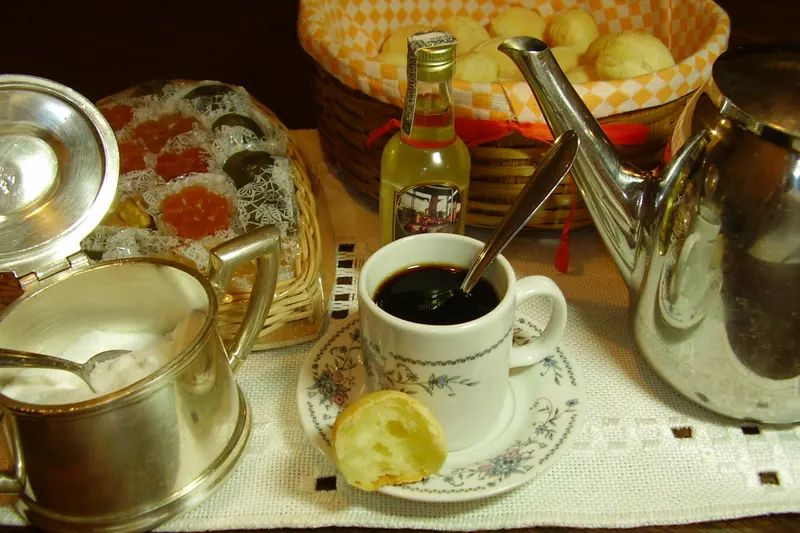
Cafezinho means small coffee,4 and in Brazil it is close to a synonym for welcome. Guests, clients at a business meeting and shoppers can all expect to be offered one, and in offices someone may come by and pour cups at people's desks.1 Made the traditional way, it is strained through cloth and served in a tiny cup, with the sugar dissolved in the water before the coffee goes in.1
Brazil grows about a third of the world's coffee and, unlike most producers, drinks a large share of it at home.9 Between November 2024 and October 2025, Brazilians got through 4.82 kg of roasted and ground coffee per person, and coffee was in 98% of households.8 The cup has become dearer: in São Paulo's padarias, filter coffee cost 36.5% more in 2025 than in 2024.6
Cafezinho and café coado
Cafezinho is not one fixed recipe. It usually means filter coffee, though depending on the family or region it can be an espresso.4 The filter coffee itself is café coado, and its classic tool is the coador de pano, a cloth filter that remains one of the oldest and most traditional ways to brew in Brazil.3
The historian Bruno Bort traces the Brazilian taste for filtered coffee to French manners the elite absorbed after the Portuguese court arrived in Rio in 1808, and argues that the cloth filter spread because it was simple, cheap and easy for anyone to copy.2 An 1865 joke in the Correio Paulistano has a servant assure his master that the coffee was well strained: through a wool stocking.2 By the early 20th century, café coado was cited as the national preference.2
Espresso took longer. It reached Brazil as early as the 1910s but struggled to win the market.2 The cloth filter, meanwhile, came back with the third wave of specialty coffee, which revived manual brewing methods.3 The trade around it keeps growing: Sebrae, the small-business agency, counted 38% more active coffee shops and coffee businesses in Brazil in 2025 than in 2020, about 482,000 in all.19
Pingado, média and café com leite
Milk drinks are where Brazilian words catch visitors out. A pingado is mostly hot milk with a little coffee, served in a small glass.45 A média is espresso with steamed milk and a thin layer of foam in a medium cup, a term used mostly in São Paulo bakeries.45 Café com leite is usually half coffee and half milk.4
For black coffee, a café curto is a small, strong cup, and an expresso duplo puts two shots in one cup.4 A carioca is an espresso made with more water, milder than the standard.4
| Order | What arrives |
|---|---|
| Um cafezinho | A small black coffee, usually filtered, sometimes an espresso4 |
| Café coado | Filter coffee, traditionally through a cloth filter3 |
| Café curto / expresso | A small, strong black coffee in a small cup4 |
| Expresso duplo | Two shots of espresso in one cup4 |
| Carioca | An espresso made with more water, milder4 |
| Pingado | Mostly hot milk with a little coffee, in a small glass45 |
| Média | Espresso, steamed milk and a thin layer of foam, in a medium cup; mostly a São Paulo word45 |
| Café com leite | About half coffee, half milk, in a medium cup4 |
What a cafezinho means varies by family and region.4
The padaria counter and pão de queijo
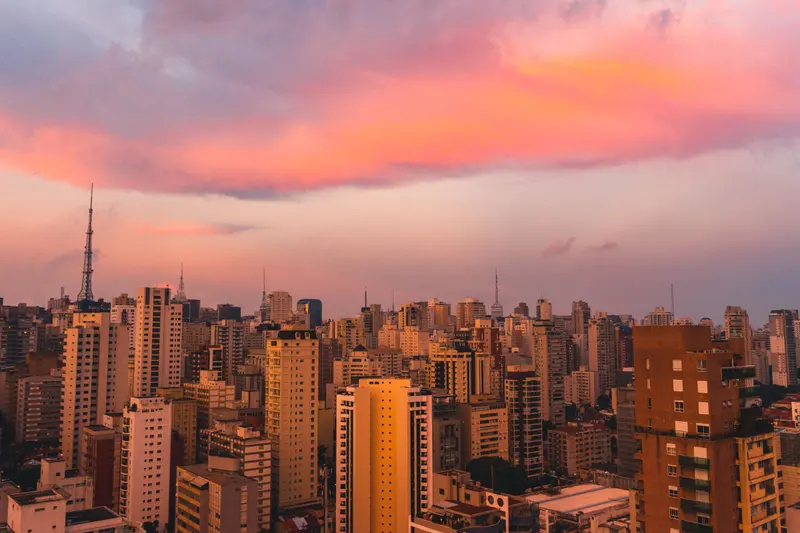
In São Paulo, much everyday coffee comes from the padaria, the neighborhood bakery, and Procon-SP, the state consumer agency, tracks its prices at 50 padarias across the city's five regions.6 In the September 2025 survey a cup of coffee averaged R$9.61, from R$7.71 in the Zona Leste to R$10.77 in the Zona Oeste. A small cup averaged R$6.37 and was cheapest in the Centro, at R$5.52.6
Procon-SP also prices coffee with pão na chapa, a buttered bread roll toasted on the griddle. The combination averaged R$16.52 in 2025, from R$14.06 in the Zona Leste to R$17.84 in the Zona Oeste.67 Outside the capital the same coffee costs far less: padarias in Presidente Prudente charged an average of R$3.83 for filter coffee in September 2025.7
Pão de queijo, a small cheese roll often eaten with coffee, comes from Minas Gerais. After mines were found near Ouro Preto around 1700, cooks there made bread from cassava starch because wheat was unavailable; grated hard cheese was added in the late 19th century.15 One averaged R$9.44 in São Paulo padarias in September 2025, against R$4.33 in Presidente Prudente.7
Santos and São Paulo's coffee fortunes
The first coffee bush in Brazil was planted in Pará in 1727 by Francisco de Melo Palheta.9 The fortunes were made further south. By the 1920s Brazil supplied 80% of the world's coffee, and the trade drew millions of immigrants, increasingly Italians, Spaniards and Japanese.9 São Paulo grew from 30,000 people in the 1850s to 240,000 by 1900.9
The beans went down to the sea by rail. The São Paulo Railway, a British company, opened on 16 February 1867 between the port of Santos, São Paulo and Jundiaí, built to carry coffee from the inland plateau to the coast; climbing the Serra do Mar took an 8 km cable-hauled incline.10 Under the Old Republic, from 1889 to 1930, national politics leaned on São Paulo's coffee elite and the dairy interests of Minas Gerais, hence the name café com leite.14
In Santos, the Bolsa Oficial de Café moved into its palace on Rua XV de Novembro on 7 September 1922, the centenary of independence.11 Most of Brazil's coffee export deals were negotiated there, when coffee made up about 70% of the country's exports.12 Benedito Calixto's panels in the trading hall compare Santos in 1822 and 1922; the last trading session took place in the 1950s.11 The palace reopened as the Museu do Café in 1998, and its cafeteria, opened in 2000, serves coffee from several Brazilian regions.11
The port still ships most of the crop: 78.7% of Brazil's coffee exports in 2025, about 31.5 million 60 kg bags.13
Rio's botequins and confeitarias
In 19th-century Rio, café and botequim were close to synonyms. Bort found one establishment advertised under both words in the Jornal do Commercio in 1841 and 1843, and the Café do Braguinha, among the city's best-known houses from the 1840s to the 1870s, was also called Botequim da Fama do Café com Leite.16 Places named Café were rare until around the 1850s, when they multiplied.16
Botequim, and its short form boteco, comes from botica, which once meant a shop rather than a pharmacy. Today a boteco is a small place selling drinks and cheap snacks.17
The confeitaria was the grander end of the trade. Confeitaria Colombo on Rua Gonçalves Dias was opened in 1894 by two Portuguese immigrants, Joaquim Borges de Meireles and Manuel José Lebrão, and a 1912–1918 renovation added crystal mirrors brought from Antwerp.18 The novelist Lima Barreto called it a branch of the Brazilian Academy of Letters.18
Tip. In a São Paulo padaria, the small cup is the cheaper order: it averaged R$6.37 in September 2025, against R$9.61 for a regular cup of coffee.6