 By Yannick Schroth
Coffee cultures · 5 min read · October 2026
Qahwa, the Arabic word that gave English "coffee", most likely first meant "dark".8 The drink spread from Sufi communities in 15th-century Yemen, who used it to stay alert through night prayers, to Mecca and Cairo, and reached Istanbul in 1554.8 The same word now covers very different cups: a pale, saffron-tinted brew in the Gulf, a dark cardamom coffee boiled with its grounds in the Levant, and a Turkish-style cup sweetened to order in Egypt.49
What links them is hospitality. In 2015 UNESCO inscribed Arabic coffee, "a symbol of generosity", on its list of the intangible cultural heritage of humanity, on a joint nomination from the United Arab Emirates, Saudi Arabia, Oman and Qatar.1 Jordan joined the listing in 2024.2 The rules for pouring and drinking are few, and most of them concern the cup and your right hand.23
Gulf gahwa: saffron, cardamom and a light roast
In the Emirates the drink is called gahwa, and it starts with green beans. They are sorted, washed, dried and roasted in a tawa, a wide round pan, until red or brown, then ground and boiled with cardamom in the large pot, the dallat al-khumrah.3 Gulf coffee, qahwa khaleeji, is typically bright yellow from heavy use of saffron and cardamom and a very light roast; some recipes add cloves.4
UNESCO's file describes the older routine: beans lightly roasted in a shallow pan over a fire, pounded in a copper mortar, boiled in a large copper pot, then poured into a smaller pot and from there into small cups, traditionally in front of the guests.1 Its main bearers are sheikhs and tribal heads who serve it in their majlis (reception rooms), elderly Bedouin men and women, and the owners of coffee shops that trade in beans.1
Saudi Arabia declared 2022 the Year of Saudi Coffee and told restaurants and cafés to say "Saudi coffee" instead of Arabic coffee.5 The kingdom's main home-grown variety is Khawlani, from Jizan in the southwest; its beans are often blended with cardamom and saffron, which turns the cup yellowish.5 In Najran, cups are smoked with mastic before serving.5
The dallah, the finjan and the cup shake
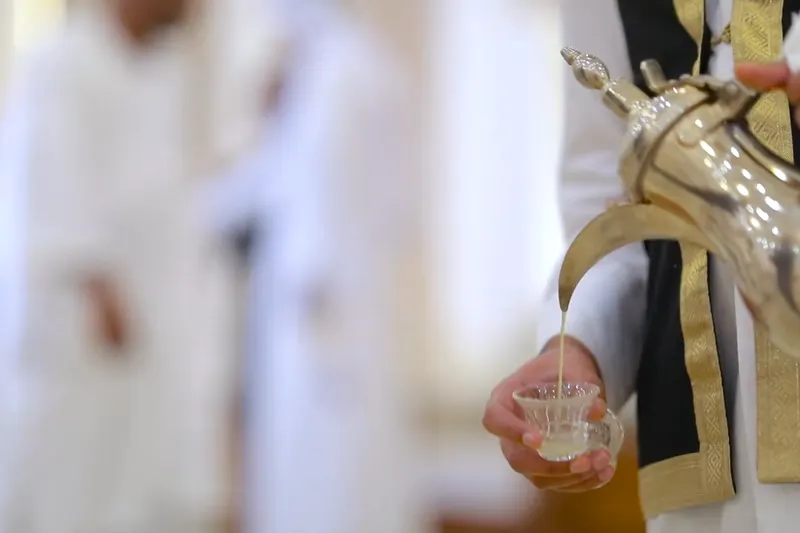
The dallah, the beaked coffee pot, comes in three working types in an Emirati set: one for boiling, one for filtering and one for serving.3 The cup is the finjan (finjal in the Emirates), small and without a handle.34 The server offers it in the right hand, and you take it and hand it back with your right hand too.3
The oldest or most important guest is served first.1 Each cup is filled only about a quarter of the way and can be refilled; a guest is expected to drink at least one cup and no more than three.1 When you have had enough, shake the cup gently as you hand it back.2 On the Arabian Peninsula the coffee almost always comes with dates, which offset its bitterness.4
The occasions run from daily visits to weddings and tribal gatherings held to settle disputes, where the coffee is part of the reconciliation.2 Gatherings often include poetry and the sharing of memories.2 On special occasions, specialists take over the preparing and serving.1
| Moment | What to do |
|---|---|
| Serving order | The oldest or most important guest is served first1 |
| Taking the cup | Receive it and return it with your right hand3 |
| How full | About a quarter of the cup, refilled as you go1 |
| How many | At least one cup, no more than three1 |
| Finished | Shake the cup gently as you hand it back2 |
| Alongside | Dates, almost always, on the Arabian Peninsula4 |
Customs vary by country; in Jordan, guests tilt the cup from side to side to decline.7
Jordan: bitter sada and Bedouin coffee
In Jordan, qahwa sada (plain coffee) is black, flavored with cardamom and unsweetened. It is often called welcome coffee, and serving it is a traditional sign of respect.4 Bedouin coffee more generally goes by qahwa murra, bitter coffee, and can be brewed for up to several hours.4 Jordan has kept the practice on its national inventory of intangible heritage since 2012.2
In a Bedouin tent the beans are roasted over the fire and pounded in a mehbash, a wooden or metal mortar whose rattle tells neighboring tents that coffee is on.7 The host pours no more than a tablespoon at a time and taps the spout on the rim to stop the drip.7 Hold the cup out for more; to decline, tilt it from side to side two or three times as you return it.7 Swirl hot coffee rather than blowing on it.7
Lebanese ahweh and the rakweh
In Lebanon and the wider Levant, coffee is close to the Turkish style: finely ground, dark or mixed roast, usually spiced with cardamom and boiled in a long-handled pot called a rakweh.46 For bigger batches and in Bedouin areas, a larger long-spouted pot takes over.4
A Lebanese recipe uses one cup of cold water and one teaspoon of ground coffee per cup, heated as slowly as possible and taken off the heat each time it rises, three times in all.6 Sugar goes in during brewing, so hosts ask how you take it; the Levantine scale runs from sada (unsweetened) through wasat (medium) to hilwe (sweet).46 The coffee is poured in front of you into cups about the size of espresso cups and served on a tray with a glass of cold water.6
Coffee is offered on almost any visit, however short.6 Accepting three cups is polite in the Levant, and the last is traditionally finished with daymen, "always", wishing the host the means to keep serving.4 After a heavy meal a Lebanese host may bring kahweh baida, white coffee, which is hot water scented with orange blossom water and contains no coffee at all.6 Some hosts read the grounds left in your cup.6
Cairo's ahwa
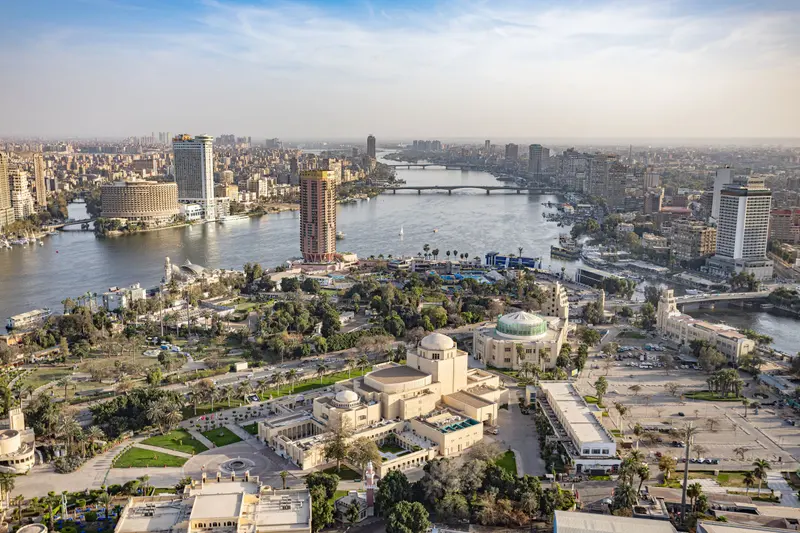
Tea is Egypt's national drink, with coffee a distant second, yet the street coffeehouse is still called an ahwa, the Egyptian pronunciation of qahwa.9 Coffeehouses opened around Al-Azhar in Cairo in the early 1500s.8 Today's ahwa serves tea, Turkish-style coffee and shisha (water pipes), plus karkadeh, a chilled hibiscus drink, and lemonade in summer, and sahlab and aniseed tea in winter.9 Dominoes and backgammon keep the tables busy.10
Coffee is brewed in a kanakah, a small pot, and served in a fengan.9 You order by sugar: sada is unsweetened, aal riha slightly sweet, mazbout medium, about a teaspoon a cup, and ziyada sweet.49
Ahwas were long a male space; in the cities they are now used by everyone, and tourists are almost always welcome.910 El Fishawy, in the Khan el-Khalili market, opened in 1797 and has been run by the same family for at least seven generations. Naguib Mahfouz was among the writers who sat there, and it is open 24 hours a day.11
Dubai and Doha: the specialty trade
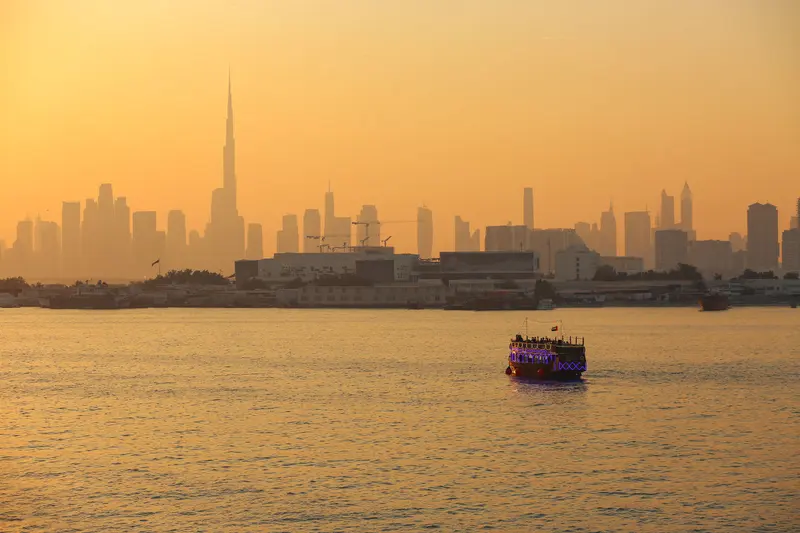
The Gulf's specialty coffee trade now has its own fairs in Dubai and Doha. World of Coffee Dubai, run by Dubai World Trade Centre's events arm DXB Live, held its fourth edition from 10 to 12 February 2025 with 1,980 companies from 78 countries; exhibitor numbers rose 50% and the show added a fourth hall.12 The Dubai Coffee Auction was presented there as a way to anchor the city in the global coffee trade.12
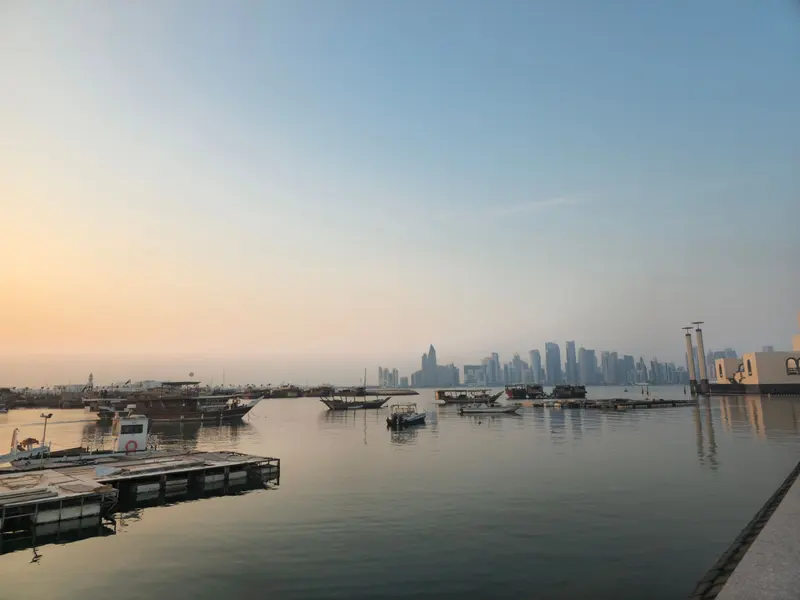
In Qatar, QatSCA, the national specialty coffee association, has worked since 2019 to promote the country's coffee culture. Its Qatar World Coffee Expo, formerly the Doha International Coffee Exhibition, ran from 23 to 25 January 2025 in Hall 7 of the Qatar National Convention Centre.13 Since its first edition it had drawn more than 340 exhibitors and 12,945 visitors, and a forecast cited by the organizers expects Qatar's coffee market to grow 7.5% a year from 2024 to 2030 on demand for specialty coffee.13