 By Yannick Schroth
City guides · 6 min read · November 2026
The Netherlands drinks about 33.5 million cups of coffee a day, black first and cappuccino second.1 Most of it is brewed at home or at work, and the country roasts for its neighbors too: it imports about 180,000 tonnes of green beans a year and, largely through JDE Peet's, the group behind Douwe Egberts, ranks as the world's third-largest coffee exporter after Italy and Germany.1
Out of the house, Amsterdam pours coffee in four settings: the brown café, the grand café, the koffiebar (coffee bar) and the roaster's own counter. The daytime ones are gaining. Koninklijke Horeca Nederland, the hospitality trade association, counted about 1,400 coffee and dessert shops in the Netherlands in 2020 and more than 2,000 in 2025, while the number of cafés and nightclubs fell by more than a fifth.2
Coffeeshop, koffiebar, koffiehuis
The first word to learn is the one to avoid. Under Dutch policy a coffeeshop is a place that sells cannabis and may not sell or serve alcohol. Selling soft drugs is still an offense, but prosecutors tolerate it as long as the shop causes no nuisance, sells no hard drugs, serves no minors, does not advertise and sells no more than 5 grams at a time.3 Since 1 January 2013 they have been limited to registered Dutch residents, though each municipality decides how actively to enforce that.3
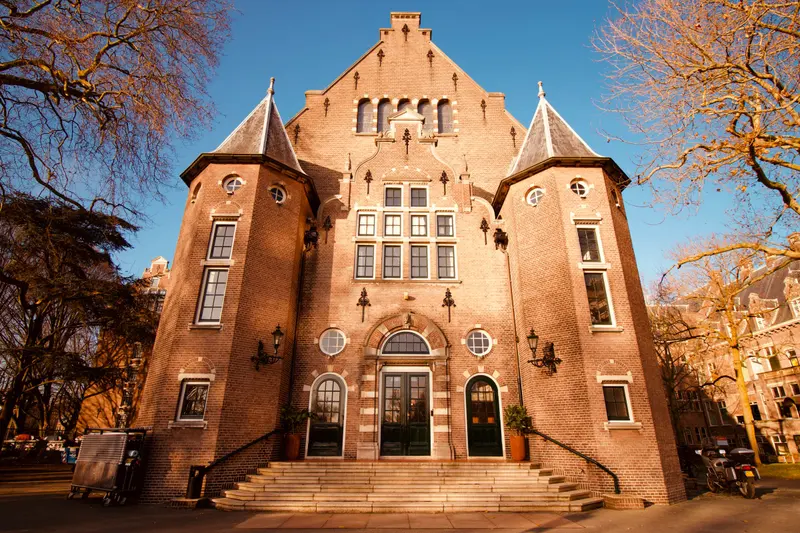
For an espresso, the sign to look for says koffiebar, café or grand café. The older word koffiehuis (coffee house) survives on one landmark opposite Centraal Station. The Noord-Hollands Koffiehuis was built there in 1911 to a design by J.H.W. Leliman, inspired by the North Holland stolp farmhouse, and opened on 29 April 1912 as the boat stop for the tram across the IJ to Purmerend and Volendam.4
The building was taken apart in 1972 for the metro works, its numbered pieces stored in a warehouse, and put back together in 1980 on a slightly different spot. Smits Koffiehuis occupied it from 1919 to 2014, and since 2016 it has been a branch of the restaurant Loetje.4
Brown cafés, open from the morning
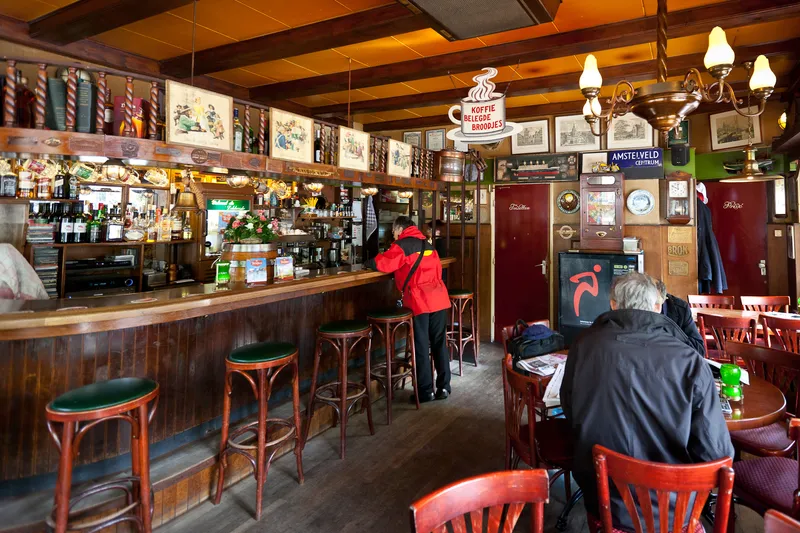
The bruin café (brown café), or bruine kroeg, goes back to the early 19th century, when more and more people fitted out their front rooms as places to drink, often so that a wife could add to the income of a husband who was regularly out of work.5 An 1881 law ended the free-for-all: it required a fairly expensive license and allowed no more than 500 of them in each of the largest cities.5
Many Amsterdam brown cafés had their names painted on the window in a calligraphic letter designed in the 1950s by Jan Willem Visser, a freelancer who painted café windows for Amstel beer; Heineken's sign painter, Leo Beukeboom, later took over the job. In 2012 the lettering could still be seen on 20 cafés.5 Some rooms are older than the type. Café Chris on Bloemstraat opened in 1624 as a beer house, and by local legend the builders of the nearby Westertoren collected their wages there.6
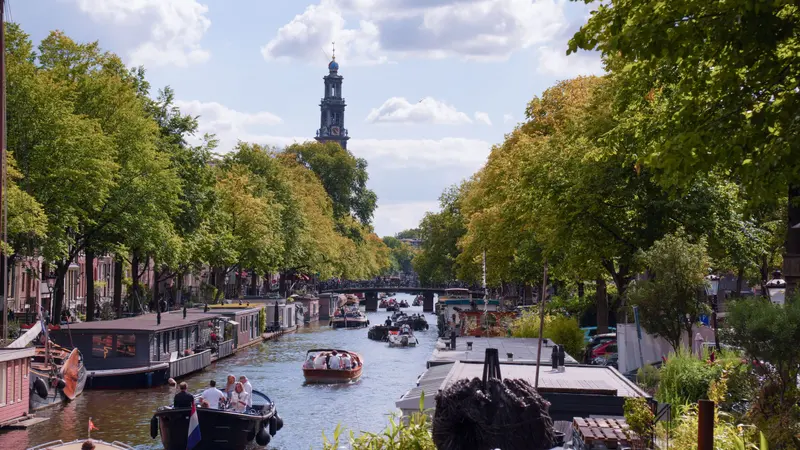
Coffee is served long before the first beer. Café Kalkhoven, on the corner of the Prinsengracht and the Westermarkt at the foot of the Westertoren, keeps behind its bar the barrels that drinks were once tapped from, and it opens at 09:00 from Tuesday to Saturday and at 10:00 on Sunday.7 Café de Wetering on Weteringstraat fills a 17th-century canal house in the Spiegelkwartier, the art and antiques quarter, with regulars at the tiny downstairs bar and an open hearth upstairs.6
Koffie verkeerd and a slice of appeltaart
Koffie verkeerd means wrong coffee, and the wrong part is the milk. Ordinary Dutch coffee took at most a splash of milk or cream, while the original koffie verkeerd was no more than half filter coffee and at least half warm milk.8 In Belgium the same drink is called a lait russe. Since most cafés now work with Italian espresso machines, it is usually built on an espresso or a lungo, which leaves nothing to separate it from a caffè latte.8
Café Americain on Leidseplein has stopped pretending otherwise: its April 2026 drinks menu lists "koffie verkeerd, caffè latte" as a single line at €4.75.9
The cake that goes with it is appeltaart (apple pie). A recipe appears in Een notabel boecxken van cokeryen, a cookbook printed in 1514.10 Two versions dominate: the classic with a lattice top and the appelkruimeltaart, finished with crumble, both usually made with goudreinet apples.10 Coffee with a warm wedge, with or without slagroom (whipped cream), is served at nearly every restaurant in the country, and the newspaper Algemeen Dagblad runs an appeltaart test every year.10 Café Americain's slice, with cinnamon, cost €6.95 in April 2026.9
Specialty coffee beyond the canals
The roasters' bars have spread well past the center. In Bos en Lommer, Fuku is the café of the roaster Friedhats, staffed by award-winning baristas, with coffee bought directly from farmers or from European importers and kimchi sandwiches and lemon cake on the counter.11 East of Centraal Station, Barmhartig sits at the top of a stairway on Veemkade, looking out over the IJhaven, and brews espresso, AeroPress or slow drip.11
In Oost, YUSU on Andreas Bonnstraat is known as much for matcha as for coffee, with crème brûlée cake and iced taro matcha, and Five Ways, on Boerhaaveplein and on Kinkerstraat, has served 100% arabica since 2017.11 Across the IJ, The Coffee Virus on Overhoeksplein brews by V60, AeroPress, Chemex and siphon for a room of freelancers. In De Baarsjes, White Label Coffee roasts and pours on Jan Evertsenstraat and also supplies schuurmanoomkensgrassotti, a coffee bar on the Overtoom.11
Beans to take home show the gap with the supermarket. In November 2026 Monks Coffee Roasters, which roasts every week in Amsterdam, sold its Cafe Blend at €14.95 for 250 g, and White Label asked €17.50 for 250 g of a washed Kenyan AA.1213 That is €60 to €70 a kilo, about three times the €20 to €22 a kilo that a supermarket A-brand cost in early 2026.1
What coffee costs, 2023 to 2026
Coffee has grown dearer at both ends. A pack of A-brand coffee cost about €14 a kilo in January 2024 and €20 to €22 by early 2026, after JDE Peet's put through several increases of 15–25% in 2024 and 2025.1 Brewed at home, a cup of filter coffee still came to about 9 to 15 cents in June 2025, by an ING economist's count of some 143 cups per kilo.14
Out of the house, Misset Horeca's 2023 survey of more than 1,200 hospitality businesses put the average coffee in Amsterdam at €3.65. Nationally, cappuccinos ran from €2.55 to €3.75, and more than 80% of businesses had raised their coffee prices that year.15 Oat or nut milk was on offer at 67% of them.15
A grand café on a big square sits well above those figures. Café Americain's April 2026 menu lists an espresso at €4.25, a coffee at €4.50 and a cappuccino at €4.75, with oat or soy milk €0.50 extra.9 Relief is expected to be slight: BDO forecast a 10–15% fall in commodity prices for 2026, with prices settling above their pre-2025 level.1
| Order | Price | Where and when |
|---|---|---|
| Filter coffee brewed at home, per cup | €0.09–0.15 | Netherlands, June 202514 |
| Cappuccino, cheapest to dearest | €2.55–3.75 | Netherlands, 202315 |
| Coffee, average | €3.65 | Amsterdam, 202315 |
| Espresso | €4.25 | Café Americain, Leidseplein, April 20269 |
| Coffee | €4.50 | Café Americain, April 20269 |
| Cappuccino or koffie verkeerd | €4.75 | Café Americain, April 20269 |
| Apple pie | €6.95 | Café Americain, April 20269 |
| Specialty beans, 250 g | €14.95–17.50 | Monks and White Label, November 20261213 |
| A-brand supermarket coffee, 1 kg | €20–22 | Netherlands, early 20261 |
Café prices are menu prices. The 2023 figures come from Misset Horeca's annual price survey.
Cards, cash and closing times
Cards are the norm. When De Nederlandsche Bank had more than 5,000 shops and 1,000 market stalls checked in 2025, 4% displayed a "PIN only" sticker, but in cities of more than 175,000 people about one outlet in eleven took cards only.16 PIN here means a debit card, usually from a Dutch bank. Many terminals have been updated to take Visa and Mastercard debit and credit cards, yet a credit card from home can still be turned down, partly because merchants avoid processing fees of about 1.8%.17
Keep a few euros in coins all the same: 78% of retailers ask customers to pay cash when card payments go down.16
Specialty bars keep shop hours. Toki, on Binnen Dommersstraat just off the Haarlemmerstraat, opens 08:00–17:00 on weekdays and 09:00–17:00 at weekends.18 For a coffee after dark, a brown café is the surer bet: Café Kalkhoven stays open until midnight from Tuesday to Sunday.7