 By Yannick Schroth
How to order · 7 min read · November 2026
In Spain the word café covers the drink, the cup and the room it is served in. The Real Academia Española's dictionary gives all three senses, with an example that could come from any bar: ¿Cuántos cafés ponemos?, how many coffees shall we pour?1 It even has a term for a breakfast that is nothing but a coffee: café bebido.1
Spain pours about 22 million cups of coffee a day, according to the Asociación Española del Café, and most of them carry milk: in Square's 2024 data from Spanish bars and cafés, eight in ten coffees were ordered with it.5 Behind the milk is a roast most visitors have never met at home. Torrefacto, coffee roasted with sugar, is the typical bar coffee and fills much of the supermarket shelf.4
Solo, cortado, con leche and manchado
Start with the plain cup. The dictionary defines a café solo, also called café negro or café puro, as coffee made by adding only water to the ground beans.1 Cut it with a short splash of milk and it becomes a cortado, served in a small cup.5 In Square's 2024 study the cortado made up 12.2% of coffee orders, against 11.9% for an espresso and 8.4% for an americano, the longer black coffee.5
A café con leche puts milk, steamed to just under the boil, into strong coffee, usually espresso, at about one to one.3 Ordered en vaso (in a glass) or de desayuno (the breakfast version), it can carry more milk.3 Say yo lo preparo, I'll make it, and the espresso and the steamed milk arrive separately for you to combine.3
At the milky end sits the manchado, or leche manchada: a glass of warm milk "stained" with a small amount of coffee.3 The café con leche itself accounted for 16.9% of orders in Square's sample, behind the latte at 20.9%.5
Bombón, leche y leche and barraquito
Condensed milk turns the cup into dessert. The café bombón comes from the Valencia region and is now ordered across Spain: usually two parts espresso poured over one part condensed milk, served in a transparent glass that shows both layers until you stir.8 On parts of the Levante coast, it is customary to add a few drops of lemon juice.8
The Canary Islands stack the layers higher. A leche y leche puts coffee, condensed milk and ordinary milk in a tall, narrow glass, three colors one above the other.11 The barraquito slips liqueur, usually Licor 43, between them and finishes with frothed milk, cinnamon and a strip of lemon peel.11 Legend names it after Sebastián Rubio, nicknamed El Barraquito, a regular at the Bar Imperial near the Plaza de la Paz in Santa Cruz de Tenerife, who always asked for his coffee this way.11
The names are shifting. Many places on Tenerife now call any coffee with condensed milk a barraquito, so the version with liqueur is ordered as a barraquito especial, and in the north of the island the original is called a zaperoco.11 Murcia has a close relative: the café asiático of Cartagena layers coffee, condensed milk and Licor 43.13
Carajillo, café del tiempo and café con hielo
A carajillo is hot coffee mixed with a high-proof spirit, and the dictionary's own example has one after lunch, made with anís (aniseed liqueur).2 Bars build it in two ways: the spirit poured straight into the coffee, or set alight in an empty cup before the coffee goes in.13
Nobody knows where the name comes from. The most-cited theory points to Cuba's war of independence of 1895–1898, when Spanish troops are said to have drunk coffee with rum before going to the front for a little coraje (courage), a corajillo.12 R. Hierro of the Osborne drinks group says it was Spanish brandy rather than rum, while the journalist Paco Alonso notes that brandy-type spirits spread in Spain only in the 20th century.1312
Each region has its own word. The drink is kafe patardun in the Basque Country and Navarre, rebentat or cremaet in the Balearic Islands and the Valencia region, and cigaló in Catalonia, where before the Civil War that word meant the glass of spirit served beside the coffee, drunk one after the other rather than mixed.13
For a cold coffee, ask for a café del tiempo, literally coffee of the weather: hot coffee poured over ice should end up at about the temperature of the day.9 It comes as a coffee with a glass of ice and sometimes a slice of lemon.9 Outside the Valencia region and Catalonia, the phrase can bring a drink at room temperature instead, so say café con hielo (coffee with ice).109 The formula fits any order: cortado del tiempo, café con leche del tiempo, even bombón del tiempo.9
Torrefacto and the taste of bar coffee
Torrefacto is the typical roast of the Spanish bar. Sucrose or glucose syrup goes in during roasting and leaves the beans in a film of caramel, and the result is so bitter that many people add more sugar in the cup.4
The method has a Caribbean precedent: the earliest record of something similar comes from Cuba, where miners roasted coffee with sugar so it would keep through long periods underground.4 In Spain it belongs to José Gómez Tejedor, from Extremadura, founder of Cafés La Estrella, who learned the technique on a trip to the Caribbean in the late 19th century and patented it in 1901. Until 1921, only his company could use it.4
Scarcity made it standard. During and after the Civil War, coffee was short, and a roast that kept longer and stretched the beans became the default across the Iberian Peninsula; by the time conditions improved, the taste was too established to go.4
Read the label on a bag. In Spain, mezcla means natural roast blended with torrefacto, commonly 50/50, 70/30 or 80/20, while in specialty coffee a blend is several origins, all naturally roasted.4 Xataka puts acrylamide, a compound formed in roasting, at about 800 μg/kg in torrefacto against about 180 μg/kg in natural roast; the EU benchmark for roasted coffee is about 400 μg/kg.4
The barra, the tostada and the hour for each cup
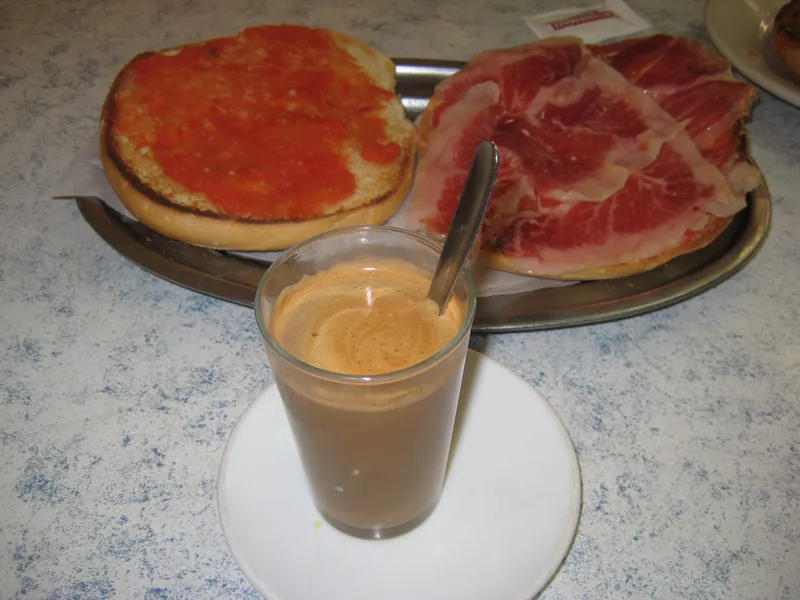
Café con leche is the morning cup: the milk makes it heavier and more filling than black coffee, and it is treated as a breakfast drink.3 Its partner is toast. A traditional Spanish breakfast of coffee, milk, sugar and toast with olive oil cost 8% more in the year to August 2025, according to Javier Rivas of EAE Business School; coffee rose 20.2%, while olive oil fell by more than 40%.7 Churros are breakfast food too, usually with a cup of hot chocolate or a café con leche.19
Old counters are built for a quick cup on your feet. In Barcelona's Barri Gòtic, the Mesón del Café has been a tiny, tile-walled counter since 1909, and regulars take their cortado standing at the marble.16
Some drinks belong to a later hour. In the Valencia region, the cremaet, a carajillo of flamed rum, closes the mid-morning almuerzo, and the dictionary's example sentence puts the carajillo after lunch.122 The café del tiempo is mostly ordered in the hot months of spring and summer, though some people drink it all year.9
What coffee costs in euros
Coffee was the product whose price rose most in Spain in 2025, with increases above 15% in the first months of the year.6 By January 2026, a café con leche at a bar usually cost €1.70 to €2, depending on the city and the neighborhood.6 In Bilbao the average was about €2, and in Logroño, one of the cheapest capitals at €1.37 in 2019, it had reached €1.60 to €1.90.6
Averages were higher in 2024 at bars and cafés using Square's payment system: €2.14 on average for an espresso, €2.38 for a café con leche and €3.14 for a flat white, the dearest drink in the sample.5 At specialty cafés, a cup cost €2.50 to €5 in 2026, depending on origin and method.14
| Order | Price | Where and when |
|---|---|---|
| Café con leche at a bar | €1.70–2.00 | Usual Spanish range, January 20266 |
| Café con leche | about €2 (average) | Bilbao, January 20266 |
| Espresso | €2.14 | Average, Square sample, 20245 |
| Cortado | €2.22 | Average, Square sample, 20245 |
| Café con leche | €2.38 | Average, Square sample, 20245 |
| Americano | €2.55 | Average, Square sample, 20245 |
| Cappuccino | €2.82 | Average, Square sample, 20245 |
| Flat white | €3.14 | Average, Square sample, 20245 |
| Specialty coffee | €2.50–5.00 | Specialty cafés, August 202614 |
Bar prices are from NueveCuatroUno's survey of January 2026; the averages come from bars and cafés using Square's payment system, published in May 2024.
Specialty coffee in Madrid and Barcelona
Specialty coffee means beans that score above 80 of 100 points in a professional cupping under Specialty Coffee Association standards.14 Madrid's last Coffee Fest gathered more than 240 cafés from around the world and drew over 60,000 visitors, Diario Qué reported in August 2026.14
Some Madrid roasters also teach. Cero Coffee Roasters, on Calle de Alcántara in Salamanca, sells 250 g bags from €11 as of November 2026 and runs paid cuppings.18
Barcelona's roasters compete as well as pour. Right Side Coffee began in 2012 in the garage of its founder, Joaquín Parra, who won Spain's SCA roasting championship in 2013 and 2017; it roasts on a restored Probat L12 from 1993 and a UG22 from 1959.17 Its bar is on Carrer de l'Arc de Sant Ramon del Call, in the Barri Gòtic.
Nomad supplies small cafés as far away as Granada, Bilbao and Santiago de Compostela. Besides its bar down a passage in the Born, Nomad Frutas Selectas in Poblenou combines a café with the roastery.15 Three Marks is named after its three founders, all called Marc or Marco, and Ugot, a brunch café in the Eixample, pours beans from Familia Osorio, the 2025 Spanish roasting champions.15 In Poblenou, SKYE Coffee brews direct-trade beans from a vintage Citroën van parked inside a concrete design space.16
Tip. On Tenerife, a plain barraquito may now arrive as coffee with condensed milk and no liqueur; ask for a barraquito especial for the layered version with Licor 43, or a zaperoco in the north of the island.11