 By Yannick Schroth
How to order · 5 min read · October 2026
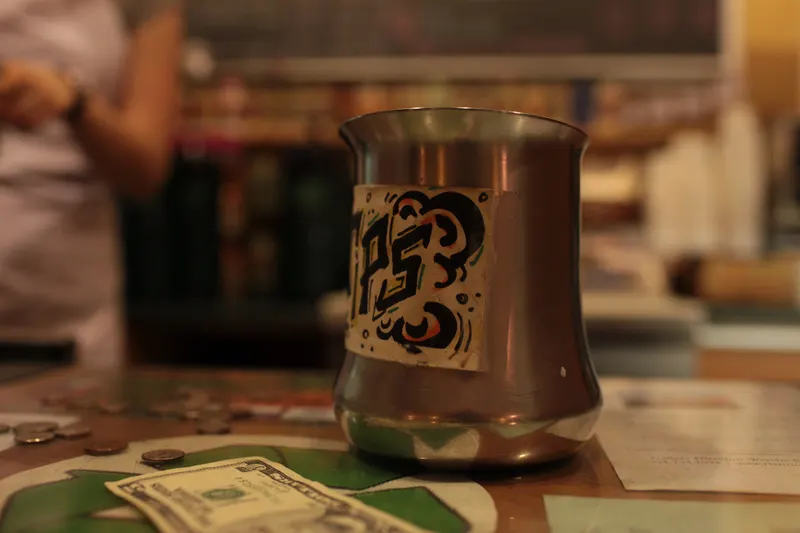
The card terminal that swings around at a coffee counter asks the same question in the United States, Canada and New Zealand, but the answer people give differs. In the US, only 25% of adults always or often tip when buying coffee, even though 92% of those who eat at sit-down restaurants do.1 In New Zealand the prompt arrived with new Eftpos machines in a country where tipping was not customary.13
Across the English-speaking world, the line that matters is counter versus table. Ordering at a till and carrying your own cup rarely calls for a tip outside North America. A server bringing food to your table often does, and in Britain, Ireland and South Africa that is also where a service charge may already be on the bill.81217
The United States: tip jars and tablet screens
American tipping is tied to pay. Under federal law, a worker who customarily and regularly receives more than $30 a month in tips counts as a tipped employee, and the employer may pay a cash wage of US$2.13 an hour as long as tips bring the total up to the federal minimum of US$7.25.3 The maximum tip credit an employer can claim is US$5.12 an hour.3
Coffee sits low on the list. In a Pew Research Center survey of 11,945 adults in August 2023, 25% said they always or often tip when buying a coffee, and 12% at fast casual restaurants.1 Seven in ten (72%) said tipping is expected in more places than five years earlier, and more opposed (40%) than favored (24%) businesses suggesting tip amounts.1
Card data shows the gap in percentages. On the Toast payment platform, tips at quick-service restaurants, where you order at a counter, averaged 15.8% in the third quarter of 2025, the fourth quarter in a row at that level; full-service restaurants averaged 19.2%.2
Where the money goes is regulated. An employer cannot keep employees' tips under any circumstances, and managers may not take a share of a tip pool.18 A tip added by card must reach the worker by the regular payday, minus at most the card company's fee.3
Canada and Québec's pre-tax rule
Canadians tip readily at restaurants and much less at counters. In a Research Co. poll of 1,001 adults on 4–6 May 2025, 14% said they tip all the time at a coffee shop, against 53% at sit-down restaurants.4 Asked about coffee shops prompting for a suggested tip when a customer pays by card, 65% disapproved.4
For an average restaurant meal, the most common answer in the same poll was 10–14%; for good service, 15–19%.4
Québec has written rules for the screen itself. Since 7 May 2025, businesses must calculate suggested tips on the amount before taxes and give you an option to set your own tip or leave none, with every option equally visible and no emojis steering the choice.5 No law in Québec requires a customer to tip, and there is no minimum amount or percentage; the 15%, 18% and 20% buttons common in Montréal and elsewhere are suggestions.5
The United Kingdom and Ireland: counter versus table
In Britain, paying at a coffee shop counter does not call for a tip. A 2018 HuffPost UK guide called tipping at a coffee shop, as at McDonald's, not so customary, and quoted VisitBritain's guidance for restaurants: a tip usually makes up 10–15% of the bill and is always discretionary.8
Table service is where the extra line appears. In 2024 The Telegraph reported that a 12.5% service charge is standard at London venues, with some charging 15–20%, and that card readers can be set to suggest 12.5%, 15% or 20%.9
Since 1 October 2024, a statutory code under the Employment (Allocation of Tips) Act 2023 has applied, and the Act makes it mandatory for all tips to be passed on to workers without deductions.6 It also made it unlawful for businesses to hold back service charges from staff; the government expected more than 2 million workers to gain an estimated £200 million.7
Ireland moved first. Since 1 December 2022, employers must clearly display how cash and card tips and service charges are shared, and a mandatory charge may be called a service charge only if the money goes to staff the same way card tips do.10 Tipping is customary in a restaurant, pub or café where you have had table service, and less common elsewhere.12 For restaurant meals, The Irish Times put 10% as the minimum in 2022 and 12.5% as the norm.11
New Zealand and Australia: prompts without a custom
New Zealand's tipping arrived with the card machine. Upgraded Eftpos terminals reported on in February 2024 give customers the option to tip 5%, 10% or 15% of the bill, even though tipping is not customary.13 In a Banked survey of 1,020 adults published in March 2024, 28% said they had felt pressured into leaving a tip, while 60% said they sometimes or often tip.14
The prompts have spread since. By October 2026 they were much more commonly switched on in restaurants and cafés, usually as 10%, 15% and 20% plus a no-tip option, and Eftpos New Zealand put the median tip at around 5% of the bill.15
Australia has screens too but few takers. In a Finder survey of 1,029 people in February 2025, 7% of Australians said they regularly tip at a restaurant, and the report set that against a minimum wage of more than A$24 an hour.16
South Africa: 10% at the table
South Africa is the exception among these countries: tips are part of how service staff are paid. A 2026 Cape Tourism guide says many workers rely on gratuities to supplement low base wages, that tips start at 10% for satisfactory service and rise to 15–20% for exceptional service, and that the custom is strongest in cities such as Cape Town and Johannesburg.17
Counter service rarely requires a tip, though rounding up is appreciated.17 For tables of eight or more, restaurants often add a gratuity of 10–12.5%, and no extra is needed on top.17 Cash in rand is preferred, since it reaches the server at once while card tips may be delayed.17
Café tipping at a glance
The table sets each country's counter habit beside its table-service norm. Japan is included for contrast: its national tourism organization says tipping is not common at cafés, restaurants, bars, taxis or hotels.19
| Country | Counter (coffee to go) | Table service |
|---|---|---|
| United States | Optional but common; 25% always or often tip for coffee (2023).1 | Expected; 92% of sit-down diners always or often tip (2023).1 |
| Canada | 14% tip all the time at coffee shops (2025).4 | 10–14% for average service is the most common answer (2025).4 |
| Québec | Suggestions must be pre-tax, with a no-tip option (since 2025).5 | No legal minimum or required percentage.5 |
| United Kingdom | Not customary at coffee shops (2018).8 | 10–15% (2018), or a service charge, often 12.5% in London (2024).89 |
| Ireland | Less common; customary only with table service (2025).12 | 10% minimum, 12.5% the norm at restaurants (2022).11 |
| New Zealand | Not customary; median Eftpos tip around 5% (2026).1315 | Prompts offer 10%, 15% or 20% (2026).15 |
| Australia | Rare; only 7% regularly tip even at restaurants (2025).16 | Optional; 7% regularly tip (2025).16 |
| South Africa | Rarely required; rounding up is appreciated (2026).17 | From 10%, up to 15–20% for exceptional service (2026).17 |
| Japan | Not common.19 | Not common.19 |
Percentages are of the bill. Years are those of the survey or report cited.
Tip. In Québec, the suggested tip buttons must be calculated on the pre-tax amount and the screen must let you enter your own tip or none, so you never need to tip on the sales tax.5