 By Yannick Schroth
How to order · 5 min read · October 2026
In Hong Kong, the everyday cup of coffee usually comes from a cha chaan teng (茶餐廳, tea restaurant), the city's answer to the greasy-spoon café, where construction workers and bankers share tables over strong black tea with canned evaporated milk.6 The menu is fast and fixed, and the drinks are ordered in a shorthand of single characters.8
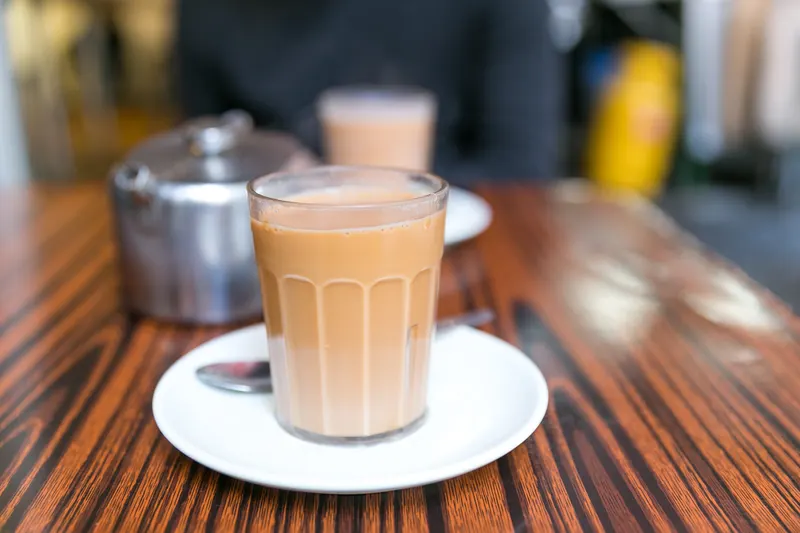
Two drinks define the counter. Hong Kong-style milk tea, strained through a cloth bag nicknamed the silk stocking, has been on the city's official intangible cultural heritage list since 2017.3 Yuenyeung (鴛鴦), coffee mixed with that milk tea, is the one most visitors come to try.1
Silk-stocking milk tea and the heritage list
Hong Kong-style milk tea grew out of English milk tea over about a century.4 The Hong Kong Association of Coffee and Tea traces it to the docks, where it was first served to sailors and laborers; canned milk was cheaper than the fresh milk the British colonists drank.13 Hong Kong drinks an estimated 2.5 million cups a day.13
The method uses black tea leaves of several grades, two light antimony kettles, a sackcloth strainer and a hot plate.5 The tea is boiled, infused and poured back through the strainer at least three times, then combined with evaporated milk or filled milk.5 The white cloth bag turns brown from repeated use, which is where the silk-stocking name (絲襪奶茶) comes from.4
Evaporated milk is the standard because it is concentrated, so it adds body without diluting the tea; Black & White is the brand most shops use.2 An iced version, bīngjan náaihchà (冰鎮奶茶, ice-bath milk tea), is chilled in a bowl of ice so melting cubes do not water it down.2
Hong Kong published its first intangible cultural heritage inventory, 480 items, in 2014, and on 14 August 2017 the Leisure and Cultural Services Department announced a shorter Representative List of 20 items that includes the Hong Kong-style milk tea making technique.3 Hongkong Post issued four stamps on the technique on 25 July 2023.4
Yuenyeung and coffee with evaporated milk
Yuenyeung takes its name from the mandarin duck, a Chinese symbol of a couple because the male and female look so different; the drink pairs two unlike things in the same way.1 The Leisure and Cultural Services Department described it as three parts coffee to seven parts milk tea, served hot or iced.1 Ratios vary by shop: a former South China Morning Post food editor put it at two parts milk tea to one of black coffee.6
Under Chinese medicine beliefs, the tea is said to offset the heatiness of coffee, which makes the mix more balanced.12 Lan Fong Yuen claims its owner, Lum Muk-ho, created both silk-stocking milk tea and yuenyeung in 1952; the milk tea claim is generally supported, the yuenyeung claim is unverified.2
Coffee (咖啡) takes the same codes as milk tea: it comes hot or iced, and can be made with condensed milk instead of evaporated milk.8 Sugar usually sits on the table in packets for you to add yourself.12 Black coffee is zaai fe (齋啡, just coffee).9
The shorthand: 走, 飛沙走奶 and 凍
The key character is 走 (zau, leave out). Said after a hot drink's name, it swaps evaporated milk and sugar for condensed milk: 茶走 (caa zau) is milk tea made that way, and the same works for coffee (啡走) and yuenyeung (鴛鴦走).8
飛沙走奶 (fei saa zau naai) means fly the sand, leave the milk: coffee or tea with no sugar and no milk, the sand being the sugar.9 Before an order, 凍 (dung) makes it iced, as in 凍檸茶, iced lemon tea.9 走冰 (zau bing) or 走雪 (zau syut) removes the ice from a cold drink, and 少甜 (siu tim) after a cold drink asks for less syrup, though some shops answer with more ice instead.8
Iced drinks cost extra. Menus write the surcharge as 凍飲加 followed by the amount, and you can ask for a separate cup of ice, 冰底, which may also be charged.8 In set meals the iced drink is usually a small add-on to the set price.9
Set meals by the clock, and what they cost
Cha chaan teng menus run in shifts, and nearly every set includes a drink, with iced as a paid upgrade.89 Breakfast runs from opening to about 11:00, sometimes 11:30 or 12:00; lunch from about 11:00 to 14:00 or 14:30; afternoon tea (下午茶) from about 14:00 to 17:00 or 18:00; dinner from about 18:00 to midnight.8 The 常餐 (regular set), noodles with eggs and buttered toast, is often served all day.8
Afternoon tea sets lean on fried food: chicken wings, French toast, fries, instant noodles with ham and egg, each with a drink.8 Lunch and dinner sets usually add a soup.9
Prices have climbed. In March 2022 a cup of milk tea usually cost about HK$20.6 In March 2024 Australia Dairy Company in Jordan raised its menu prices by 10%, putting a tea set at up to HK$60.10
| Item | Where | Price | Date |
|---|---|---|---|
| Hong Kong-style milk tea, one cup | Typical cha chaan teng | about HK$20 | March 20226 |
| Tea set, after a 10% menu rise | Australia Dairy Company, Jordan | up to HK$60 | March 202410 |
| Iced Americano, new-member price | Luckin Coffee | HK$15.9 | 202511 |
| Single-origin pour-over | Specialty cafés | HK$80 or more | August 202511 |
Prices in Hong Kong dollars as reported by BBC Travel (2022), The Standard (2024) and China Daily Hong Kong (2025).61011
Before the cha chaan teng: the bing sutt
Ice reached Hong Kong long before most residents could use it. It was shipped in from North America in the 1840s, and the first local ice machine was patented in 1874.7 Bing sutt (冰室, ice rooms) brought it into Cantonese life in the early 20th century as cafés selling iced drinks, and they peaked in the 1950s and 1960s.7
Mid-century licensing let bing sutt serve only drinks and food that needed no cooking, so the menu was iced red bean, pineapple buns, French toast and sandwiches; many shops advertised with a refrigerator in the window.7 Many faded in the 1970s, when home air conditioning spread, and others were absorbed by the cha chaan teng.7
The cha chaan teng grew from the same postwar boom: Hong Kong's population rose from 600,000 to more than two million between 1945 and 1951, and by the late 1950s rising incomes made cheap Western-style food popular.6 Mido Cafe in Yau Ma Tei, open since 1950, is sometimes called the first.8 In 2007 legislator Choy So Yuk proposed the cha chaan teng for UNESCO's heritage list; it was not added.6
The specialty side of Hong Kong coffee
Specialty coffee arrived late and grew quickly. Fineprint co-founder Scottie Callaghan recalled that 13 years before 2025 there were maybe three cafés doing what is now called specialty coffee; by 2025 Hong Kong had more than 250 independent coffee shops.11
In February 2025 Espresso Alchemy ranked 43rd on CoffeeFest's World's 100 Best Coffee Shops list, the first café in Chinese territory to reach the top 50.11 Independents face high rents, roasting restrictions and supply-chain disruption, and mainland chains undercut them: in 2025 Luckin Coffee offered new members an iced Americano for HK$15.9, while a single-origin pour-over at a specialty café could cost HK$80 or more.11