 By Yannick Schroth
How to order · 4 min read · October 2026
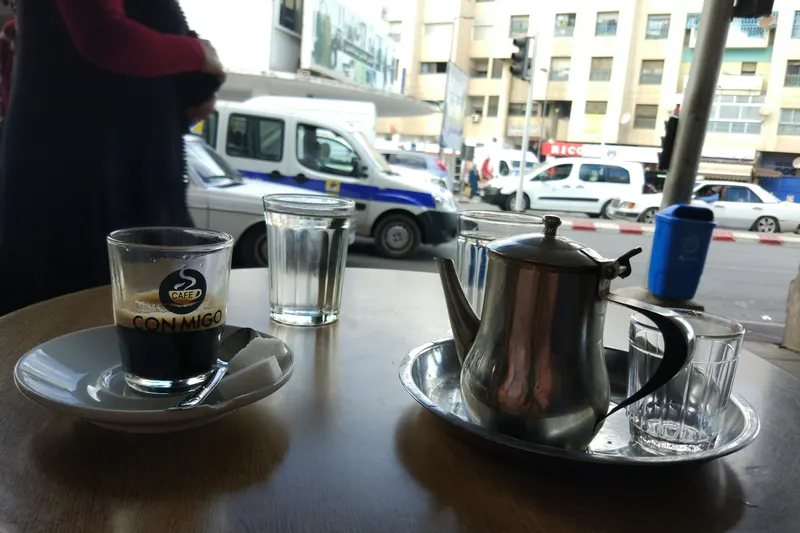
Coffee in a Moroccan café usually arrives in a glass, not a cup, with sugar on the side so you sweeten it yourself.12 The menu is short. You decide on milk or no milk and sugar or no sugar, then order by name: café noir, also called a normale, or nous-nous, half espresso and half milk.1 A latte or a cappuccino is available, but asking for one marks you as a visitor.1
Coffee is the smaller habit. Moroccans drink 800 to 900 grams of it per person a year, against about 1.9 kg of green tea, and coffee remains mostly a city drink.9 Kahwa is the Darija (Moroccan Arabic) word for coffee, and many coffee houses call themselves salons de thé.1
Nous-nous: half coffee, half milk
Nous-nous, also written nouss-nouss or nus-nus, means half-half in Darija.1 It comes in a small glass with roughly equal parts strong coffee and steamed milk.14 The usual method fills the glass about halfway with hot milk, froths it until it rises over the rim, then lets the espresso drip into the milk or pours it slowly on top.2
Sugar cubes come on the saucer, not in the glass.2 Some descriptions spell it nss nss and define it as half coffee made with water, half milk.3 In Marrakech's Guéliz district, a nous-nous at Le Grand Café de la Poste cost 30 dirhams (MAD) as of April 2026.11 Most of the city's specialty coffee bars are in Guéliz too, though filter coffee is still rare in the city.14
Café noir, café cassé and the rest of the menu
A café noir is essentially an espresso, served in a small glass with sugar alongside.1 Some menus call it a normale, and in a traditional café a regular often orders it by name from a waiter who already knows him.16 Café cassé, from the French for broken, is black coffee broken with a little milk.3
Plain coffee with milk usually comes in a cup, sometimes in a tea glass.3 Iced coffee is rare and found mostly in upscale cafés, where it is usually sweet and milky.1 At home and on the go, many Moroccans drink Nescafé stirred with sugar and fresh or powdered milk, sold cheaply at corner shops and supermarkets.1
| Order | What arrives |
|---|---|
| Café noir / normale | An espresso in a small glass, sugar on the side1 |
| Nous-nous (nouss-nouss) | Half coffee, half frothed milk, in a glass12 |
| Café cassé | Black coffee with a little milk3 |
| Coffee with milk | Usually in a cup, sometimes in a tea glass3 |
| Nescafé | Instant coffee with sugar and fresh or powdered milk, mostly at home1 |
| Atay | Mint tea, sweetened in the pot8 |
Spellings vary: nous-nous, nouss-nouss, nus-nus and nss nss all name the same drink.1311
Ordering in Darija and French
In Marrakech, Arabic is the main language and most people also know French.14 The simplest Darija order is shî qhwa ʿafâk (شي قهوة عفاك), a coffee, please.7 ʿAfâk (عفاك), please, goes at the end of a request, as in jîb liyya shî kâs d'atây ʿafâk (جيب لي شي كاس دأتاي عفاك), bring me a glass of mint tea, please.7
Most drink names are French, café noir and café cassé among them, while nous-nous is Darija.13 The real choices are milk or no milk and sugar or no sugar, and with the sugar on the saucer the second one is yours to make at the table.12
The terrace: a men's room, slowly opening
Cafés came to Morocco with French colonization and became a male space through social norms that kept public space for men.6 Traditional terraces line up tables along the sidewalk with chairs facing the street, and a 2019 Morocco World News report described them as busier and more male-dominated than the seating indoors.6 Said Graiouid, a communication and cultural studies professor at Mohammed V University in Rabat, said women were simply not expected in that space.6
That has been shifting. Modern cafés, with more food, music, comfortable seats and fewer neighborhood ties, draw younger and mixed crowds, while traditional and sports cafés still lean male.6 By 2025 more women could be seen at outdoor tables reading, smoking and talking.1 Women also have their own coffee hour at home, usually between 17:00 and 19:00 with friends.2
Expect to sit. A café visit means taking a table for a while, and coffee is almost never a breakfast drink, though men often start on espresso from mid-morning.2
Spiced coffee at home
Qahwa maʿatra, spiced coffee, is mainly a home drink; cafés rarely serve it, and visitors usually find only espresso-based drinks.4 A typical blend adds cloves, cardamom, cinnamon and nutmeg to a dark roast, sometimes with black pepper, ginger, anise or vanilla, and every family keeps its own mix.4 One home method warms three whole cloves in the milk, or stirs in a quarter teaspoon of ras el hanout, the Moroccan spice blend.3
Spiced coffee is also sold ready-ground: in 2012 Kraft Foods Maroc launched Samar Maâtra, which it called the first Moroccan ground coffee with spices.5 For guests, the woman who heads the household traditionally pours, and guests are served first.4
Mint tea at the next table, and what a glass costs
Atay b naʿnaʿ, mint tea, is still the most culturally important drink.1 Tea likely reached Morocco in the 18th century under Sultan Moulay Ismail, and it is made from Chinese gunpowder green tea, fresh spearmint and sugar, poured from a height so it foams in the glass and traditionally served three times in succession.8 Offered at the start of a visit or in a shop, it is hard to refuse without seeming distant, and city cafés now pour it alongside espresso.8
In working-class neighborhoods, where 70 to 80% of café customers drink, a cup of coffee generally cost 7 to 10 MAD in April 2025, according to Noureddine El Harrak of the national federation of café and restaurant owners.10 Entry-level beans had reached 125 MAD a kilo, up from about 50 to 55 MAD some 17 months earlier.10
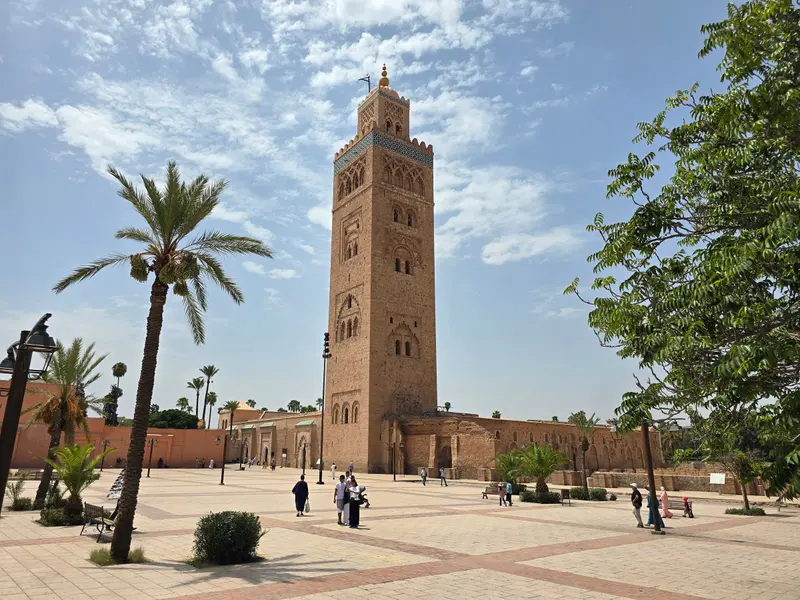
Marrakech charges more near the sights. Jemaa el-Fna, the square at the entrance to the medina, has been on UNESCO's intangible heritage list since 2008 for its storytellers, musicians and food stalls.13 Café de France opened there in 1915 for French settlers, and most Moroccans boycotted it as a colonial symbol; today tourists drink mint tea on its roof terrace.12 In the alleys nearby, a coffee or a mint tea at Dar Cherifa cost 35 MAD as of April 2026.11