 By Yannick Schroth
Coffee travel · 6 min read · October 2026
Costa Rica has grown coffee since 1779, when the first plantings went into the Meseta Central, and by 1832 it was shipping beans to Chile, where they were re-bagged for England.1 It now produces under 1 percent of the world's coffee.1 Panama grows less still: its agriculture ministry counted about 17,548 ha of coffee and 8,287 producers in 2021, with Chiriquí the largest producing province.27
The two countries share a plant history. The Geisha variety, collected in Ethiopia's Gori Gesha forest, went to a research station in Tanzania and then to CATIE, the tropical agriculture research center in Costa Rica, which spread it across Central America.17 Hacienda La Esmeralda in Boquete acquired its seeds from CATIE, and in 2004 a Geisha lot from its Jaramillo farm won the Best of Panama competition.18 Auction prices for Panamanian Geisha have climbed ever since.2022
Costa Rica's growing regions, old map and new
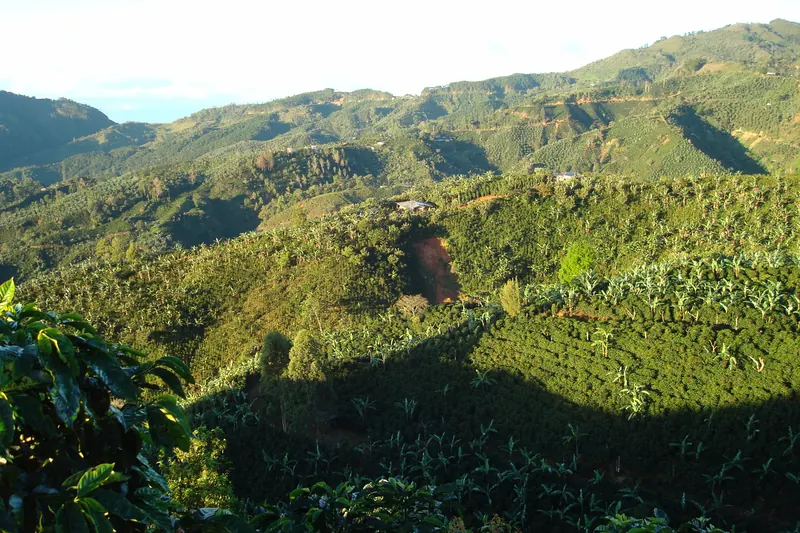
For years ICAFE, the Instituto del Café de Costa Rica, recognized eight regions: Valle Occidental, Tarrazú, Tres Ríos, Orosi, Turrialba, Valle Central, Guanacaste and Brunca.1 It divides them into low zones under 1,000 m, where the coffee is lighter, and high zones above 1,200 m on volcanic soil, where it carries more acidity and aroma.2
In 2025 the map changed. Tres Ríos stopped being a region after urban growth took its farms and was folded into Valle Central; Orosi joined Turrialba; Brunca split into Pérez Zeledón and Coto Brus; and Tarrazú became Los Santos, because the Tarrazú name now belongs to a denomination of origin.4 Growers in Tres Ríos can still use the name to sell their coffee.4
The denomination covers coffee from Tarrazú, Dota and León Cortés, the three cantons of the Los Santos zone, grown above 1,200 m. The graneas and repelas, the first and last pickings of the season, do not qualify.5 The name was first registered on 4 January 2019 and is now protected in 180 countries through WIPO.5
Valle Occidental, settled from the Central Valley in the 19th century, takes in San Ramón, Palmares, Naranjo and Grecia. ICAFE puts its farms at 800 to 1,400 m, with Naranjo's reaching 1,700 m, on about 25,476 ha planted mainly in Caturra and Catuaí, with about 2,250 mm of rain a year.3
Arabica by decree
Costa Rica banned robusta by decree in 1988, steering farmers toward arabica for its stronger market prospects.6 By 2018 ICAFE, the sector's main trade and farmer-support body, backed lifting the ban, and the agriculture ministry had drafted a decree tying any robusta to zones ICAFE would define, to keep varieties from mixing.67
The target areas were those unsuited to arabica: the Caribbean, the northern plains and the southern lowlands.7 In February 2018 the draft still needed the signature of President Luis Guillermo Solís.67
The chorreador and agua dulce
The home method is café chorreado. A chorreador is a wooden stand holding a bolsita, a long cotton bag that serves as the filter; hot water is poured slowly over the grounds and drips into the container below.8 The name comes from chorrear, to drip or trickle.8
Two baristas interviewed in 2020 brewed at 1:15 to 1:16 with water at 92 to 97°C and a medium grind, aiming for 3 to 3.5 minutes in total, since cloth lets water through quickly.9 The bag is boiled, rinsed and refrigerated between uses and lasts about a month with good care.9 One of them called it the coffee every grandmother offers you.9
Breakfast may come with agua dulce instead: tapa de dulce, the local name for panela (unrefined cane sugar), dissolved in hot water or milk.10
Harvest months and farm visits from San José
In Valle Occidental, picking runs from November to February, about four months in the dry season.3 In Los Santos, the 2025–2026 harvest in Dota, Tarrazú and León Cortés officially opened on 5 December 2025, with three days of tastings, a walk through coffee farms and a parade at CoopeDota, the cooperative in Santa María de Dota, promoted by the tourism institute ICT.11 The harvest there involves more than 14,000 pickers.11
Nationally, ICAFE put the workforce at about 25,000 pickers a season in 2023, mostly Nicaraguans along with Panamanians and Costa Ricans, earning about US$0.15 per kilo of cherries.12
Farm tours sit close to the capital, in the provinces of Heredia and Alajuela. In 2017 Café Britt's tour in Mercedes Norte de Heredia drew more than 2,500 visitors a month and Doka Estate's in San Luis de Sabanilla de Alajuela about 9,500, while CoopeDota had run tours in Santa María de Dota for ten years.13
Starbucks opened a visitor center in March 2018 at Hacienda Alsacia, a 240 ha farm on the slopes of the Poás volcano that it bought in 2013. The route passes a seedling nursery, a greenhouse of disease-resistant varieties, the fields, a wet mill and a drying patio, and ends at a café that roasts the farm's own coffee.14
Boquete, Volcán and the Geisha auctions
Panama's best-known coffee grows in Chiriquí around Volcán Barú, at 3,475 m the country's highest point.24 Boquete sits at about 1,200 m on the Caldera River, with temperatures of 14 to 22°C, and farming, coffee above all, is still its main industry.23 Volcán town, at 1,400 m, stands on an old lava flow from Barú.24 Boquete's coffee festival dates from 1950 and became the Feria de las Flores y del Café in 1973.25
Hacienda La Esmeralda shows how Geisha got there. The Peterson family bought the estate in 1967 as cattle land, turned to coffee in the 1980s and in 1997 bought Jaramillo, a high farm on Barú. After leaf rust hit, Daniel Peterson saw that the Geisha trees had suffered less, and the family planted more, some above 1,650 m.18 In 2004 they cupped that lot separately and won.18 Its top Geisha lots now come from above 1,950 m.19
Best of Panama is run by SCAP, the Specialty Coffee Association of Panama.21 In August 2025 a 20 kg lot of washed Geisha from Hacienda La Esmeralda sold to Julith Coffee of Dubai for US$30,204 a kilo; the auction brought in US$2.8 million in total.20 The 2026 edition, the competition's 30th year, closed on 24 September 2026 with 50 lots of 15 kg, and Lamastus Family Estates' Elida Geisha Torre topped it, bought by China's JD.com.22
Picking in Chiriquí starts low. The 2023–2024 harvest began in the last week of September 2023 in the lower and middle zones of Renacimiento district and in Jaramillo and Palmira, in Boquete district.26
| Year | Lot | Auction price (US$) |
|---|---|---|
| 2004 | Geisha, Hacienda La Esmeralda | 21 per lb17 |
| 2019 | Geisha, top lot | 1,029 per lb17 |
| 2025 | Washed Geisha, Hacienda La Esmeralda | 30,204 per kg (13,705 per lb)20 |
| 2026 | Elida Geisha Torre, Lamastus Family Estates | 18,004 per kg22 |
Best of Panama auction prices for green (unroasted) coffee, sold in small lots.1721
Drinking coffee in San José and Panama City
Coffee money built much of San José. The trade paid for the first railway to the Atlantic coast in 1890, and the National Theater is described as a product of the first coffee farmers.1 Farms around the capital have shrunk since, as growers sold land to builders.1
In June 2025 a café owner put espressos and cappuccinos at ₡1,800 to ₡2,300, and a Statista study ranked Costa Rica's cappuccinos the second most expensive in Latin America, after Uruguay's.16 Imports, mostly from Honduras and Nicaragua, made up an estimated 58.3 percent of the coffee consumed in Costa Rica in 2024.15
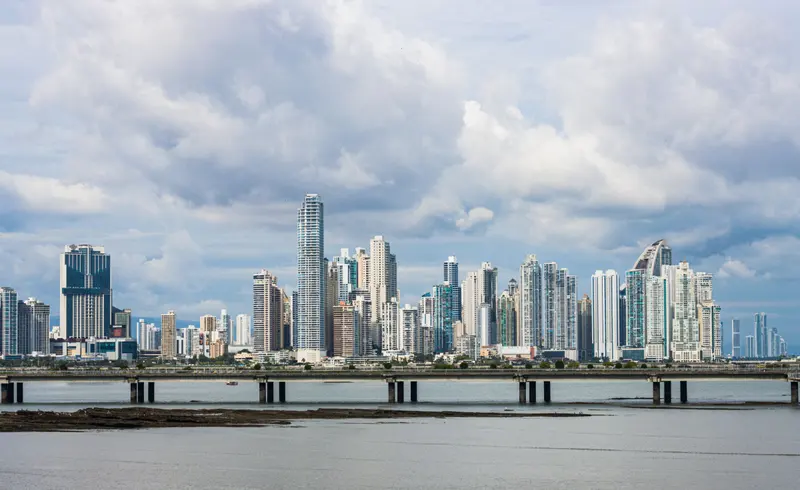
Panama uses the US dollar. The balboa has been pegged 1:1 to it since 1904, and US banknotes, counted in balboas, serve as the cash.29 Cappuccino, latte and frappuccino are the favorite orders, and Panama City, David and La Chorrera place the most coffee orders on the PedidosYa delivery app.28
In Casco Antiguo, the old quarter, the operator Viajes Auténticos announced in February 2026 a barista session on the grounds of the Iglesia de La Merced that pairs the church's history with coffee, lasting one to two hours, in Spanish or English.30