 By Yannick Schroth
Coffee travel · 4 min read · October 2026
Both countries grow little coffee. Ecuador harvested 5,584 tonnes in 2023, about 97,000 sacks, from 22,373 hectares, according to the national statistics office INEC.1 Bolivia exported 4,583 tonnes of coffee in 201111 and 2,169 tonnes in 2025, yet those 2025 exports earned a record US$17.1 million.12
For a traveler, that means small farms and expensive lots. Ecuador has competition-winning Geisha in Loja, cloud-forest farms within a day trip of Quito and an old plantation on the Galápagos. Bolivia's coffee grows in the Yungas, the valleys on the eastern slopes of the Andes below La Paz,10 and the capital brews it with water that boils well short of 100 °C.
Ecuador: instant coffee and too few beans
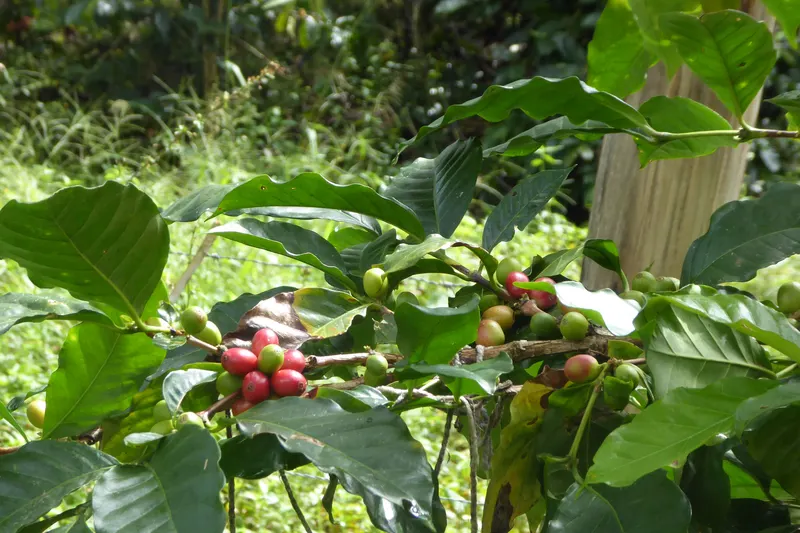
Ecuador's coffee trade runs on soluble coffee. More than 90% of the country's coffee exports are instant; the rest leaves as green, roasted or ground coffee.1 About 45% of the crop is robusta, grown mainly in the Amazon provinces of Orellana and Sucumbíos for the soluble plants, and about 55% is arabica from Manabí, Loja, Pichincha and Imbabura.1
The farms no longer supply the factories. In 2025 Anecafé, the exporters' association, put production at no more than 200,000 sacks a year against domestic consumption of more than 300,000.1 In 2022 Ecuador imported 1,551 tonnes of coffee from Vietnam, worth US$3 million, and about 40% of the beans the soluble maker SICA processed that year came from Vietnam and Brazil.2 Soluble exports had halved over the previous decade, partly because of Vietnamese competition.2
Taza Dorada, Loja and Zamora-Chinchipe
The specialty side is measured at the Taza Dorada (golden cup), a quality competition Anecafé created in 2007; a separate robusta edition was later added for growers on the coast and in the Amazon.5 The 17th edition, judged and auctioned in the United States on 18 November 2023, went to Geisha: the first three places all used the variety, and two of the three farms were in Loja.3
The winning lot from La Noria sold for US$45 a pound.3 In 2024 the top prize moved north: José Miguel Villa of Pallatanga, Chimborazo, won with a Sidra scoring 91.02, five of the top ten coffees came from Chimborazo, and the 13 lots above 88 points went to an online auction on 12 December 2024.4
In Ecuador's southern Amazon, Zamora-Chinchipe grows arabica at an average altitude of 1,200 m.6 The cantons of Palanda and Chinchipe give the best yields, close to a tonne per hectare, and the agriculture ministry estimated the province's 2018 crop at about 1,500 tonnes.6 Growers in the APECAP and ACRIM associations, part of the FAPECAFES federation, are adding Geisha, Sidra and Típica mejorada (improved Typica) to older plantings of Caturra and Sarchimor.6
| Result | Farm and place | Variety and altitude | Score |
|---|---|---|---|
| 2023, first | La Noria, Loja canton, Loja | Geisha Verde, 2,050 m | 91.503 |
| 2023, second | Cruz Loma, San José de Minas, Quito | Washed Geisha, 1,450 m | 90.133 |
| 2023, third | El Dorado, Olmedo, Loja | Geisha Verde, 1,720 m | 89.753 |
| 2024, first | Las Palmeras, Pallatanga, Chimborazo | Sidra | 91.024 |
The 2024 judging took place in New York from 22 to 24 October 2024.4
Quito, Mindo and the Galápagos
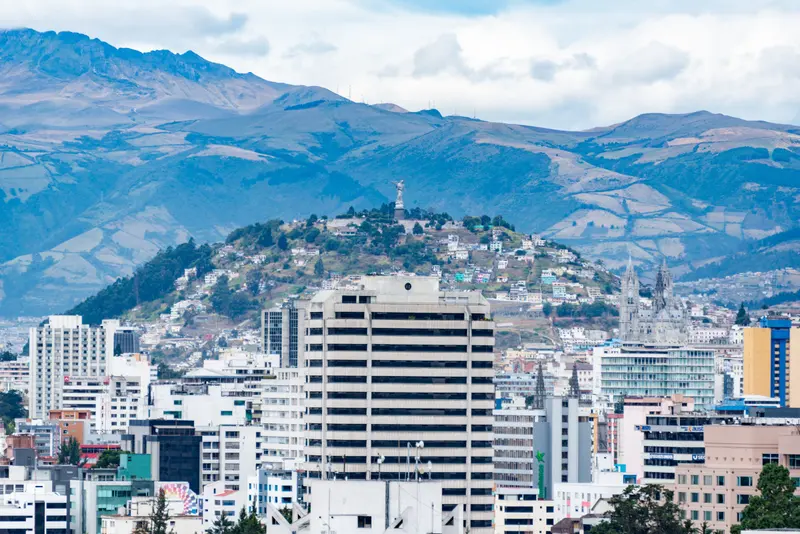
Coffee grows inside Quito's own district: the 2023 runner-up, Finca Cruz Loma, is in the parish of San José de Minas.3 The city's café trade has grown faster than the farms. Ecuador had 13,407 coffee shops at the end of 2023, 48% more than five years earlier; the local chain Sweet & Coffee leads the market, and Starbucks opened its first Ecuadorian branch in a mall in Cumbayá, Quito, on 15 August 2024.9
Mindo, in the Pichincha cloud forest about two and a half hours from Quito, has farms that take visitors.8 In 2026 one Quito tour operator listed a full-day private tour from Quito that stops at a cloud-forest reserve and then at Frajares Farm, following the harvest, selection, drying, roasting and packing of the beans and ending with a tasting.8 Rates were US$415 for one person, US$204 each for two and US$156 each for three.8
Coffee reached the Galápagos around 1870. In 2008 Hacienda El Cafetal on San Cristóbal, the easternmost island, covered about 400 ha and grew heirloom Bourbon under native shade trees at about 500 m; because most farm chemicals are banned in the archipelago, the coffee is certified organic.7
Bolivia: the Yungas and Caranavi
The Yungas grow some 95% of Bolivia's coffee, and Caranavi is now the largest producing area; between 85% and 95% of the crop comes from smallholders on plots of 1 to 8 ha.10 In 2019 the newspaper Los Tiempos counted 12,000 coffee-growing families in the municipality of Caranavi.13 The Yungas are also the traditional and legal area for growing coca leaf.10
The crop shrank for years. Exports fell from 4,583 tonnes in 2011 to 3,636 tonnes in 2013, and growers told La Prensa that some had switched to coca, which yielded more and suffered no pests.11 A government official quoted by Los Tiempos in 2019 said the country had produced only 30,000 sacks in 2017.13 In 2025, 99% of exports left as green coffee, and the United States took 31%, Belgium 17% and France 13%.12
Quality moved the other way. The Cup of Excellence ran competitions in Bolivia from 2004 to 2009, and the country held its first Taza Presidencial (presidential cup) in 2014.10 Caranavi is about three hours by road from La Paz; the route crosses a pass above 4,000 m and descends to the town at 976 m, which has hotels, restaurants and coffee shops.14
| Year | Bolivian coffee exports |
|---|---|
| 2011 | 4,583 tonnes11 |
| 2013 | 3,636 tonnes11 |
| 2016 | 1,339 tonnes12 |
| 2019 | 1,234 tonnes12 |
| 2022 | 2,504 tonnes, US$16.3 million12 |
| 2025 | 2,169 tonnes, US$17.1 million12 |
Figures for 2024 and 2025 are preliminary.
La Paz: brewing at 3,650 m
Most Bolivian coffee is drunk abroad. In 2019 about 80% of production was exported, and a good cup of gourmet coffee in Bolivia could cost more than Bs 50 (bolivianos).13
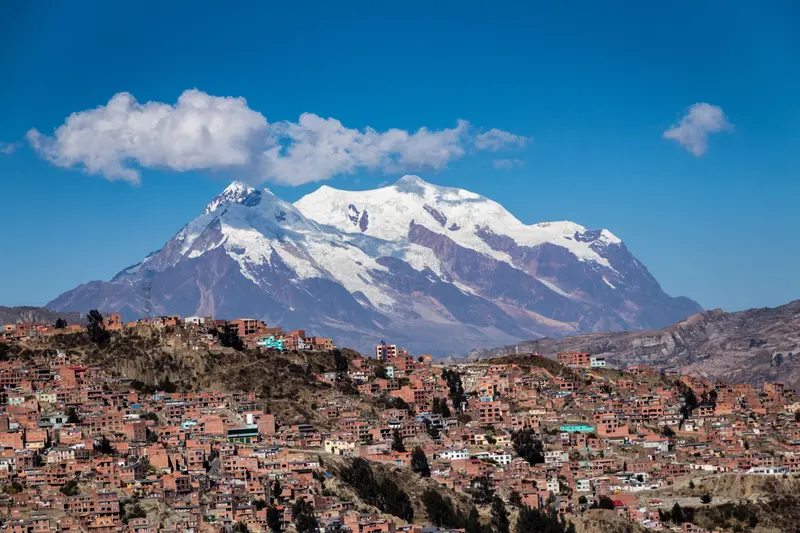
The center of La Paz sits at roughly 3,650 m.15 At 3,658 m, water boils at 87.6 °C rather than 100 °C.16 The usual recommendation for brewing, from the National Coffee Association in the United States, is 195 to 205 °F, about 90 to 96 °C.17 A kettle taken straight off the boil in central La Paz is already below that range.
Arriving by air, you land at El Alto International Airport at 4,061 m,15 where water boils below 86.5 °C.16