 By Yannick Schroth
How to order · 5 min read · October 2026
Order "a coffee" in a German-speaking Swiss café and what arrives is usually a café crème, a long coffee with a small portion of cream on the saucer. It is the country's own drink and barely known outside it.4 Cross into the French- or Italian-speaking regions and the default cup gets shorter, the milk words change and the price drops.689
Behind the cup sits an unlikely industry. Switzerland grows no coffee, yet it ranks second in the world for coffee exports by value, behind Brazil, and makes most of the fully automatic machines sold anywhere.1 Nespresso capsules were born here too, out of an engineer's visit to a Roman espresso bar.11
The café crème and its cream
A café crème starts as an espresso but keeps running, to about 120 ml instead of 25 ml.3 The crème in the name is not the foam on top. It is the coffee cream of roughly 10% fat that comes with it.3 Swiss Germans also call it a Schümli, and in 2017 CafetierSuisse, the café owners' association, put it at about one in three coffees served.4 Italian speakers say caffè crema.3
Asking for a coffee is still the safest order, but the habit is shifting. In a 2024 Deloitte survey that included 1,000 people in Switzerland, 46% of respondents said they preferred espresso, ahead of cappuccino at 37% and latte at 32%; the café crème lost its top spot, which the authors read as Swiss coffee culture turning "Italianised".7
The cream usually arrives in a single-serve portion. Those cups replaced open cream jugs in cafés, and their foil lids, Kaffeerahmdeckeli, became a national collecting hobby from the late 1970s. Collectors call them KRD.12 The peak came in 1994, with about 150 series issued, and single series traded for several thousand francs in that era. Today it is a buyer's market: a series once catalogued at up to CHF 6,000 can turn up for CHF 150.12
Schale, mélange, renversé and Kafi Luz
Milk coffee has its own name in the German-speaking regions: a Schale, also ordered by its French name, café au lait. A café mélange comes with whipped cream, often in a separate small dish.3 In French-speaking Switzerland the milky order is a café renversé, a Swiss term for café au lait.9
Coffee with schnapps goes by many names: Luzerner Kafi, Kafi Luz, Kaffee Träsch or Kaffee fertig. The coffee is thin and sweetened, laced with a spirit such as Träsch, plum or cherry brandy, and served in a glass.3 Träsch is distilled mainly from whole pears and apples, and in Central Switzerland it is mostly drunk this way, mixed with weak coffee.13
Some vendors sell the drink as Kaffee Lutz, a name said to come from Lucerne, though nobody can say where the t came from.17 A Kafi GT adds coffee cream to a coffee with pomace brandy, and a Schümli-Pflümli tops the schnapps coffee with whipped cream.3
| Order | What arrives |
|---|---|
| Café crème / Schümli / caffè crema | A long coffee, about 120 ml, with a portion of coffee cream3 |
| Schale / café au lait | Milk coffee3 |
| Café renversé | Milk coffee, the French-speaking Swiss term9 |
| Café mélange | Coffee with whipped cream, often on the side3 |
| Kafi Luz / Kaffee fertig / Kaffee Träsch | Thin, sweet coffee with schnapps, in a glass3 |
| Kafi GT | Coffee with pomace brandy and coffee cream3 |
| Schümli-Pflümli | Schnapps coffee topped with whipped cream3 |
| Café complet | Not a drink but a meal: milk coffee with bread, butter, jam, cheese and cold cuts3 |
Names vary from valley to valley; café crème is understood in every language region.3
French- and Italian-speaking Switzerland
The language border is also a coffee border. French- and Italian-speaking Switzerland lean toward espresso and ristretto, while German speakers order larger cups, reports RSI, the Italian-language public broadcaster.8 Workers in Ticino tend to take their break coffee at a bar rather than from the office machine; by the vending company Selecta's count, the heaviest workplace coffee drinkers are in St. Gallen, at 2.28 cups per person a day, followed by Zurich.8
What goes in the cup splits too. Deloitte's 2024 survey found German speakers most likely to add a splash of milk, while sugar was the most popular addition in the French- and Italian-speaking regions; the authors called it a "coffee divide".7
Prices fall as you head south and west. A 2019 survey by CafetierSuisse and GastroSuisse put the average coffee at CHF 2.70 in Ticino and CHF 3.24 around Lake Geneva, against CHF 4.35 in Zurich, and the association's president linked the lower prices partly to cheaper competition across the borders.6
What a coffee costs in CHF
CafetierSuisse surveys café crème prices in German-speaking Switzerland every autumn. In November 2025 its survey of 670 cafés, bakeries and restaurants found an average of CHF 4.65, the sixth rise in a row and CHF 1.08 more than twenty years earlier; a cappuccino averaged CHF 5.37.2 The association blamed staff, energy and operating costs and expected prices to keep climbing.2
Zurich sits at the top. The 2024 survey put the city average at CHF 4.86, the highest of any city, with some restaurants in the canton charging up to CHF 6. Canton Zug had the highest cantonal average, CHF 4.84, and Solothurn the lowest, CHF 4.45, though the single cheapest café crème, CHF 2.50, was in Aargau.5 In 2017 the average had stood at about CHF 4.23.4
Nescafé, Nespresso and the trading desks
Instant coffee came out of Nestlé in 1938. Max Morgenthaler developed Nescafé after Brazil's government asked the company to find a use for the country's coffee surplus.10 The capsule followed decades later. Éric Favre, an engineer from Vaud who joined Nestlé's packaging department in 1975, watched a barista at Rome's Caffè Sant'Eustachio pull the lever in several short bursts, and designed a sealed capsule around that idea.11 Nespresso launched in 1986 in Japan, Italy and Switzerland.10
The capsules for the world market are still made only in three Swiss factories.1 About 70% of the fully automatic coffee machines sold worldwide come from Switzerland, from makers such as Jura, Schaerer and Thermoplan.1
The green beans mostly bypass Swiss cups. An estimated 60 to 70% of the world's green coffee trade passes through Swiss trading desks, and coffee exports run at about CHF 3.3 billion a year, around a third of all Swiss agricultural exports.1 Deloitte put the 2023 figure at over CHF 3.2 billion.7
Zurich, old and new
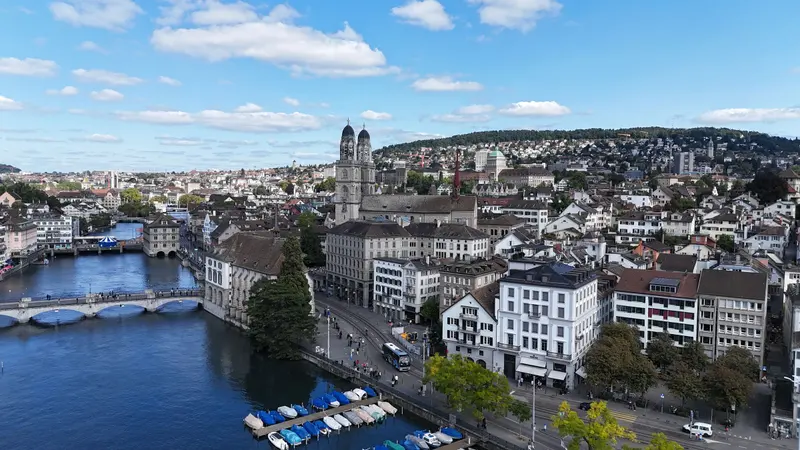
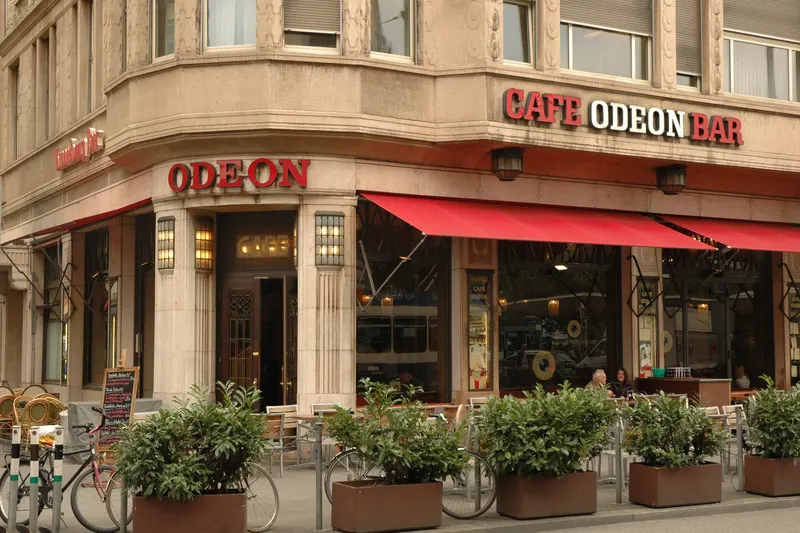
Zurich's best-known coffeehouse is on Limmatquai. The Grand Café Odeon, at Limmatquai 2, opened on 1 July 1911 as an art nouveau café in the Viennese tradition, and James Joyce, Albert Einstein, Lenin and the founders of Dada were among its regulars.14
Older cafés serving the café crème now share the city with a younger specialty crowd focused on flavor and origin, with several Swiss Barista and Latte Art champions behind the counters.16
In 2018 Emi Fukahori, who runs MAME in Kreis 5 with Mathieu Theis and had been Swiss Barista Champion in 2015, won the World Brewers Cup in Brazil.15 Miró, a roastery on Brauerstrasse open since 2018, was named Switzerland's Roaster of the Year in 2025.16 MAME, which opened its own roastery in 2019, lists flavors rather than origins on its menu.16