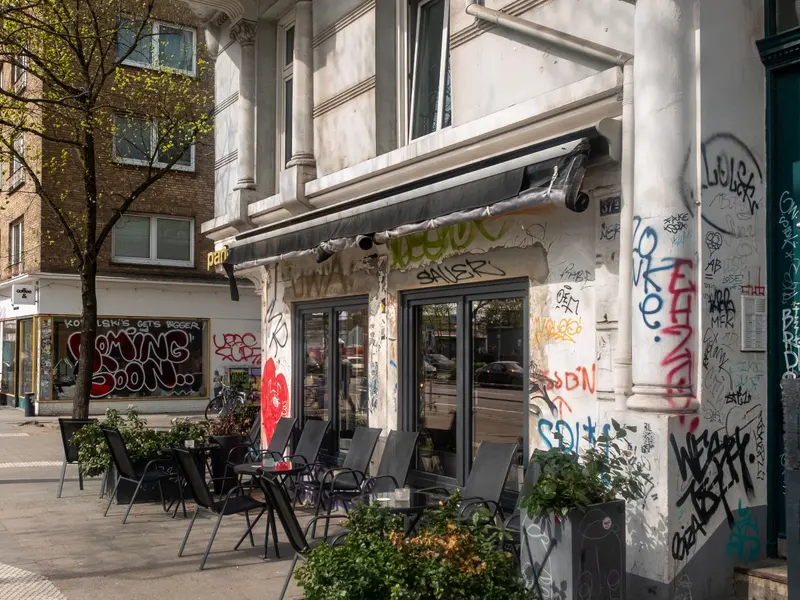
CAFE BY DOKUWA
- Outdoor seating
- Takeaway
- Card payment
- Vegetarian options
- Partial wheelchair access
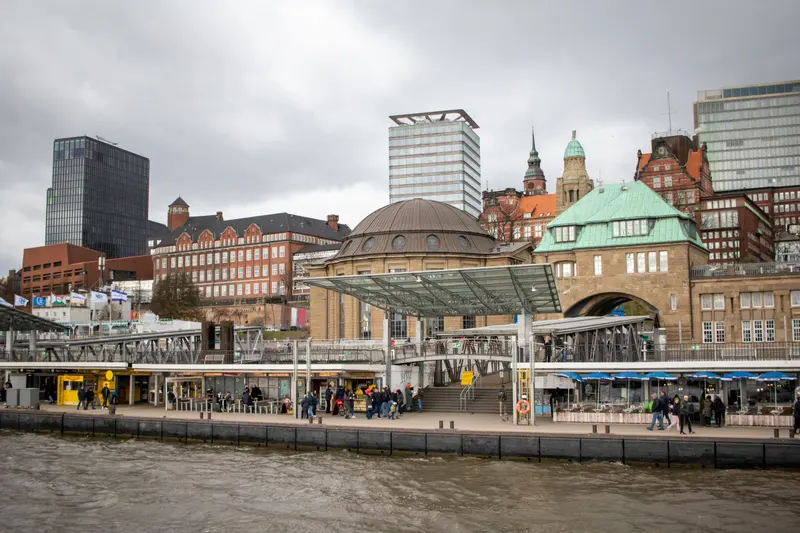
Marktstraße in the Karoviertel, the green bunker on Feldstraße and roasters off the Reeperbahn.
Photo: Frank Rietsch, Pexels License
St. Pauli grew outside Hamburg’s walls on the Hamburger Berg, where the city put the trades it did not want inside; ropemakers arrived in 1633 and gave the Reeperbahn its name. The suburb took the name of its St. Pauli church in 1833 and was fully incorporated in 1894. It had 22,377 residents on 2.3 km² at the end of 2024.1
The Heiligengeistfeld in its middle hosts the Dom funfair three times a year and FC St. Pauli’s Millerntor stadium, and the Hafenstraße, occupied from 1981, became the center of the quarter’s squatting tradition.1 Its cafés keep their distance from the nightlife strip. They cluster in the Karolinenviertel, known as the Karoviertel, north of the Heiligengeistfeld, around Wohlwillstraße, and on the streets between the Reeperbahn and the harbor.
Local tip: Pair the bunker with Marktstraße: Moin Karo at number 119 opens at 08:00 from Monday to Saturday, and most of the street’s cafés are open by 10:00.
Nothing matches those filters here. See all cafés in Hamburg.
The Karoviertel takes its name from Karolinenstraße, named in 1843 from a list of women’s first names. Marktstraße, probably named in 1841 because it led to the Neuer Pferdemarkt, is its unofficial main street and is known for second-hand, fashion and design shops.2
It is also the quarter’s café street: Panther cafébarkitchen at number 3, CAFE BY DOKUWA at 21, La Maison at 36, Verlan Cafe at 102, Moin Karo at 119 and Gretchens Villa at 142. On Karolinenstraße, Goldenblack at number 16 opens at 08:30 on weekdays.
The flak bunker on Feldstraße was built in about ten months in 1942, partly by forced laborers.2 A private owner added five floors and planting, raising it from 38 m to 58 m, with about 4,700 plants on the roof garden. Hotel, café and roof garden were due to open on 5 July 2024, after about €60 million of work.3
At its foot, Matcha Dream and café panda are on Feldstraße itself. West of the bunker, the Alte Rinderschlachthalle at Neuer Kamp 35, a former cattle slaughter hall, was converted into a venue and start-up space in 1996–98; Juicy Project and Gaumengold are across the street.2
Playground Coffee started as a counter in a burger restaurant and has roasted since 2014.4 Its St. Pauli café at Detlev-Bremer-Straße 21 roasts on site.5 Veljko Tatalović, who co-founded Public Coffee Roasters, now runs Playground, which also has a coffee bar in the Grindel quarter and a kiosk at the Rathausmarkt.6 On the same street, Lieblings Café Bar at number 50 reopens on Friday and Saturday nights, 21:00–01:00.
Mother’s Fine Coffee on Kastanienallee stays open until 21:00 on Fridays and Saturdays. Wohlwillstraße has Kandie Shop at 16, Café Stark at 20 and Graupi Bistro & Café at 54, open to 22:00 on most days.
The Landungsbrücken are the largest pontoon landing system of their kind in Germany, and the Alter Elbtunnel, opened in 1911, still takes people under the river through two tiled tubes with lifts.1 Between the harbor and the Reeperbahn, Buttercrumbs Bakery is on Bernhard-Nocht-Straße.
In St. Pauli, also browse: Breakfast & brunch Outdoor seating Bakery cafés & Konditoreien Vegan & vegetarian Wi-Fi
The Karoviertel, or Karolinenviertel, is the northern part of St. Pauli, named after Karolinenstraße, which got its name in 1843. Marktstraße is its unofficial main street, known for second-hand, fashion and design shops and for cafés such as Moin Karo at number 119 and Gretchens Villa at 142.
The roof garden, hotel and café of the Feldstraße bunker were due to open on 5 July 2024. A private owner raised the 1942 flak bunker from 38 m to 58 m with five new floors and about 4,700 plants on the roof, investing around €60 million.
The Alter Elbtunnel opened in 1911 and is still in use, with two tiled tubes and lifts that carry people under the Elbe. It starts by the Landungsbrücken, the largest pontoon landing system of its kind in Germany. St. Pauli itself was fully incorporated into Hamburg in 1894.
Free listings are free for good. A featured page gives you photos, a menu and your own URL, in your café's own design, for less than a coffee a day.