 By Yannick Schroth
Coffee cultures · 5 min read · October 2026
Vienna's first coffee house dates from the late 17th century, and Budapest and Prague both count theirs from 1714.169 By 1900 Vienna had about 600 coffee houses and Budapest about 500.35 Writers met, worked and founded magazines in them, and a single cup could buy an afternoon with the newspapers.
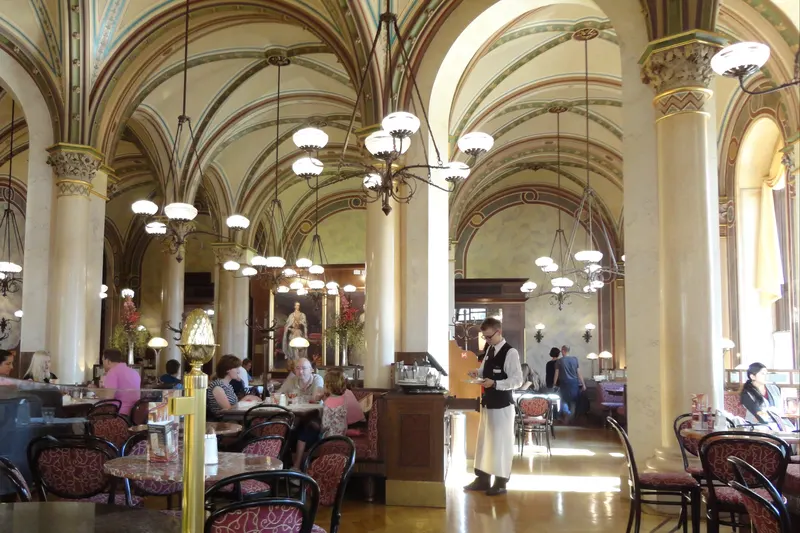
Vienna's version is the best preserved. Its official description calls the coffee house a place where time and space are consumed but only the coffee appears on the bill.1 Ordering there takes its own vocabulary, and Budapest's cafés were modeled on Viennese ones for two centuries.6
Ordering in Vienna: Melange, Brauner, Einspänner
The base of most Viennese orders is the Mokka, a short black coffee; a Kleiner Schwarzer is that coffee with nothing added, the local counterpart to an espresso.4 Early coffee houses had no drink names at all, only a color chart running from very dark to milky white for guests to point at.3
The Melange, Vienna's everyday milky coffee, is a slightly lengthened espresso with hot milk and a cap of milk foam, milder than a cappuccino.2 The Einspänner takes its name from a one-horse carriage: drivers wanted their coffee to stay warm, so the mokka was topped with whipped cream as insulation. It now comes in a glass mug with a handle.2 Viennese coffee houses offer more than 40 kinds of coffee in all.2
| Order | What arrives |
|---|---|
| Kleiner Schwarzer | A short Mokka without milk, Vienna's counterpart to an espresso4 |
| Verlängerter | A Mokka lengthened with hot water, milder than a Kleiner Schwarzer4 |
| Kleiner Brauner / Großer Brauner | A short Mokka with a splash of milk or Schlagobers (whipped cream); the Großer is larger, with a little more milk4 |
| Melange | A slightly lengthened espresso with hot milk and milk foam2 |
| Kapuziner | A small Mokka with a touch of Schlagobers, named for the brown of a Capuchin habit4 |
| Einspänner | A strong Mokka in a tall glass under a cap of whipped cream24 |
| Fiaker | A strong Mokka in a glass with a shot of kirsch or rum, topped with whipped cream4 |
| Maria Theresia | A double Mokka with orange liqueur and plenty of whipped cream4 |
Recipes vary from house to house; the names are what the waiter expects to hear.4
The glass of water, the newspaper and Herr Ober
The glass of tap water comes free with the coffee.3 It was first set down so guests had somewhere to put the spoon after stirring, and later served to show off the quality of the city's water, which gained weight in 1873, the year of the World Expo and of the First Vienna Mountain Spring Pipeline.2 Sending it back is a small breach of manners.4
Newspapers are part of the deal. In 1720 the Kramersche Kaffeehaus on the Graben became the first to lay them out.1 Regulars still read the day's papers for a long time over a single cup without being pressed to order again.3 The waiter expects to be addressed as Herr Ober.3 When you pay, rounding up is the custom.4
The room has its own kit too: marble tables, booths, small newspaper tables and Thonet chairs.1 The Thonet No. 14, first made in 1859, has a backrest of just two pieces of bent wood and is still produced, as the No. 214.2
Kaffeesieder, blockades and a heritage listing
Owners roasted and blended their own beans, which is why they called themselves Kaffeesieder, coffee boilers, a title still in use.3 The trade nearly collapsed when Austria joined Napoleon's blockade in 1808 and tariffs priced beans out of reach; coffee houses were then allowed to serve wine and hot food for the first time. Women were admitted from 1856.1
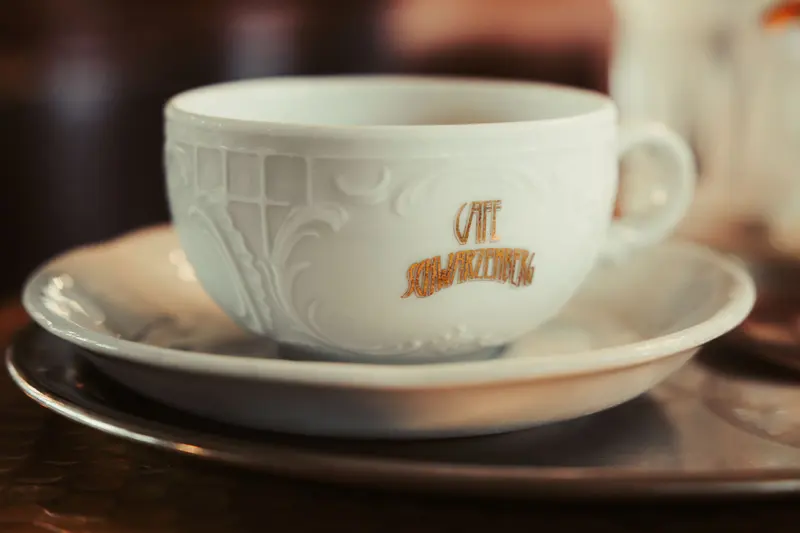
Vienna had about 150 coffee houses in 1819 and about 600 around 1900.3 Café Landtmann opened on the Ringstrasse in 1873, while City Hall, the University and Parliament were still building sites; of the 27 cafés the Ring once had, it and Café Schwarzenberg are among the few left.2 In 2011 Viennese coffee house culture was entered in Austria's national inventory of intangible cultural heritage, kept by the Austrian UNESCO Commission.1
Budapest: kávéház and presszó
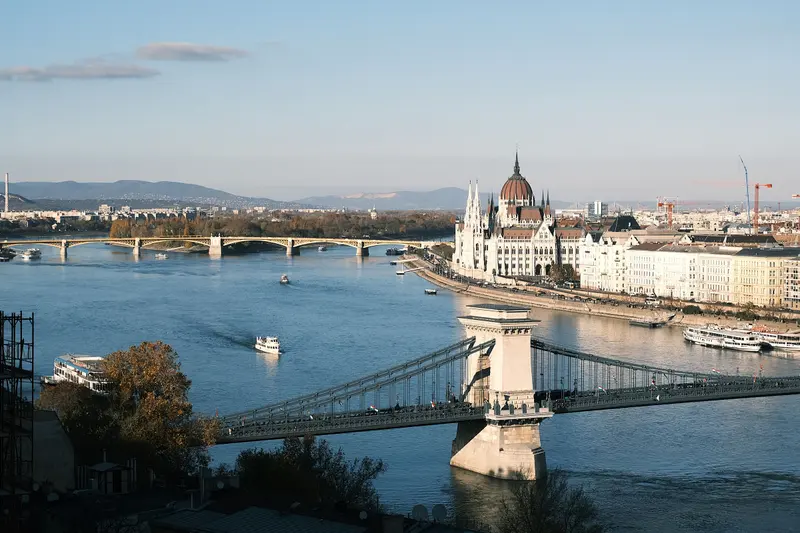
Hungarians first met coffee under Ottoman rule and called it black soup.5 The first Hungarian coffee house opened in 1714, run by a merchant known as Balázs Kávéfőző, Balázs the Coffee-Maker, and the kávéház (coffee house) followed Viennese models for the next two centuries.6 Around 1900 Budapest had about 500 cafés.5
Their golden age ran with the city's literature. The Centrál, founded in 1887, is where the literary review Nyugat was established in 1908. The New York Café opened in 1894, and in the early 1900s staff of Pesti Napló, Nyugat and the Est papers were there daily.5 After the Second World War most of these cafés closed; the Centrál shut in 1949 and reopened as a café in 2000.5
The presszó, a small espresso bar, filled the gap. Budapest's first opened between 1937 and 1944, a state-run network was built from the early 1950s, and the bars kept the live music of the old cafés until it faded in the 1980s.7 Hungarians still favor a short, strong Italian-style espresso over longer coffees.6 To order one, say egy kávét kérek, a polite "I'd like a coffee".8
Prague: the kavárna and the turek
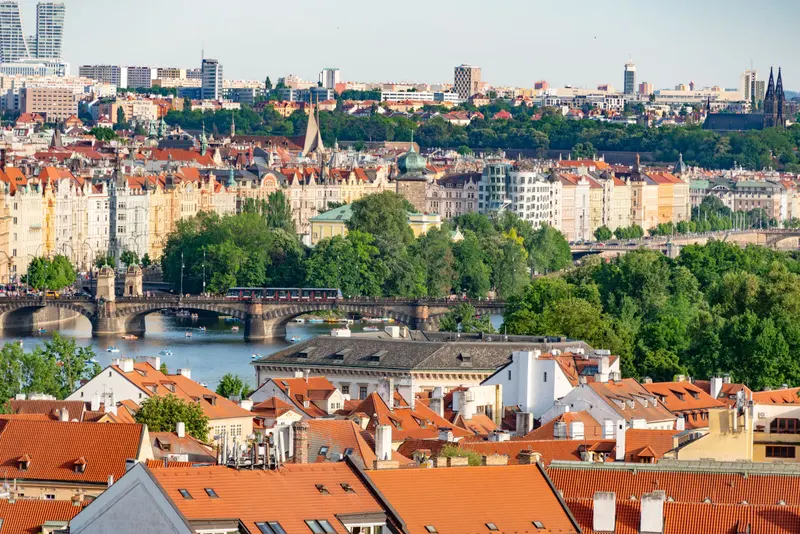
Prague dates its first coffee house, later called a kafírna, to 1714. Jiří Deodat, a coffee maker from Damascus, first sold cups in the street from a charcoal stove to customers who drank standing, then rented a wooden hut at the end of the Charles Bridge and finally a shop beside the Lesser Town bridge tower, where he sold coffee until his death on 2 December 1730.9
The kavárna (café) peaked later. Café Louvre opened in 1902 on Ferdinand Avenue, now Národní třída; Franz Kafka and Max Brod rented a club room there with friends, and Albert Einstein, teaching at the German University in 1912, also spent time at the café.12 Café Slavia, at Národní 1 opposite the National Theatre, opened in 1884 and was rebuilt in Art Deco after the First World War.10
Viktor Oliva's painting The Absinthe Drinker went up at the Slavia during its 1931–1932 rebuild. It was nationalized in 1948 and closed in 1992 over a legal dispute.11 Václav Havel sat at the painter Jiří Kolář's table there and, as president, petitioned for its reopening, which came on 17 November 1997.10
A humbler drink once filled Czech café cups: turecká káva or turek, ground coffee with boiling water poured over it and drunk with the grounds still in the cup, the teeth acting as a filter. It has little in common with the Turkish coffee it is named after.13
Kraków: Jama Michalika
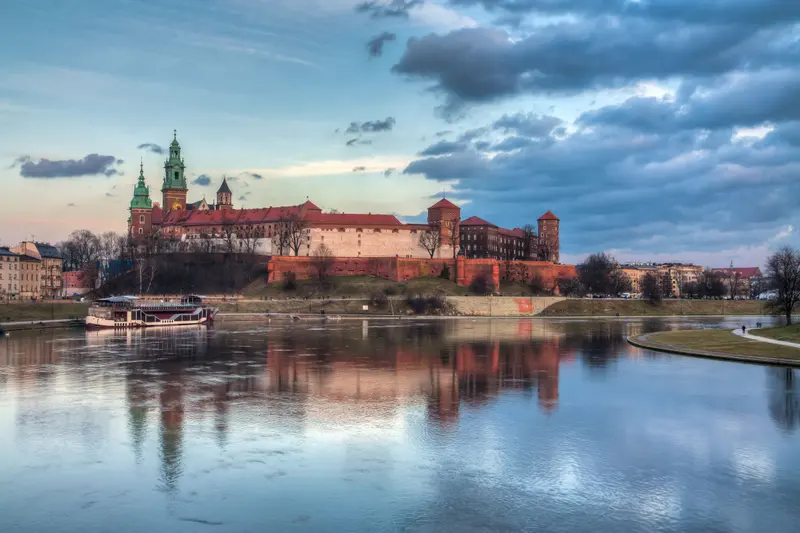
Kraków's best-known café began in 1895 as the Cukiernia Lwowska (Lwów Confectionery), opened at Floriańska 45 by Jan Apolinary Michalik. He could at first afford only a windowless back room, hence its nickname, Jama Michalika: Michalik's Cave.14 Students from the nearby Academy of Fine Arts got free meals in exchange for small artworks.14
From 1905 the café staged Zielony Balonik (the Green Balloon), a cabaret whose puppet shows mocked bigotry and imperial censorship; some of the puppets, caricatures of prominent Cracovians, are still on display among the Art Nouveau mirrors, stained glass and lamps.14
Tip. In a Viennese coffee house, leave the glass of water where it is and don't stir an Einspänner: drink the hot coffee through the cool cream.4