 By Yannick Schroth
City guides · 5 min read · October 2026
Melbourne was buying coffee on the street by the 1850s, when stalls sold cheap breakfasts to city workers and kept serving late into the night.1 The habit moved indoors in the 20th century: by the 1920s the city had about a dozen Continental-style coffee lounges, still brewing by percolation.1 Espresso arrived after that, and the inner suburbs later built their own ritual around it, the weekend brunch.15
For a visitor, the calendar matters as much as the map. A Victorian public holiday can add 10% to 20% to the bill, Melbourne Cup Day falls on Tuesday 3 November in 2026, and since 1 October 2026 paying by Visa, Mastercard or eftpos should cost nothing extra.8912
Centre Place, the Block Arcade and the CBD lanes
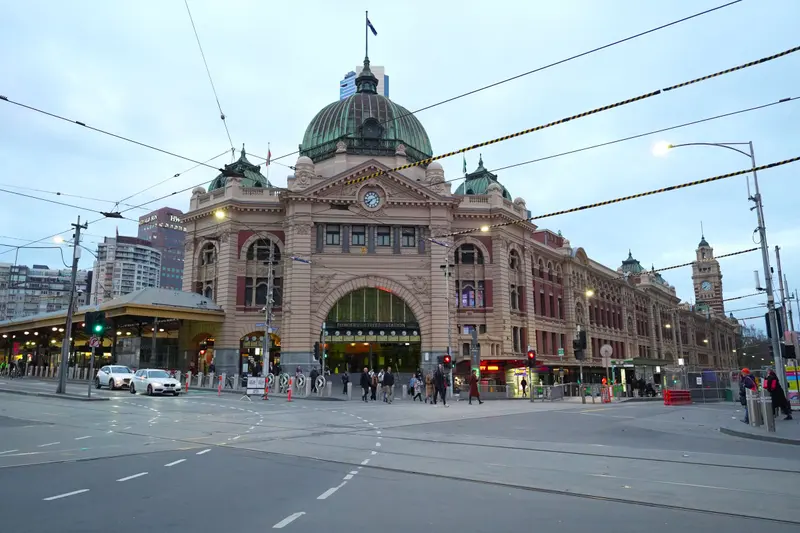
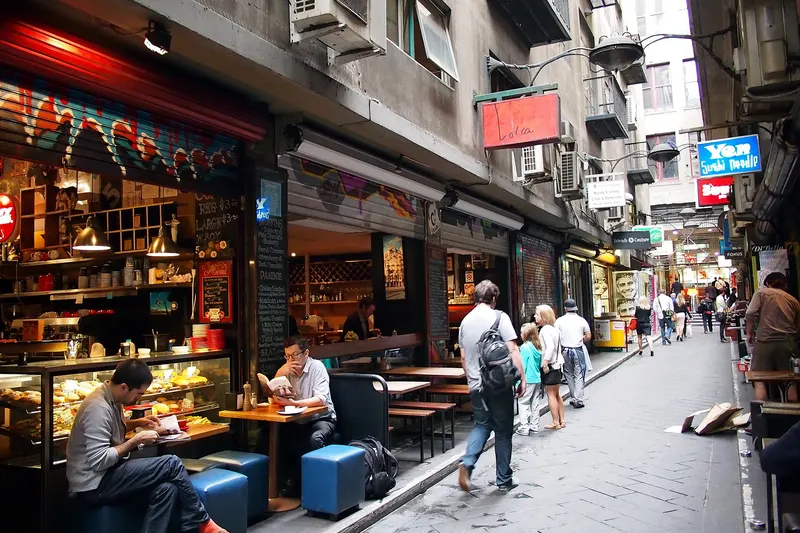
Centre Place is the lane most visitors walk first. It runs about 50 m north from Flinders Lane to Collins Street, and the usual route from Flinders Street Station reaches it through the Campbell Arcade underpass and Degraves Street, then leaves through the Centreway Arcade.2 In the 1890s it was Cummings Alley, winding between warehouses; by 1915 it was joined to Collins Street and renamed Centre Court.2
A sharp bend halfway along keeps vehicles out. In the 1980s the city and state governments made it one of the first generation of revitalized lanes, courting boutique shops and cafés with street frontage.2
Across Collins Street, the Block Arcade runs in an L to Elizabeth Street. Twentyman & Askew designed it, and it opened in full on 7 October 1893.3 The name comes from "doing the Block", the custom of strolling Collins Street between Elizabeth and Swanston Streets to be seen, which Fergus Hume described in an 1886 novel.3 Block Place, the covered lane on its north side, was once Carpenters Lane and leads to Little Collins Street.3
The arcade's tea room is among the city's oldest. eMelbourne, the University of Melbourne's encyclopedia, dates the Hopetoun Tea Rooms to 1892, run until 1907 by the Victorian Ladies' Work Association as an alcohol-free room for women, before they moved to shops 1 and 2 at the arcade's front.4 After receivership in 2020, the Cohen family reopened them as The Tea Rooms 1892.3
Where espresso landed first: Carlton and Bourke Street
Espresso machines reached Melbourne by the 1930s, mostly out of sight in restaurant kitchens and Italian grocers.1 The change came in 1953, when Henry Cyril Bancroft and his son Peter took the agency and manufacturing rights for Gaggia machines.1 Their machines went to University Café on Lygon Street in Carlton and to Pellegrini's on Bourke Street, and from there spread to milk bars and suburban shopping centers.1
The bars became meeting places. By the 1960s espresso bars were focal points for migrant communities, while some Melburnians eyed them with suspicion as places linked to gambling.1 Espresso also left the city early: one of the first espresso lounges opened in the late 1950s at the Federal guesthouse in Mornington.1
Fitzroy, Collingwood and the brunch habit
Broadsheet, the Melbourne food magazine, traces Australian brunch to lo-fi cafés in Fitzroy and Sydney's Darlinghurst in the early 1990s, and calls 2010, the year Instagram launched, the watershed.5 Some of the dishes that defined it are still served: Proud Mary in Collingwood has kept its potato hash on the menu since 2009, and Top Paddock in Richmond made its name with ricotta hotcakes.5
Nathan Toleman, who co-founded Top Paddock and also Kettle Black in South Melbourne, says that model fit a moment when brunch was becoming a cultural institution.5 By October 2025 Broadsheet found its hold less certain, with menus moving toward sandwiches, cinnamon scrolls and matcha, and cafés such as Beautiful Jim Key in Brunswick switching from breakfast to lunch at noon.5
Collingwood's coffee still ranks abroad. In The World's 100 Best Coffee Shops for 2026, published in February, Proud Mary placed 27th, down from fourth a year earlier.6 The ranking weighs some 350,000 public votes at 30% and a panel of 800 judges at 70%.6
What a cup costs in 2026
A regular flat white or latte cost about A$3.50 to A$4 ten years ago. By November 2025 Time Out put the national average near A$5.50, 37% above pre-pandemic prices, and called a coffee under A$5 almost impossible to find.7 Victoria was the exception it named: a crowded café scene keeps prices there closer to A$5 a cup.7
The pressure came from the farms. Australia imports about 90% of its beans, and extreme weather cut exports from Brazil and Vietnam, the two largest producers, by about 30%.7 A procurement consultant quoted in the same report expected prices to plateau or fall slightly by the end of 2026.7
Public holidays, surcharges and paying by card
Victoria's calendar has a few holidays of its own. Labour Day fell on Monday 9 March in 2026 and the Friday before the AFL Grand Final on 25 September, and Melbourne Cup Day applies statewide unless a non-metropolitan council has arranged a local alternative.8 Good Friday, Anzac Day and Christmas Day are restricted trading days.8
Expect a surcharge on those days. Among the cafés Broadsheet listed as open for Labour Day 2026, 15% was the most common rate; ST. ALi in South Melbourne and Prior in Thornbury added 18%, and Axil Coffee Roasters in Hawthorn and Project281 in Brunswick 20%.9
The menu has to say so. The ACCC requires the wording "A surcharge of [percentage] applies on [day or days]", and a consumer advocate told Yahoo Finance in June 2024 that 10% to 15% is the norm and 20% rare.10 That King's Birthday weekend, a medium almond cappuccino in East Melbourne came to A$8.18 with a 15% holiday surcharge and a card fee on top.10 One Glen Waverley café has also added 7% on ordinary Saturdays and Sundays since June 2022.11
The card fee, at least, is gone. Since 1 October 2026 businesses may not surcharge debit, credit or prepaid payments on eftpos, Mastercard or Visa; American Express and buy-now-pay-later services are not covered.12 The Australian Restaurant and Cafe Association expected small menu rises in return, with cash payers losing most.12
| Victorian public holiday | Date in 2026 |
|---|---|
| Labour Day | Monday 9 March8 |
| King's Birthday | Monday 8 June8 |
| Friday before the AFL Grand Final | Friday 25 September8 |
| Melbourne Cup Day | Tuesday 3 November8 |
| Christmas Day (restricted trading) | Friday 25 December8 |
| Boxing Day | Saturday 26 December, plus Monday 28 December8 |
Cafés that open on these days may add a surcharge if the menu shows it.910
Reusable cups and the March expo
The reusable KeepCup is a Melbourne product. The siblings Abigail and Jamie Forsyth, who had run a café business in the city, released the first cups in 2009, and the company is still headquartered there.13
The trade gathers each March. The Melbourne International Coffee Expo, held since 2012, ran from 26 to 28 March in 2026, with equipment launches, green-bean origins and a Roasters Playground stage where Australian roasters perform.14