 By Yannick Schroth
City guides · 4 min read · October 2026
Tokyo spends more on café visits than almost any other city in Japan. Over 2023–2025, households of two or more people in the 23 wards spent an average of ¥16,270 a year on kissadai (喫茶代, money spent in cafés and tearooms), second only to Nagoya at ¥16,431 and well above the national ¥10,261.1 The same households spent ¥9,679 a year on beans, ground and instant coffee for home, fourth among Japan's prefectural capitals and large cities.1
The spread of what that money buys is wide, from a machine cup at a convenience store to a hand-poured single origin. Where to drink it is mostly a question of district, and Tokyo's coffee districts often go by nicknames you won't find on a station sign. When to drink it depends on the season: festivals in the Jingūmae courtyard of the United Nations University, and an autumn day when the vending machines turn hot.
From the konbini machine to the chain counter
The cheapest fresh cup in Tokyo comes from a konbini (コンビニ, convenience store). As of October 2026, a hot regular coffee cost ¥140 at Seven-Eleven and a hot small one ¥160 at Lawson's Machi Café, tax included.3 Lawson's price has stood since July 2025, Seven-Eleven's since the same month.3
Chains sit one step up. On 23 July 2026 Doutor moved its small blend from ¥280 to ¥300 and its small café latte from ¥380 to ¥400, at Doutor and Excelsior Caffé shops across the country.2 Starbucks Japan followed on 9 October 2026, adding ¥4 to ¥35 to its regular drinks and pointing to higher costs for ingredients, logistics and energy; it did not publish the new price of each item.4
| Order | Where | Price |
|---|---|---|
| Hot coffee, R | Seven-Eleven (Seven Café) | ¥140, October 20263 |
| Hot coffee, S | Lawson (Machi Café) | ¥160, October 20263 |
| Blend coffee, S | Doutor | ¥300, from 23 July 20262 |
| Café latte, S | Doutor | ¥400, from 23 July 20262 |
Prices include consumption tax. Starbucks Japan's 9 October 2026 rise of ¥4–35 was announced without a per-item list.4
Okushibuya, Yanesen, Kuramae: the district nicknames
Ask about coffee north of Shibuya Station and you may hear Okushibuya (奥渋谷, "back Shibuya"): the Kamiyamachō and Tomigaya blocks within about ten minutes' walk past Bunkamura-dōri and the old Tōkyū main store.6 In June 2017, Tokyo Walker listed an AeroPress coffee at Fuglen Tokyo at ¥520 and the Immortal Latte at CAMELBACK sandwich&espresso at ¥594.6
Yanesen (谷根千) joins the first characters of Yanaka, Nezu and Sendagi. The name comes from a local magazine founded in 1984, which applied it to the old streets that escaped large-scale postwar redevelopment.7 Kuramae, on the Sumida's west bank south of Asakusa, is called Tokyo's Brooklyn. GO TOKYO, the metropolitan tourism site, ties the name to its riverside setting, its long run as a district of wholesalers and workshops, and its renovated old buildings, and describes it as a place people come to go café-hopping.8
Ginza's nickname is the oldest and the most disputed. Ginbura (銀ブラ) means strolling around Ginza, but Café Paulista says the word meant going to Ginza for a five-sen cup of its Brazilian coffee, coined by Keiō students in 1913 or 1915.5 Iima Hiroaki, an editor of the Sanseidō Japanese dictionary, told J-CAST in 2018 that the coffee version appears in no old text and is not worth debating.5
Two roasteries that drew the crowds
Blue Bottle opened its first café in Japan in Kiyosumi-Shirakawa on 6 February 2015, to a line that Gizmodo Japan, looking back in 2025, called huge.9 To mark the tenth anniversary, the company brought back its Kiyosumi tote bag in a limited run on 6 February 2025.9
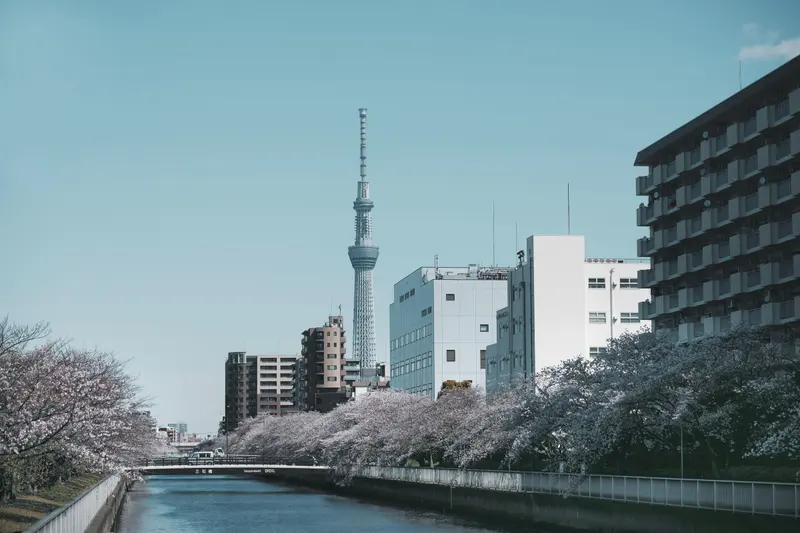
On the other side of the city, the Starbucks Reserve Roastery Tokyo opened in Nakameguro in February 2019, beside the cherry-lined Meguro River. It covers 1,200 m² over four floors, with an exterior by Kengo Kuma and a roasting cask about 17 m tall, and Time Out reported it as the largest Starbucks in the world.10 It was the fifth Reserve Roastery, after Seattle, Shanghai, Milan and New York.10
The coffee calendar: festivals and hot cans
The Tokyo Coffee Festival, first held in autumn 2015, brings roasters, food stalls and equipment sellers to the courtyard of the United Nations University in Jingūmae, and admission is free.11 The 2026 spring edition ran from 2 to 4 May, 11:00–17:00, with tastings, brewing-method comparisons, and beans and gear for sale.12 A winter edition follows on 30–31 January 2027, and by 17 October 2026 it had listed 68 exhibitors, 37 of them selling coffee or other drinks.11
The vending machines keep a calendar of their own. Kirin Beverage starts switching its machines from cold to hot drinks once daytime highs fall to about 25°C; in Kumamoto in October 2025, after a long summer, the change ran about a week later than usual.13 Tokyo's normal daily high drops from 27.5°C in September to 22.0°C in October, so hot canned coffee tends to return between those months.14 August is iced-coffee season, with a normal daily high of 31.3°C.14
Seats, cups and bins
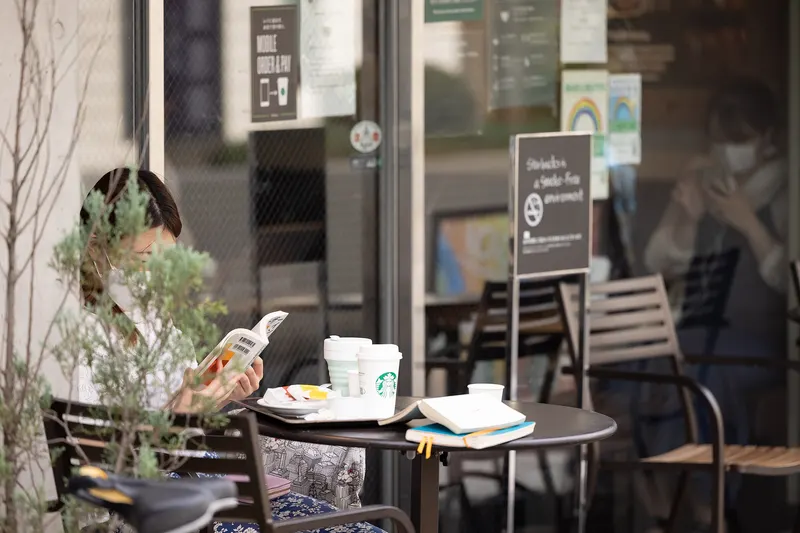
At a busy self-service café, find a seat before you queue. Some shops have staff ask 席は確保されていますか? (seki wa kakuho sarete imasu ka, "have you got a seat?") at the till and suggest you claim one first.15 The usual way to claim it is to leave a bag on the table, and Toyo Keizai reported in 2018 on a handbag holding a wallet, commuter pass and house keys stolen that way while its owner ordered.15 Hold the table with a scarf or a paperback instead.
Plan where the empty cup goes. Public bins are scarce on Tokyo's sidewalks, in its parks and in its stations; many were removed for security after the 1995 sarin attack on the subway, and the practice stuck.16 Bins stand most often outside convenience stores, while the ones beside vending machines are meant only for bottles and cans sold by that machine.16 Many residents simply carry their trash home and sort it there.16
Tip. Carry a takeaway cup until you pass a convenience store: its bins out front are the likeliest place to drop it, since the one beside a vending machine is meant only for that machine's bottles and cans.16