 By Yannick Schroth
Coffee cultures · 6 min read · November 2026
The espresso is national, but what goes into the glass with it can be local. Turin layers coffee with chocolate and cream, Lecce pours it over almond milk and ice, and Fano and Livorno heat spirits with sugar and lemon peel before the coffee goes in.12 Gambero Rosso dates the espresso's own story to 1884, when Angelo Moriondo patented his machine.1
Some of these drinks are older than the machine and have official standing. Piedmont published the bicerin as a traditional Piedmontese drink in its regional bulletin of 7 March 2001.4 Others, such as the caffè alla nocciola in Naples, date only from the 1990s.9
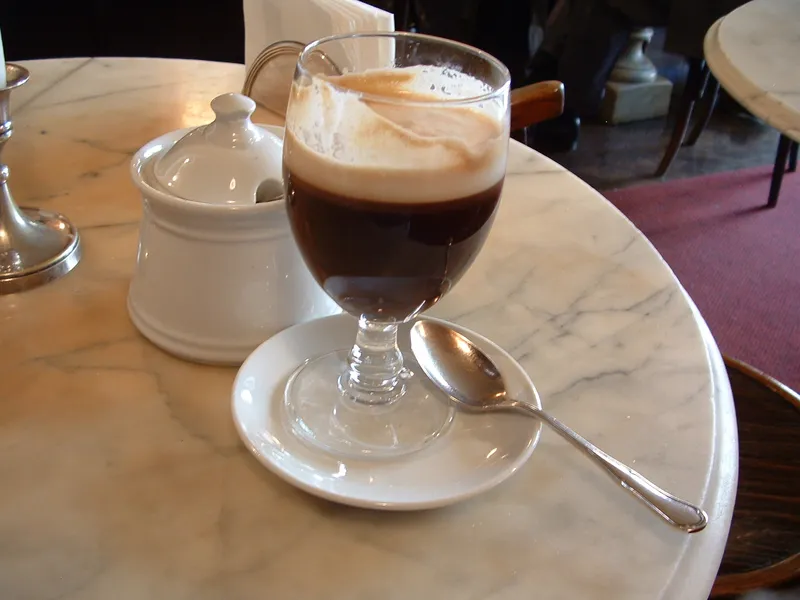
Bicerin, Turin: coffee, chocolate and cream in a small glass
The bicerin belongs to Caffè Al Bicerin, opposite the Sanctuary of the Consolata in central Turin, where Giuseppe Dentis, a maker of citron drinks, opened a small shop in 1763.3 The drink grew out of the bavareisa, an 18th-century mix of coffee, chocolate, milk and syrup served in large glasses.3 At first the parts came separately; by the 19th century they shared one glass in three versions: pur e fiur (close to a cappuccino), pur e barba (coffee and chocolate) and 'n poc 'd tut (a little of everything).3
The third version won and took its name from the small handleless glass, bicerin in Piedmontese.3 It was cheap: three soldi, or 15 cents of a lira, from the mid-1800s until 5 December 1913, when the price went up to 20.3 Churchgoers who had fasted before communion drank it on leaving the sanctuary, and in Lent it counted as a drink rather than food.3
The café keeps its proportions secret. Its chocolate cooks for hours in copper pots, and the coffee is a light blend, since the recipe is older than espresso machines.4 The glass arrives unstirred, so hot chocolate, coffee and cold cream reach the palate separately.4 A cousin went east: Domenico Barbaja, once a café boy in Turin, took a coffee-and-chocolate mix to Milan as the barbaiada.2
Caffè leccese, Lecce: espresso on almond milk and ice
In Salento, the heel of Puglia, purists use neither caffè leccese nor caffè salentino. They ask for un caffè in ghiaccio con latte di mandorla (iced coffee with almond milk), the Salentine owners of Osteria Popolare Pugliese in Milan told Gambero Rosso in October 2025.6 The almond milk goes into the glass first, usually as a syrup in bars, then a long espresso and plenty of ice.2 Stir before drinking, or the syrup stays at the bottom.2
Gambero Rosso ties the drink to the Quarta family of Lecce roasters. Antonio Quarta invented it more than 70 years ago, when he distributed ice in the city and the whole town came to his bar, then La Casa del Caffè and now Avio Bar, for ice; the original used ice broken into coarse shards by pick.1 Italian Wikipedia gives an older line, tracing iced coffee in Salento to the early 17th century and to Valencia's café del tiempo, with almond milk later replacing the sugar and the slice of lemon.5
Dissapore pairs it with biscotti di Ceglie, a Slow Food presidium.2 The Milan osteria pours Quarta's espresso at €1 a cup, which its owners called a promise rather than a promotion in October 2025; paying €1.50, sometimes €2, for an espresso in a Milan bar had started to feel out of place, they said.6
Moretta fanese, Fano: the fishermen's three layers
The Marche town of Fano drinks the moretta: espresso over a hot mix of anise liqueur, rum and brandy with sugar and lemon peel.7 Tradition gives it to the port's sailors and fishermen, who poured the dregs of liqueur bottles into hot coffee before going to sea; another account credits the old town's street sweepers.71 The first documented mention is a 1908 advertisement in a local weekly, in which Giuseppe Armanni's Caffè Cavour offered it for 10 cents of a lira.7
The barista heats about three teaspoons of the spirits with two of sugar and a strip of lemon peel in the glass, using the steam wand, then pours in the espresso with the glass tilted.7 A proper moretta shows three layers: liqueur at the bottom, coffee, then crema, a shape it took after the war as espresso machines spread.72 At home it is made in a moka with 20 ml of anise, 10 ml of rum and plenty of sugar.2
AIBES, the Italian bartenders' association, listed the moretta as an official cocktail in 2006, and the Marche added it to its traditional food products in 2011.1
Ponce alla livornese, Livorno: punch made with coffee
Livorno's ponce is British punch remade with coffee in place of tea, credited to the port's large British community and dated to the 17th or 18th century.82 Instead of Caribbean rum it uses rumme, or rum fantasia, a local spirit of alcohol, sugar and dark caramel, sometimes flavored with rum essence.8 Until the early 1900s, bar owners could legally make rumme and mastice, an anise liqueur, in their own back rooms.8
Today's version dates from the 1950s.2 Sugar and rumme, alone or mixed with cognac or sassolino, go into a thick 10 cl glass called a gottino, with a strip of lemon peel known as the vela (sail); the steam wand brings it to the boil and a ristretto fills the glass.8 It is drunk scalding after lunch or dinner, and it is said the lemon was once rubbed round the rim to clean the cup.82
The torpedine, a stronger variant, adds a pinch of chili to the ground coffee.8
Caffè alla nocciola and strapazzato, Naples
Naples' best-known flavored coffee is young. Michele Sergio, whose family runs Gran Caffè Gambrinus, dates the caffè alla nocciola to the mid-1990s, after the 1994 G7 summit put the city back in the news, and calls it the first Neapolitan gourmet coffee; versions with Nutella, Kinder and Rocher followed.9 In his recipe a hazelnut mousse of hazelnut paste, icing sugar and whipped cream goes into a glass, topped with a Neapolitan espresso.9
Raffaele Ferrieri claims it for Il Vero Bar del Professore, on the same square as Gambrinus. In 2012 he said he first gave the drink away to skeptical customers, and that his sign reads unica sede (only branch) because so many bars imitated him, some calling their coffee "del professore".10 Dissapore links the flavor to Giffoni hazelnuts and notes a dab of cream is often floated on top.2
Neapolitan baristas devised the caffè strapazzato for anyone who dislikes the scalding cup: sugar cream and cocoa are whisked into the espresso, and the wet spoon is run round the rim to cool it.11 At Gambrinus, its longtime director Gennaro Ponziani was the first to add a spoonful of cream.11 In 2016 the café brought back the barbajata, of sugar cream, coffee, hot chocolate and whipped cream, named for the impresario Domenico Barbaja, who in 1816 shut Rossini in a room of his Naples palazzo until Otello was written.12
Crema di caffè, caffè del nonno and espressino
Crema di caffè, the cold, thick coffee cream that bars bring out once the heat arrives, has no certain birthplace, Gambero Rosso wrote in May 2026.13 The best-supported theory points to Boccadasse, the fishing village in Genoa, where pànera, a semifreddo of cream and coffee, was invented more than a century ago.13 In the 1980s and 1990s bars revived it as caffè del nonno, a name that recalls the Coppa del Nonno coffee ice cream, born in 1955.13
Naples claims it too, with a story that 19th-century women invented it to drink coffee in summer.13 Campania's spumone al caffè is airier, whipped from coffee, sugar and iced water with no milk or cream.13 In France it is called crème de café à l'italienne.13
The espressino is hot and typical of central Puglia: a ristretto topped with milk froth and cocoa, in a glass.14 Italian Wikipedia separates it from the marocchino, built the other way up with chocolate at the bottom, and from the espressino freddo, a cold coffee cream for summer.14 In Salento, though, the marocchino is simply called an espressino.6
More regional coffees at a glance
Caffè d'orzo, from roasted barley, is caffeine-free and made on the same espresso machines in cafés; at home Italians use an orziera, a moka pot adapted for barley.15 It is traditionally thought of as children's coffee.15
Naples' caffè sospeso, a coffee paid for and left for a stranger, spread during the Second World War, and Gran Caffè Gambrinus revived it in 2010 for its 150th anniversary.1 Trieste has its own counter words: the espresso is a nero, and espresso with milk foam in a small glass is a capo in b.16 Gambero Rosso recommends Antico Caffè Torinese on Corso Italia for a well-made one.16
| Drink | Where | In the glass |
|---|---|---|
| Bicerin | Turin | Coffee, hot chocolate and cream, layered and unstirred4 |
| Caffè leccese (caffè in ghiaccio con latte di mandorla) | Lecce and Salento | Almond milk, long espresso, ice2 |
| Moretta fanese | Fano | Anise, rum, brandy, sugar and lemon peel under espresso, in three layers7 |
| Ponce alla livornese | Livorno | Rumme, sugar and lemon peel brought to the boil, topped with ristretto8 |
| Caffè alla nocciola | Naples | Hazelnut cream and espresso in a glass9 |
| Caffè strapazzato | Naples | Espresso whisked with sugar cream and cocoa11 |
| Espressino | Central Puglia | Ristretto, milk froth and cocoa in a glass14 |
| Crema di caffè / caffè del nonno | Bars across Italy in summer | Cold, thick whipped coffee cream13 |
| Caffè padovano | Padua, from the 19th-century Caffè Pedrocchi | Espresso under cream, milk and mint syrup, dusted with cocoa1 |
| Caffè alla valdostana | Cogne, Aosta Valley | Hot coffee, grappa or génépi, sugar, citrus peel and spices, flamed and shared from a wooden coppa dell'amicizia2 |
| Caffè calabrese | Calabria | Brandy and cane sugar heated with crushed licorice, then espresso2 |
| Capo in b | Trieste | Espresso with milk foam in a small glass16 |
| Caffè d'orzo | Across Italy | Roasted barley, no caffeine15 |
At Cogne the friendship cup passes from one drinker to the next, counterclockwise, each sipping from a different spout.2