 By Yannick Schroth
Coffee cultures · 6 min read · November 2026
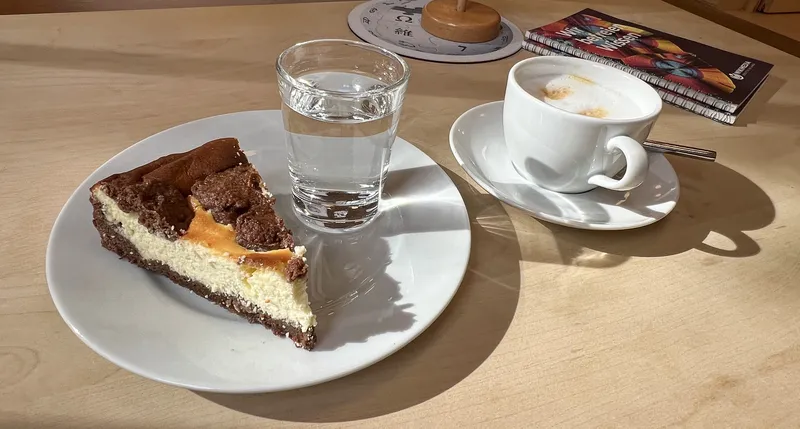
Kaffee und Kuchen is a meal of its own, taken between lunch and dinner. Some regions call it das Kaffeetrinken or das Vesper; in Saxony the Vesper means coffee and cake in the afternoon, and in the Bergisches Land, east of Cologne, families still lay an elaborate Bergische Kaffeetafel (coffee table).1
The drink arrived long before the custom. Germany's first coffeehouse, the Schütting, opened in Bremen in 1673, and by about 1850 coffee had become a drink for everyone.2 Germans now drink about 161 liters of it a year on average, by the count of the German Coffee Association, yet specialty coffee is a niche: in 2018 the curator of the Berlin Coffee Festival put it at under 2% of the German market.210
The afternoon table
The custom grew out of the coffeehouse. Coffee reached Europe in the early 17th century as a luxury of the aristocracy, the first public coffeehouses served the bitter drink with sweets, and people liked the pairing enough to copy it at home.1 On Sunday afternoons households laid the table according to their standing, took the home-baked cake out of the oven and opened the Kaffeetafel.1
Prussia once policed the habit. From 1780 Frederick the Great kept roasting a state monopoly, and until his death so-called Kaffeeschnüffler (coffee sniffers) were employed to catch people roasting at home by the smell.2 For poorer families coffee was food: a Kaffeesuppe simmered on the stove all day with bread broken into it, to keep people warm, fed and awake, and factory workers drank coffee to last their shifts.2
After the Second World War, a cup of coffee became a symbol of reconstruction and the Wirtschaftswunder (economic miracle): drinking it meant you could afford something again.2
The Konditorei and its regional cakes
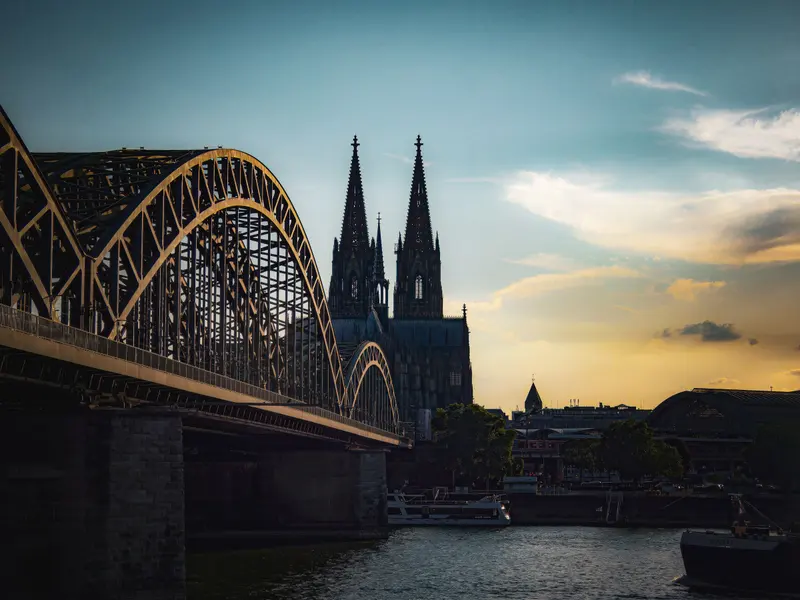
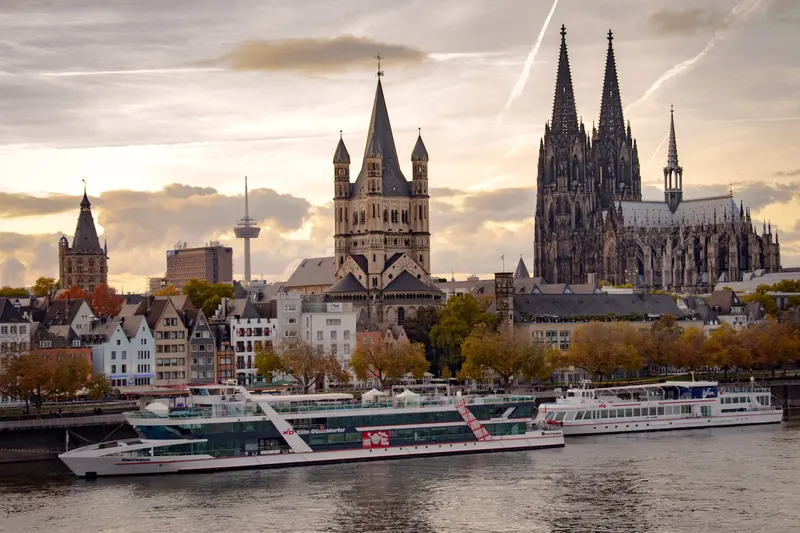
Away from home, the afternoon belongs to the Konditorei (pastry café). Café Reichard in Cologne was founded by Georg Reichard on 9 November 1855 at Hohe Straße 154 and moved in 1905, under the master confectioner Rienemann, to Unter Fettenhennen 11 at the foot of the cathedral towers. The broadcaster WDR bought the building in 1966 and had it rebuilt in its neo-Gothic style.3
Schwarzwälder Kirschtorte (Black Forest cherry torte) layers chocolate sponge with cherries, Kirsch (cherry brandy) and whipped cream. Its origin is disputed: the name first appeared in print in February 1915 in Brandenburg an der Havel, far from the Black Forest, and the oldest written recipe, from 1927, is kept in an archive in Radolfzell.4
Bienenstich (bee sting) is a yeast-dough cake under a baked crust of caramelized almonds, filled with custard, buttercream or cream. A legend ties it to bakers' boys in Andernach in 1474, but the cake is documented only shortly after 1900.5
The Frankfurter Kranz stacks sponge, buttercream and Krokant (nut brittle) in a ring. As a showpiece of the craft it is expected to contain real buttercream, and in 1984 a court in Koblenz ruled that a margarine-based cream has to be declared to the buyer.6 In Hamburg the pastry is the Franzbrötchen, laminated dough with sugar and cinnamon; a baker's handbill of 1825 already offered "Franzschbrod" made to the recipe of the French baker in Altona, then under Danish rule.7
Even the doughnut changes name. The jam-filled yeast ball goes by Berliner in the north and west, Krapfen in Bavaria, and Pfannkuchen in Berlin, Brandenburg, Saxony and Saxony-Anhalt, where a pancake is called Eierkuchen instead.8
Filterkaffee and the Melitta filter
Melitta Bentz, a Dresden housewife born in 1873, wanted coffee without grounds or the bitterness of the percolator. She tore a sheet of blotting paper from her son's school exercise book, laid it in a brass pot she had punched with holes and poured water over the ground coffee.9 In June 1908 the Imperial Patent Office in Berlin granted protection for her paper filter, and she founded the Melitta company with her husband Hugo the same year, making filters at home; the cone-shaped filter followed in 1932.9
The German Coffee Association counts the 1908 filter as still in use in many households.2 At home the machine took over: "Every German household had a classical filter machine from Braun or Philips," the Berlin coffee writer Melanie Böhme told The Berliner in 2018.10 Decaf is a German invention too. In 1905 Ludwig Roselius of Bremen took the caffeine out of coffee and sold it as Kaffee HAG.2
East Germany's coffee crisis
In the GDR, coffee was bought with scarce hard currency. In the 1970s East Germans drank 3.6 kg of beans per head a year and spent 3.3 billion marks on coffee annually, almost as much as on furniture.11 After a failed Brazilian harvest in 1975–76, the import bill rose from about 150 to nearly 700 million Valutamark (foreign-trade marks) a year.11
In 1977 the state dropped Kosta, its cheapest coffee at 7.50 marks per 125 g, and launched Kaffee-Mix, 49% substitute, at 4 marks.11 Shoppers rejected it and nicknamed it "Erichs Krönung", a dig at the West German brand Jacobs Krönung, and the pea flour in the mix swelled under pressure and clogged café machines.11 In September 1977 the GDR lifted its limits on coffee in gift parcels from the West, which supplied 20 to 25% of what East Germans drank.11
The crisis reached Vietnam. Under agreements of 1980 and 1986, East Germany supplied machinery for new plantations in exchange for half the harvest over 20 years, with the first usable crop planned for 1990.11 Röstfein in Magdeburg, one of seven East German roasteries meeting a demand of 50,000 tonnes a year, credits its 1980s success to fluidized-bed roasting, in which the beans float in hot air and steam.1213 When its Rondo Melange returned in 1997, the first 100 packs offered in a Halle supermarket sold out in two hours.12
The Kaffeesteuer
Germany taxes coffee by weight. Green beans come in free of customs duty and coffee tax; the tax falls due once they are roasted, because the levy has turned from an import duty into an excise.14 It is a national tax outside EU harmonization, and in 2018 it brought the federal government about €1 billion a year.14
The rates are €2.19 per kilogram of roasted coffee and €4.78 per kilogram of instant coffee, with lower, staggered rates for goods that only contain coffee.15 A 250 g bag of beans therefore carries about 55 cents of Kaffeesteuer. Two places lie outside the tax area: the North Sea island of Helgoland and Büsingen on the Upper Rhine.14
Roasters in Berlin and Hamburg
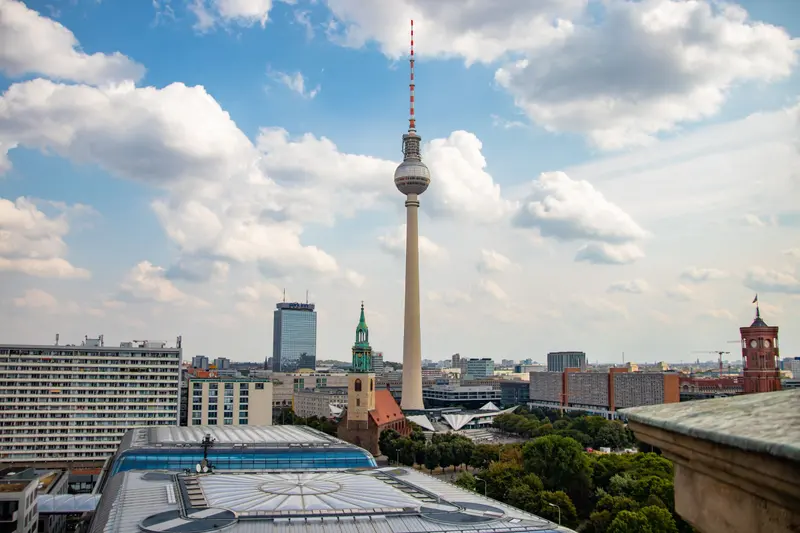
Berlin's specialty scene is young. Bonanza opened its roastery in 2006 and claims to have brought third-wave coffee to Berlin, The Barn followed in 2010, and by 2018 the city counted more than 50 specialty roasteries.10 Bonanza still roasts in Berlin and ships beans across Europe; Bonanza Coffee Heroes on Oderberger Straße in Prenzlauer Berg pours them.16 The Barn's café at Schönhauser Allee 8 is about a kilometer south.
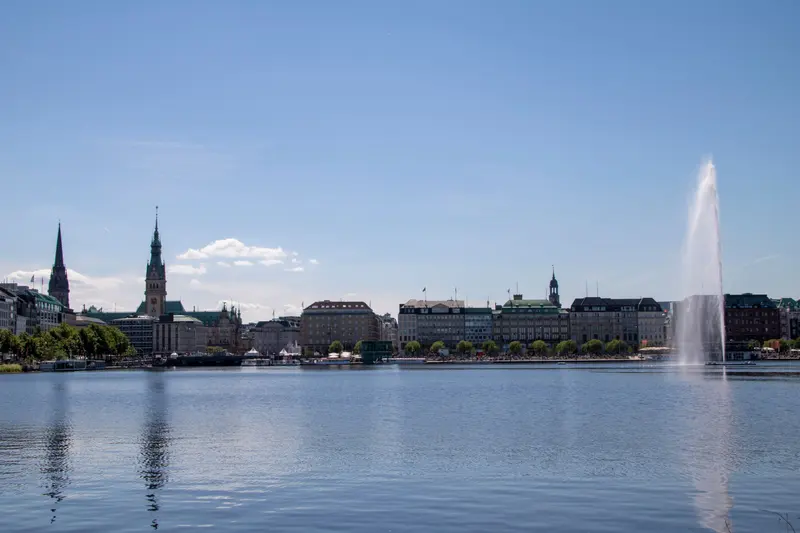
Hamburg roasts where the beans used to be stored. Since 2006 the Speicherstadt Kaffeerösterei has run an open roastery at Kehrwieder 5, in a district it calls the center of the European coffee trade for centuries, so that visitors can follow the beans from jute sack to cup.17 Nord Coast roasts by hand at Deichstraße 9 and keeps a light roast, with pronounced acidity and fruity notes, for its coffees from Nicaragua, Rwanda, Colombia and Kenya.18
How to order, and what it costs
Filter coffee comes as a Tasse (cup) or a Kännchen (small pot). The DWDS dictionary of German lists "ein Kännchen Kaffee bestellen" (to order a pot of coffee) as a standard phrase, and the old terrace rule "draußen nur Kännchen" (outside, pots only) still turned up in the Frankfurter Allgemeine Zeitung in July 2024.19 Café Reichard's menu, updated in April 2026, priced the Kännchen at exactly twice the Tasse.20
For cake, ask for ein Stück (a slice) of the one you want, and add mit Sahne for whipped cream. At Café Hauptwache in Frankfurt a slice of Kuchen or Torte cost €5.00 and fresh Schlagsahne (whipped cream) €1.50 extra, as of November 2026.21 Milchkaffee is a large coffee with hot milk, and zum Mitnehmen means to take away.
Espresso drinks cost much the same from city to city. A survey by the coffee retailer Coffee Friend of 1,232 cafés in ten large German cities, using prices from June 2026, found averages of €2.58 for an espresso, €3.80 for a cappuccino and €4.33 for a latte macchiato; Cologne was cheapest, at €2.44 for an espresso, and Bremen dearest, at €2.78.22
| Order | Price | Where and when |
|---|---|---|
| Tasse Kaffee (cup of filter coffee) | €4.60 | Café Reichard, Cologne, April 202620 |
| Kännchen Kaffee (small pot) | €9.20 | Café Reichard, Cologne, April 202620 |
| Baumkuchen, one portion | €6.90 | Café Reichard, Cologne, April 202620 |
| Ein Stück Kuchen or Torte (slice of cake) | €5.00 | Café Hauptwache, Frankfurt, November 202621 |
| Mit Sahne (whipped cream) | +€1.50 | Café Hauptwache, Frankfurt, November 202621 |
| Espresso | €2.58 (average) | 1,232 cafés in ten cities, June 202622 |
| Cappuccino | €3.80 (average) | 1,232 cafés in ten cities, June 202622 |
| Latte macchiato | €4.33 (average) | 1,232 cafés in ten cities, June 202622 |
Menu prices in euros as of 2026; the averages come from a retailer's survey of published café prices.
Tip. On a café terrace, look for the Tasse before you order: at Café Reichard by Cologne Cathedral a Kännchen cost €9.20 and a Tasse €4.60 as of April 2026.20