 By Yannick Schroth
Coffee cultures · 5 min read · October 2026
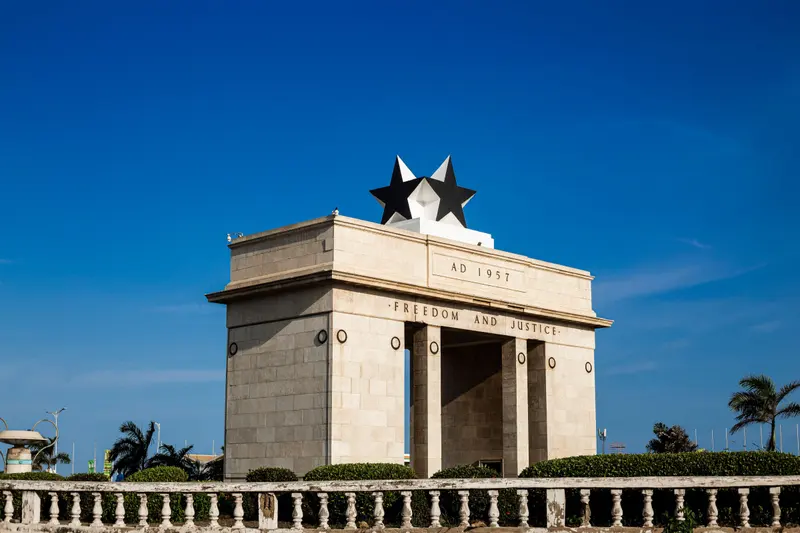
Ghana is known for cocoa, and the same board runs its coffee. The Ghana Cocoa Board (COCOBOD) regulates cocoa and also oversees coffee and shea production.1 Virtually all Ghanaian coffee is robusta, grown mostly on smallholdings between 400 and 800 m in the Ashanti, Bono Ahafo, Eastern, Central, Western and Volta regions.1 In 2025 the coffee publication Sprudge called Ghana the third-smallest coffee producer in sub-Saharan Africa.2
Further west the picture changes. Côte d'Ivoire was the world's third-largest coffee producer in the 1970s, after Brazil and Colombia,15 and in Senegal a coffee roasted with a peppery West African spice is sold from roadside stands for a handful of coins. In Accra, breakfast still runs on tea, Milo and instant coffee, while a small roaster-café scene has grown around Osu, Airport Residential and East Legon.
Ghana: coffee in a cocoa country
Coffee came first. The earliest evidence of structured coffee production in Ghana dates to the mid-18th century, and a price crash in the 1980s pushed many farmers into cocoa.1 Output then climbed from 123 tons in 1984 to 5,700 tons in 1999 under the Agricultural Diversification Project, and reached 12,650 tons in 2015 after the Coffee Rehabilitation Project began in 2011.2 A 2011 government scheme produced 2,400 hectares of new and revitalized plantations.4
Recent figures disagree. A 2021 estimate put the crop at around 37,000 bags of 60 kg a year, with harvesting starting in September and average yields of about 300 kg of cherries per hectare.1 In 2022 SABC News reported about 10,000 tonnes a year for the domestic market, and a COCOBOD plan to reach 50,000 tonnes and hand out more than 600,000 coffee seeds.3 Many coffee farmers also grow cocoa, the crop in which Ghana trails only Côte d'Ivoire as an exporter.4
| Year | Ghana's coffee crop | Context |
|---|---|---|
| 1984 | 123 tons | Low point after the 1980s price crash2 |
| 1999 | 5,700 tons | After the Agricultural Diversification Project2 |
| 2015 | 12,650 tons | After the Coffee Rehabilitation Project of 20112 |
| 2021 | About 37,000 bags of 60 kg | Mostly robusta from smallholdings1 |
| 2022 | About 10,000 tonnes | COCOBOD target: 50,000 tonnes a year3 |
Estimates for the 2020s vary widely between sources.
Tea, Milo and instant coffee at breakfast
Ordering a hot drink in Ghana starts with vocabulary. Ghanaians sometimes call hot chocolate "tea", and a typical city breakfast is that "tea" with bread and margarine; tea from teabags, with milk and sugar, is also popular.7 Nestlé's factory in Tema, east of Accra, opened in 1971 making Ideal milk and Milo, a malted chocolate drink, and later added Nescafé 3-in-1; its output is sold across Central and West Africa.6
Tea is growing. Ghana imported US$128 million of tea in 2021, up from US$94.1 million in 2020, and in January 2024 a Ghanaian report linked rising demand to the higher cost of koko (a grain porridge) and chocolate drinks.17 Brewed coffee has a harder time. In 2018 a farmer planting 900 government-supplied coffee seedlings told AFP of supermarket instant coffee: "It doesn't taste like coffee."4
Accra's roaster cafés: Osu, Airport Residential and East Legon
In 2015 Time Out Accra described an explosion of coffee culture in the capital over the previous few years; two of the cafés on its list were in Airport Residential Area and one bakery in Osu.8 By 2018 the South African chain Vida e Caffè and Canada's Second Cup had opened in Accra, and local cafés were serving beans from Volta Region farms.4
Jamestown Coffee shows how the scene works. Founded by Kwasi Osei-Kusi in 2018 as a small-batch roastery of 200 to 300 kg in its first year, it now roasts five to six tons a year, opened an open-roastery café in Nyaniba, Osu, in 2020, and buys single-origin beans from Kpedze in the Volta Region.2 A December 2024 review described the Osu café as an all-day coffee shop with bags of Ghanaian coffee on display, and noted a second branch in East Legon, north of Accra Mall.9
The state now promotes drinking the crop at home. On 30 May 2024 COCOBOD signed with Asili, a licensed coffee dealer, to run four mini cafés at filling stations in Greater Accra and to plan a coffee shop concept, GHCOFFEE HUB, selling locally processed coffee.5 Asili is based at Akropong-Akuapem in the Eastern Region and sells diffuser bags of about 10 g of robusta.2 By 2025 specialty cafés were moving into malls and key urban areas of Accra, Kumasi and Takoradi.2
Accra held Ghana's first Coffee Week from 21 to 26 October 2024.1011 It ended with a fair where local roasters showed their coffee, alongside barista training.11
Café Touba, Senegal's spiced coffee
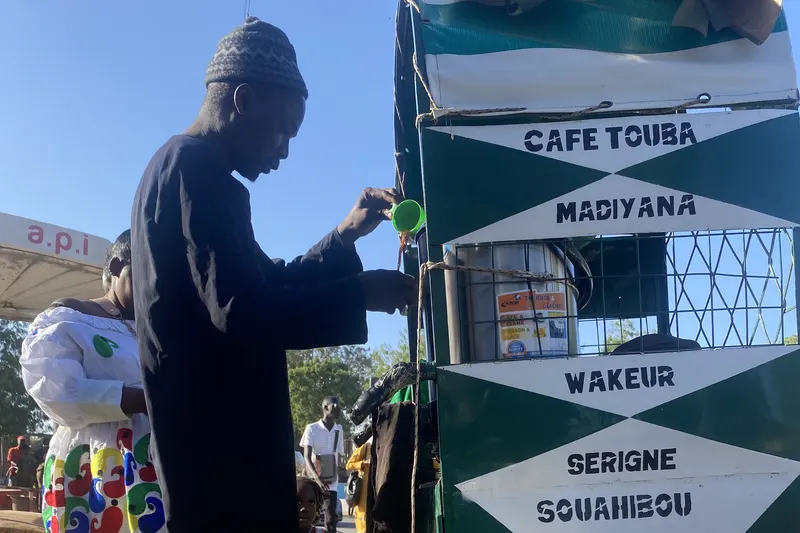
Café Touba is coffee roasted with djar, the Wolof name for grains of Selim, the dried fruit of the tree Xylopia aethiopica, and sometimes cloves.12 The spices are roasted with the beans and ground with them, at roughly 80% coffee to 20% djar, and the powder is brewed through a filter.12 The drink is named after Touba, the holy city of the Mouride Sufi brotherhood.1213
Its story belongs to the brotherhood's founder. Sheikh Amadou Bamba founded the Mourides in 1883 and Touba in 1887; the French exiled him to Gabon in 1895, where he is said to have found that roasting grains of Selim with coffee kept him alert for prayer and writing.13 For nearly a century the drink stayed largely within the order, and pilgrims still drink it at the Grand Magal, the pilgrimage to Touba that commemorates his exile.13
On the street it is cheap and quick. In April 2026 a cup cost as little as 100 CFA francs, about 18 US cents.13 Vendors at a tangana (a roadside coffee stall) boil water over charcoal, pour the coffee back and forth between cup and ladle to aerate it, and leave sugar on the side; most buy robusta from Côte d'Ivoire.13 After the 2008 financial crisis raised the price of imported coffee, a 2012 World Bank report found vendors on every street corner.13
The drink has political weight too. A 2017 essay framed it as resistance to imports such as Nestlé's instant coffee and powdered milk,14 and Nestlé answered with Nescafé Ginger & Spice.12 Café Touba has also become the most popular drink in Guinea-Bissau.12
Côte d'Ivoire's robusta
Côte d'Ivoire was Africa's largest coffee producer in the 1970s and 1980s.15 Output rose from 36,000 tons in 1945 to 112,500 tons in 1958 and peaked at 380,000 tons of green robusta in 2000; civil wars in 2002 to 2007 and 2010 to 2011 cut the crop to 32,291 tons in 2011.15
According to US Department of Agriculture (USDA) figures, the country exported 650,000 bags of 60 kg in 2024 and ranks among the world's top 20 producers, almost all of it robusta.16 At home, coffee has mostly meant low-cost formats, and in January 2026 an Abidjan coffee company described drinkers moving from instant Nescafé to capsules, as specialty shops multiply in the city.16