 By Yannick Schroth
Coffee cultures · 4 min read · October 2026
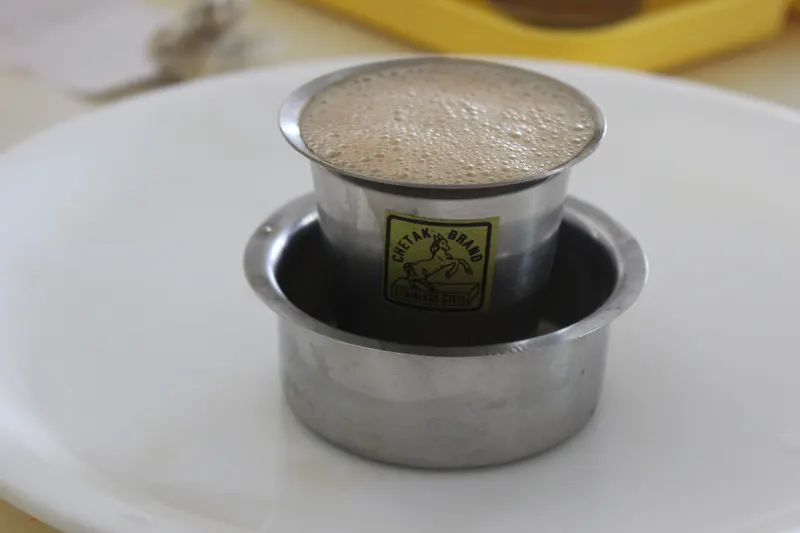
Filter kaapi, as India calls it, is hot milk and sugar mixed with a strong brew of finely ground coffee and chicory, made in a two-part metal filter and served in a steel tumbler.5 It is a southern habit first. In a 2009 Coffee Board study, the south drank about 78% of all coffee consumed in India, and in the south filter coffee outsold instant; in the north, east and west, instant led.4
India also grows the beans. The country was the world's seventh-largest coffee producer when the Press Information Bureau reported in January 2025 that exports had reached US$1.29 billion in 2023–24.3 Most of it comes from the Western Ghats of Karnataka, Kerala and Tamil Nadu, grown under a canopy of natural shade.1
The steel filter and the decoction
The South Indian filter is two metal cylinders that sit one on top of the other. Ground coffee goes into the perforated upper cup and is pressed down with a disc; boiling water is poured over it, the lid goes on, and the brew drips slowly into the lower cup.5 That concentrated brew is the decoction. A heritage record from INTACH, an Indian heritage trust, describes the filter as having a third piece, the kodai (Tamil for 'umbrella'), which slows the dripping and makes the decoction stronger.6
In many homes the decoction is brewed fresh before sunrise, and the first draw, made with the least water, is prized as the strongest.7 The decoction is then mixed with hot milk and sugar in the cup.5 Until the middle of the 20th century, jaggery (unrefined cane sugar) or honey sweetened the drink; white sugar took over after that.5
Chicory, and what 'degree coffee' means
Filter coffee powder is traditionally dark-roasted Plantation A washed arabica or peaberry, ground and blended with roasted chicory root: coffee makes up 80–90% of the blend and chicory 10–20%.5 The chicory adds a slight bitterness and a thicker cup.57 When you buy filter coffee powder to take home, the chicory share is the number to check on the pack.
In the Cauvery delta of Tamil Nadu, the strong stuff goes by 'degree coffee'. One explanation, given by The News Minute in 2017, is that households tested milk for purity with a lactometer, which people mistook for a thermometer, so pure milk became 'degree' milk and the coffee made with it 'degree coffee'.7 Tamil Nadu was also the biggest coffee-drinking state in the 2009 Coffee Board study, with 36% of southern consumption against Karnataka's 31%.4
The davara and the tumbler
Filter coffee arrives in a set: a tall tumbler standing inside a davara (also spelled dabara), a wide, rimmed bowl.6 Both were traditionally brass; most are stainless steel today.67 The set exists for the pour. The coffee is tipped from tumbler to davara and back to cool it and raise a froth, and the set keeps the rest of the drink warm while you do.56
Bengaluru's darshinis and the Udupi restaurants
Much of South India's eating out traces back to Udupi, a temple town on the Karnataka coast. After a major flood in 1923 sent many of its workers to the big cities, cooks trained at the town's Krishna matha (monastery) ran the cheap eateries that fed them.10 In Bengaluru, Mavalli Tiffin Rooms began in 1924 as the Brahmin Coffee Club on Lal Bagh Road.1110 In Mumbai, Udupi restaurants opened in Matunga in the 1930s and 1940s, and in Chennai, Udupi Sri Krishna Vilas, now Old Woodlands, opened in 1939.10
The darshini is Bengaluru's faster version. R. Prabhakar opened the first of its kind, Café Darshini, in Jayanagar, south Bengaluru, in 1983, inspired by Western fast-food chains.913 You pay first at the counter, take a token, collect your idli, dosa or vada and filter coffee, and eat standing up.913 By the 2010s the city was estimated to have several thousand places calling themselves darshinis, many run by families from the Udupi–Mangalore coast.13
| Date | Filter coffee and coffee prices in Bengaluru |
|---|---|
| February 2025 | INR 12 to INR 40 a cup, depending on the eatery, before a planned 10–15% rise12 |
| January to mid-February 2025 | Robusta beans from INR 200 to INR 520 a kg; some arabica grades from INR 290 to INR 750 a kg12 |
Figures as reported by The Hans India on 20 February 2025, quoting the Bruhat Bangalore Hotels Association and the Indian Coffee Roasters Association.12
The Indian Coffee House cooperative
The Indian Coffee House began in 1936 at Churchgate in Bombay, now Mumbai, run by the Indian Coffee Board.8 When the Board decided to close its coffee houses in the mid-1950s, the workers took them over and formed workers' cooperatives, encouraged by the communist leader A. K. Gopalan. The first cooperative started in Bangalore on 19 August 1957, and a Delhi one followed on 27 December 1957.8
Thirteen cooperative societies now run nearly 400 Indian Coffee Houses across India.8 Kolkata has several, among them the College Street branch, and Delhi has three, in Kamla Nagar, near the Supreme Court and at Connaught Place.8
Baba Budan, Chikmagalur and where India's coffee grows
The Coffee Board tells the origin story this way: around 1600, the holy man Baba Budan planted seven seeds of Mocha coffee in the courtyard of his hermitage on the Baba Budan Giris in Karnataka, and commercial plantations followed in the 18th century.13 In the usual telling he smuggled the beans home from a pilgrimage to Mecca, and the hills, in Chikmagalur district, were later named after him.5
Karnataka grows nearly 70% of the crop. The Coffee Board's final estimate for 2025–26 puts India's harvest at 373,000 tonnes, of which 262,000 tonnes are robusta and 111,000 tonnes arabica.2 Kodagu (Coorg) is the largest district, mostly robusta; Wayanad in Kerala grows only robusta; Tamil Nadu's Pulneys grow mostly arabica.2 Home demand is far smaller than the harvest: domestic consumption was 91,000 tonnes in 2023, up from 84,000 tonnes in 2012.3
| Region | 2025–26 final estimate (tonnes) |
|---|---|
| Karnataka | 256,695, of which Kodagu 121,185, Chikkamagaluru 94,760 and Hassan 40,7502 |
| Kerala | 80,350, of which Wayanad 68,8002 |
| Tamil Nadu | 19,975, of which the Pulneys 8,235 and the Nilgiris 6,3352 |
| Andhra Pradesh | 15,2902 |
| India | 373,0002 |
Coffee Board of India; the 2026–27 post-blossom estimate is 404,000 tonnes.2
Specialty coffee in Bengaluru and Mumbai
Espresso bars arrived late. In 2012, long queues formed outside India's first Starbucks, in Mumbai.14 Early the next year Matt Chitharanjan, who had moved from Chennai to Delhi in 2012 and found only stale supermarket coffee, started Blue Tokai Coffee Roasters by cold-calling coffee estates to buy their export-grade beans.14 By 2022 the company had 50 outlets and had roasted more than 1,000 tonnes.14
The Coffee Board itself is based in Bengaluru, on Ambedkar Veedhi.4 The city also holds a large share of the new chains: in October 2023 Third Wave Coffee opened its 46th café there, more than 40% of its 109 outlets across India.15
Tip. At a darshini, pay at the cash counter first and hand the token over at the coffee counter; filter coffee at Bengaluru eateries cost INR 12 to INR 40 a cup in February 2025.12